Corma Raises $60M for Defensive AI
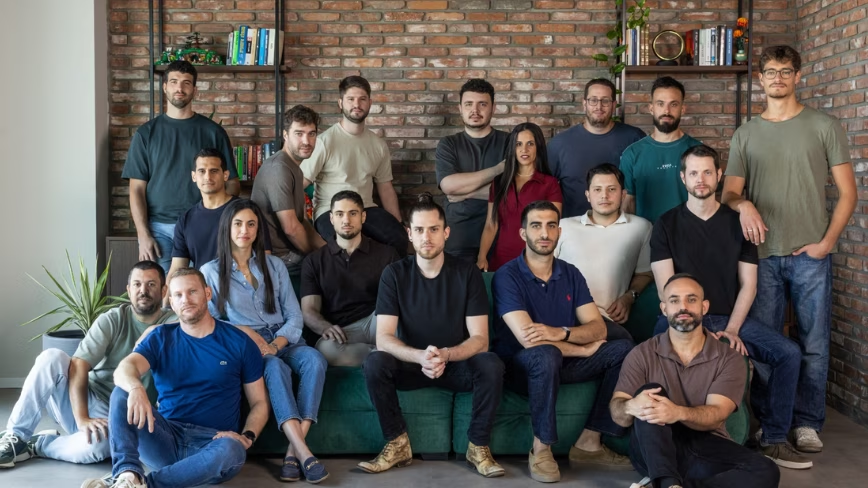
Corma’s 88% attacker success rate reveals why defensive AI needs stronger adversarial testing.
30-Second TL;DR
What Changed
Corma secured $60 million in funding led by Sequoia.
Why It Matters
The results suggest that adding more security tools may not be enough if organisations cannot coordinate detection and response. Corma’s approach could create demand for AI-native security validation and autonomous defense platforms.
What To Do Next
Reproduce a small attacker-versus-defender evaluation with GPT and Claude against your staging environment before deploying autonomous security agents.
Key Points
- •Corma secured $60 million in funding led by Sequoia.
- •The company simulated Fortune 500 organisations with dozens of security tools.
- •GPT and Claude attackers succeeded in 88% of simulations before being asked to defend.
- •The same AI models struggled to detect and remove threats they had planted.
Deep Insight
AI-generated analysis for this event — not the original article.
Enhanced Key Takeaways
- •Corma's platform utilizes a proprietary 'Red-Teaming-as-a-Service' (RTaaS) architecture that continuously updates its attack vectors based on real-time threat intelligence feeds.
- •The $60 million Series B funding round brings Corma's total valuation to approximately $450 million, positioning it as a high-growth player in the autonomous security sector.
- •Corma's defensive AI engine is designed to integrate with existing Security Information and Event Management (SIEM) systems, specifically targeting the reduction of 'alert fatigue' for SOC analysts.
- •The company's research indicates that the 88% success rate of AI attackers is primarily due to 'prompt injection' and 'context poisoning' techniques that bypass traditional signature-based detection.
- •Corma plans to utilize the new capital to expand its engineering team in Europe and establish a dedicated research lab focused on 'adversarial robustness' for large language models.
Competitor Analysis
- Corma
- Autonomous Defensive AI
- Darktrace (HEAL)
- Self-Learning Cyber AI
- CrowdStrike (Falcon)
- Endpoint Protection/XDR
- Corma
- Native AI-driven Red Teaming
- Darktrace (HEAL)
- Limited/Third-party
- CrowdStrike (Falcon)
- Managed Threat Hunting
- Corma
- Usage-based/Enterprise
- Darktrace (HEAL)
- Subscription/SaaS
- CrowdStrike (Falcon)
- Per-endpoint/Subscription
- Corma
- High (LLM-native)
- Darktrace (HEAL)
- High (ML/Heuristic)
- CrowdStrike (Falcon)
- Medium (ML/Behavioral)
| Feature | Corma | Darktrace (HEAL) | CrowdStrike (Falcon) |
|---|---|---|---|
| Core Focus | Autonomous Defensive AI | Self-Learning Cyber AI | Endpoint Protection/XDR |
| Attack Simulation | Native AI-driven Red Teaming | Limited/Third-party | Managed Threat Hunting |
| Pricing Model | Usage-based/Enterprise | Subscription/SaaS | Per-endpoint/Subscription |
| AI Maturity | High (LLM-native) | High (ML/Heuristic) | Medium (ML/Behavioral) |
Technical Deep Dive
- Corma employs a dual-agent architecture where an 'Attacker Agent' and a 'Defender Agent' operate in a closed-loop environment to facilitate reinforcement learning.
- The system utilizes a proprietary fine-tuned version of open-source LLMs, optimized for low-latency inference to detect threats in sub-millisecond timeframes.
- Implementation involves a sidecar container deployment model that monitors API calls and memory access patterns to identify anomalous behavior indicative of prompt injection.
- The platform supports 'Explainable AI' (XAI) modules that provide natural language justifications for why a specific action was flagged as a security threat.
Future ImplicationsAI analysis grounded in cited sources
Timeline
- 2024-03Corma founded by former cybersecurity researchers and AI engineers.
- 2024-11Company completes Seed funding round of $8 million.
- 2025-09Launch of the initial beta platform for Fortune 500 enterprise testing.
- 2026-08Corma secures $60 million Series B funding led by Sequoia.
Weekly AI Recap
Read this week's curated digest of top AI events →
Related Updates


AI-curated news aggregator. All content rights belong to original publishers.
Original source: The Next Web (TNW) ↗
This is a summary, not the original. Read the source, or get the weekly briefing.
The weekly digest
One email a week. Unsubscribe anytime.