Controversy over Formamide Detection in Diapers
Examine the ethical and accuracy pitfalls of using AI in investigative reporting and data verification.
30-Second TL;DR
What Changed
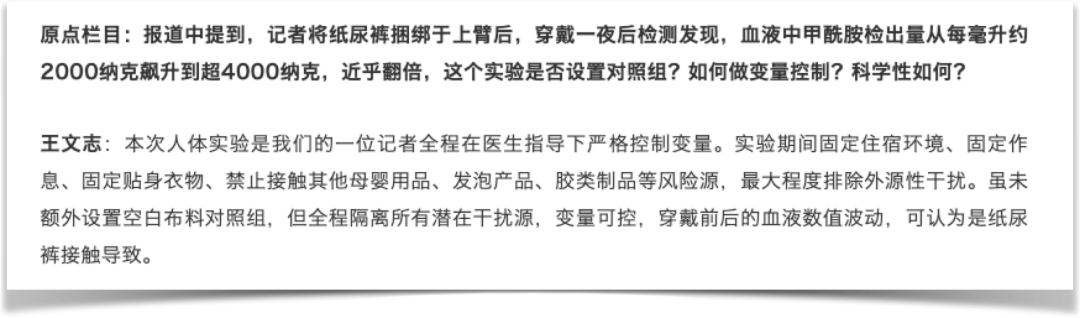
The journalist's claim of formamide toxicity is questioned due to lack of standardized testing.
Why It Matters
This highlights the risks of using AI tools in investigative journalism without proper verification and the importance of rigorous scientific methodology.
What To Do Next
Always verify AI-generated data or media content with peer-reviewed scientific sources before incorporating it into professional reports.
Key Points
- •The journalist's claim of formamide toxicity is questioned due to lack of standardized testing.
- •Discrepancies exist between the reporter's findings and other laboratory results.
- •The use of 'Doubao AI' generated images in the report raises concerns about journalistic integrity.
Deep Insight
AI-generated analysis for this event — not the original article.
Enhanced Key Takeaways
- •Formamide is often used as a solvent or plasticizer in industrial manufacturing, but its presence in consumer goods like diapers is typically a byproduct of material degradation rather than an intentional additive.
- •The controversy highlights a growing trend in Chinese media where AI-generated imagery is being used to illustrate investigative reports without clear disclosure, leading to public distrust.
- •Regulatory bodies in China, such as the State Administration for Market Regulation, have not established specific mandatory limits for formamide in disposable diapers, complicating the legal basis for the journalist's claims.
- •Industry experts have pointed out that the testing methodology used in the report failed to account for 'matrix effects,' where other chemical components in the diaper material interfere with the detection of formamide, leading to potential false positives.
- •The incident has prompted discussions within the Chinese journalistic community regarding the ethical guidelines for using generative AI tools like Doubao in news production.
Technical Deep Dive
- Formamide (CH3NO) detection in complex matrices typically requires Gas Chromatography-Mass Spectrometry (GC-MS) or Liquid Chromatography-Mass Spectrometry (LC-MS) with specific extraction protocols.
- The primary technical challenge in diaper testing is the extraction process; improper solvent selection can cause the release of formamide from the polymer matrix, leading to artificially high concentration readings.
- AI-generated imagery in journalism often utilizes diffusion models (like those powering Doubao) which can hallucinate visual details, potentially misrepresenting the physical state of the product being investigated.
Future ImplicationsAI analysis grounded in cited sources
Timeline
- 2024-05Doubao AI officially launched by ByteDance for public use.
- 2026-03Initial investigative report alleging formamide contamination in diapers published.
- 2026-04Industry associations and independent labs publicly challenge the testing methodology of the initial report.
Weekly AI Recap
Read this week's curated digest of top AI events →
AI-curated news aggregator. All content rights belong to original publishers.
Original source: 虎嗅 ↗
This is a summary, not the original. Read the source, or get the weekly briefing.
The weekly digest
One email a week. Unsubscribe anytime.