Continual Learning Layers for AI Agents
💡Unlock 3 layers of AI agent learning beyond model weights for better evolving systems.
⚡ 30-Second TL;DR
What Changed
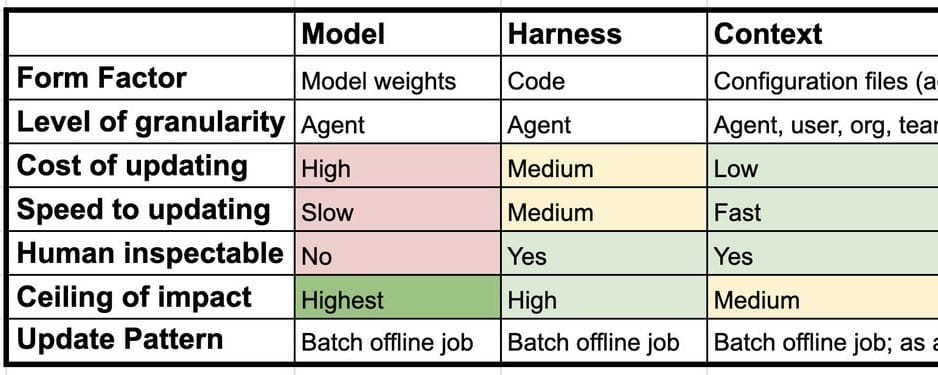
AI agent learning spans model, harness, and context layers
Why It Matters
Enables more robust AI agents that adapt continuously without full retraining, potentially reducing costs and improving performance in dynamic environments.
What To Do Next
Experiment with LangChain agents by adding context and harness updates for continual learning.
Key Points
- •AI agent learning spans model, harness, and context layers
- •Traditional focus limited to model weight updates
- •Shifts perspective on building evolving AI systems
🧠 Deep Insight
AI-generated analysis for this event — not the original article.
🔑 Enhanced Key Takeaways
- •The 'harness' layer refers to the agent's orchestration logic, including memory management, tool-use strategies, and planning loops, which can be optimized independently of the underlying LLM weights.
- •Context-layer learning leverages dynamic RAG (Retrieval-Augmented Generation) and episodic memory stores to allow agents to adapt to new domains without requiring expensive fine-tuning or catastrophic forgetting risks.
- •This layered architecture enables 'modular evolution,' where developers can upgrade the agent's reasoning harness or knowledge base independently of the model, significantly reducing the latency and cost of system updates.
🛠️ Technical Deep Dive
- •Model Layer: Focuses on weight-based adaptation (e.g., LoRA, QLoRA) for domain-specific reasoning capabilities.
- •Harness Layer: Implements state-machine or graph-based orchestration that updates its decision-making heuristics based on successful/failed execution traces (e.g., ReAct, Plan-and-Solve).
- •Context Layer: Utilizes vector databases and long-term memory buffers that ingest real-time feedback loops to refine retrieval relevance and agent persona consistency.
🔮 Future ImplicationsAI analysis grounded in cited sources
⏳ Timeline
Weekly AI Recap
Read this week's curated digest of top AI events →
👉Related Updates
AI-curated news aggregator. All content rights belong to original publishers.
Original source: LangChain Blog ↗
This is a summary, not the original. Read the source, or get the weekly briefing.
The weekly digest
One email a week. Unsubscribe anytime.