Context and Agents Reshape AI Work
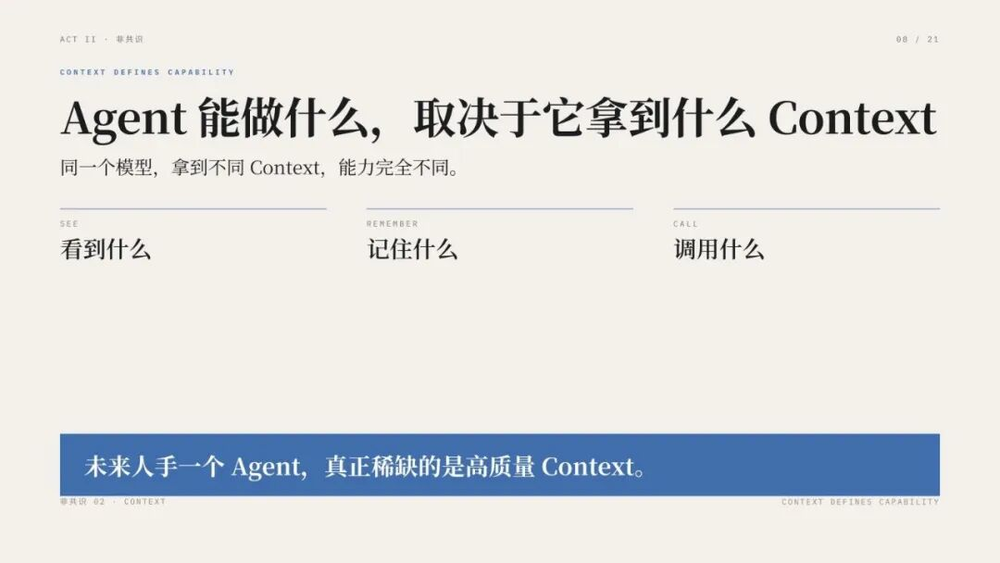
💡Learn why persistent context, tool use, and verifiable goals may define the next Agent product war.
⚡ 30-Second TL;DR
What Changed
Personal context from notes, conversations, and recordings can compound over time and improve Agent-assisted work.
Why It Matters
For AI builders, the competitive advantage is shifting from standalone model quality toward context retention, tool execution, and reliable task completion. Products that fail to define verifiable outcomes or close the environment loop may remain dependent on human operators.
What To Do Next
Prototype an Agent workflow that ingests your notes and meeting audio, then enforce a measurable completion test before allowing Computer Use or Browser Use actions.
Key Points
- •Personal context from notes, conversations, and recordings can compound over time and improve Agent-assisted work.
- •Long-horizon execution and Computer Use or Browser Use are reducing the need for continuous human intervention.
- •Agent goals must be measurable and verifiable; ambiguous goals can cause endless iteration and wasted credits.
- •Codex and WorkBuddy indicate that Agent adoption is spreading beyond developers to knowledge workers.
- •A super Agent may increasingly coordinate or operate other software instead of users interacting with each application directly.
🧠 Deep Insight
Background and context from public sources — not the original article. 16 sources cited.
🔑 Enhanced Key Takeaways
- •The industry has shifted toward 'Context Engineering,' moving beyond simple RAG to structured, long-term memory systems that preserve business semantics across sessions.
- •Multi-agent architectures are replacing monolithic models, utilizing orchestrator agents to manage specialized sub-agents for parallelized, complex enterprise workflows.
- •Interoperability is being standardized through the Model Context Protocol (MCP) and the Agent2Agent (A2A) protocol, enabling cross-platform collaboration between disparate agent systems.
- •A new security paradigm known as 'Authority Control Planes' has emerged to provide granular, action-level authorization, replacing traditional identity-based IAM for autonomous agents.
- •The rise of 'botsitting'—the overhead of managing and cleaning up after AI agents—has become a significant source of worker fatigue, driving demand for deterministic guardrails.
🛠️ Technical Deep Dive
- •
- Model Context Protocol (MCP): A standardized interface layer that decouples agent logic from specific data sources and toolsets.
- •
- Agent2Agent (A2A) Protocol: A communication framework governed by the Agentic AI Foundation to facilitate state sharing and task delegation between agents from different vendors.
- •
- Authority Control Planes: A security architecture that implements action-level authorization, requiring agents to possess cryptographically verified permissions for specific software operations.
- •
- Orchestrator-Subagent Architecture: A hierarchical design pattern where a central controller manages task decomposition, state tracking, and error handling across multiple specialized agent nodes.
🔮 Future ImplicationsAI analysis grounded in cited sources
⏳ Timeline
📎 Sources (16)
Factual claims are grounded in the sources below. Forward-looking analysis is AI-generated interpretation.
Weekly AI Recap
Read this week's curated digest of top AI events →
👉Related Updates

AI-curated news aggregator. All content rights belong to original publishers.
Original source: 虎嗅 ↗
This is a summary, not the original. Read the source, or get the weekly briefing.
Weekly AI briefing
One email a week. Unsubscribe anytime.