Connery Brings Open Plugin Infrastructure to LLM Apps
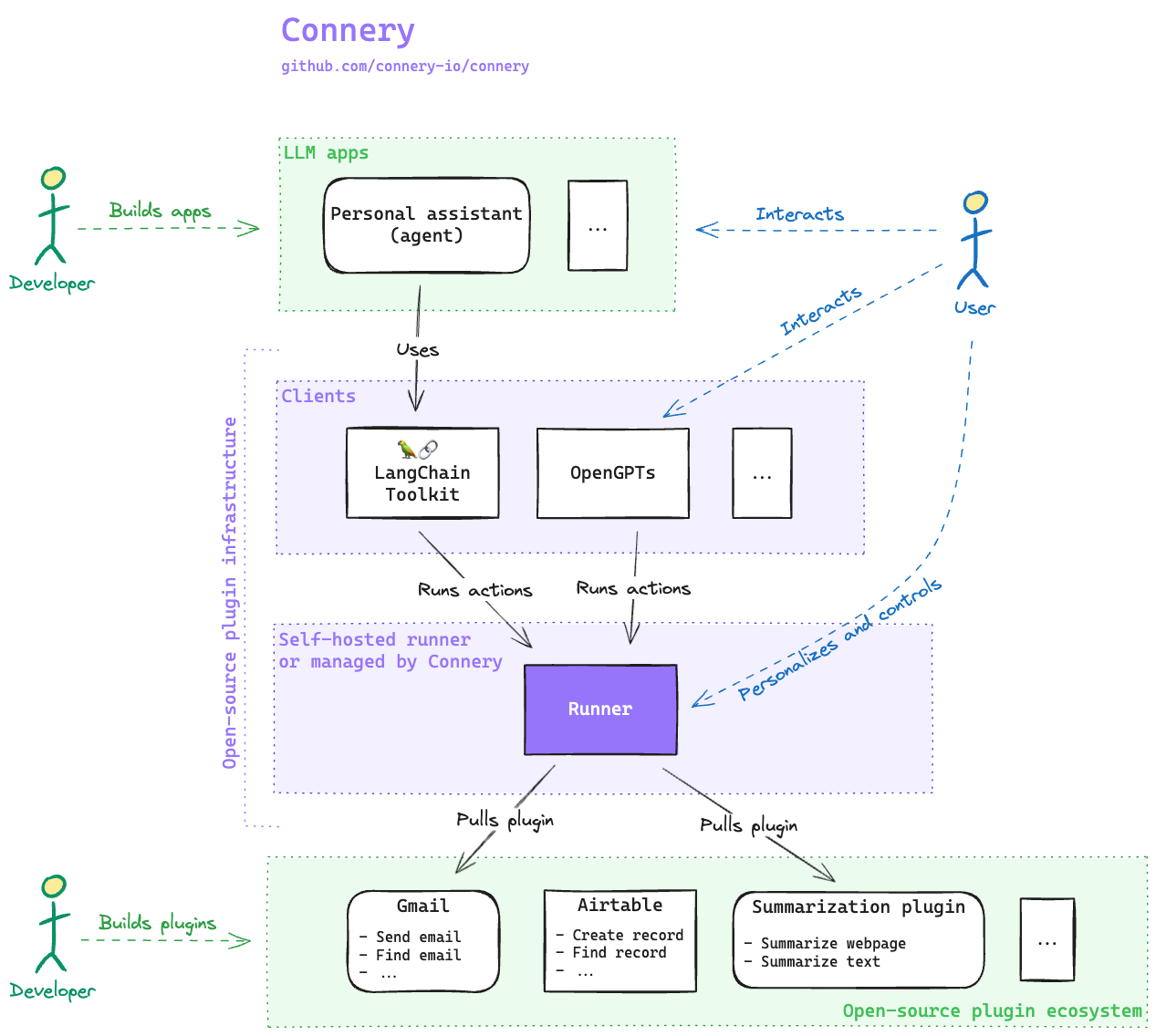
💡See how Connery handles secure plugins and human control for production-ready LLM agents.
⚡ 30-Second TL;DR
What Changed
Provides open-source plugin infrastructure for OpenGPTs and LLM applications
Why It Matters
Connery could reduce the engineering effort required to connect LLM applications with external tools and services. Its human-in-the-loop approach may also make agent deployments easier to govern and personalize.
What To Do Next
Review Connery's plugin architecture and prototype one human-approved integration for an existing LLM agent.
Key Points
- •Provides open-source plugin infrastructure for OpenGPTs and LLM applications
- •Supports secure integrations between AI agents and external services
- •Adds personalization and human-in-the-loop controls for agent workflows
🧠 Deep Insight
Background and context from public sources — not the original article. 10 sources cited.
🔑 Enhanced Key Takeaways
- •Connery abstracts complex backend requirements like OAuth and API key management, allowing developers to focus on defining plugin actions rather than infrastructure plumbing.
- •The framework utilizes a modular architecture where 'Actions' are grouped into 'Plugins,' both of which are maintained as open-source TypeScript repositories.
- •Native integration is provided via the 'ConneryToolkit' within the langchain-community package, enabling seamless tool-calling capabilities for LangChain agents.
- •The platform includes a dedicated runtime management layer that provides a UI for connection handling and safety, separating agent reasoning from deterministic execution.
- •Connery contributes to the emerging industry standard for agentic skills, aligning with broader architectural shifts toward reusable protocols for LLM tool-use.
📊 Competitor Analysis▸ Show
| Feature | Connery | LangChain Tools | MCP (Model Context Protocol) |
|---|---|---|---|
| Primary Focus | Plugin Infrastructure/Runtime | Agent Orchestration | Universal Data/Tool Protocol |
| Open Source | Yes | Yes | Yes |
| Runtime Management | Built-in UI/Management | Developer-defined | Protocol-based |
| Integration Type | Plugin-centric | Direct Tool/Function | Server-Client Protocol |
🛠️ Technical Deep Dive
- Architecture: Utilizes a plugin-based model where individual tasks are defined as Actions within a Plugin repository.
- Language Support: Primarily implemented in TypeScript for plugin definition and execution.
- Integration Layer: Leverages the ConneryToolkit to bridge the gap between LLM reasoning engines and external API endpoints.
- Security Model: Implements connection management and safety controls to mitigate risks like privilege escalation and prompt injection.
- Execution Pattern: Supports both synchronous and asynchronous operation patterns for diverse real-world system interactions.
🔮 Future ImplicationsAI analysis grounded in cited sources
⏳ Timeline
📎 Sources (10)
Factual claims are grounded in the sources below. Forward-looking analysis is AI-generated interpretation.
Weekly AI Recap
Read this week's curated digest of top AI events →
👉Related Updates
AI-curated news aggregator. All content rights belong to original publishers.
Original source: LangChain Blog ↗
This is a summary, not the original. Read the source, or get the weekly briefing.
Weekly AI briefing
One email a week. Unsubscribe anytime.