Confirmation Bias in AI Risk Thinking
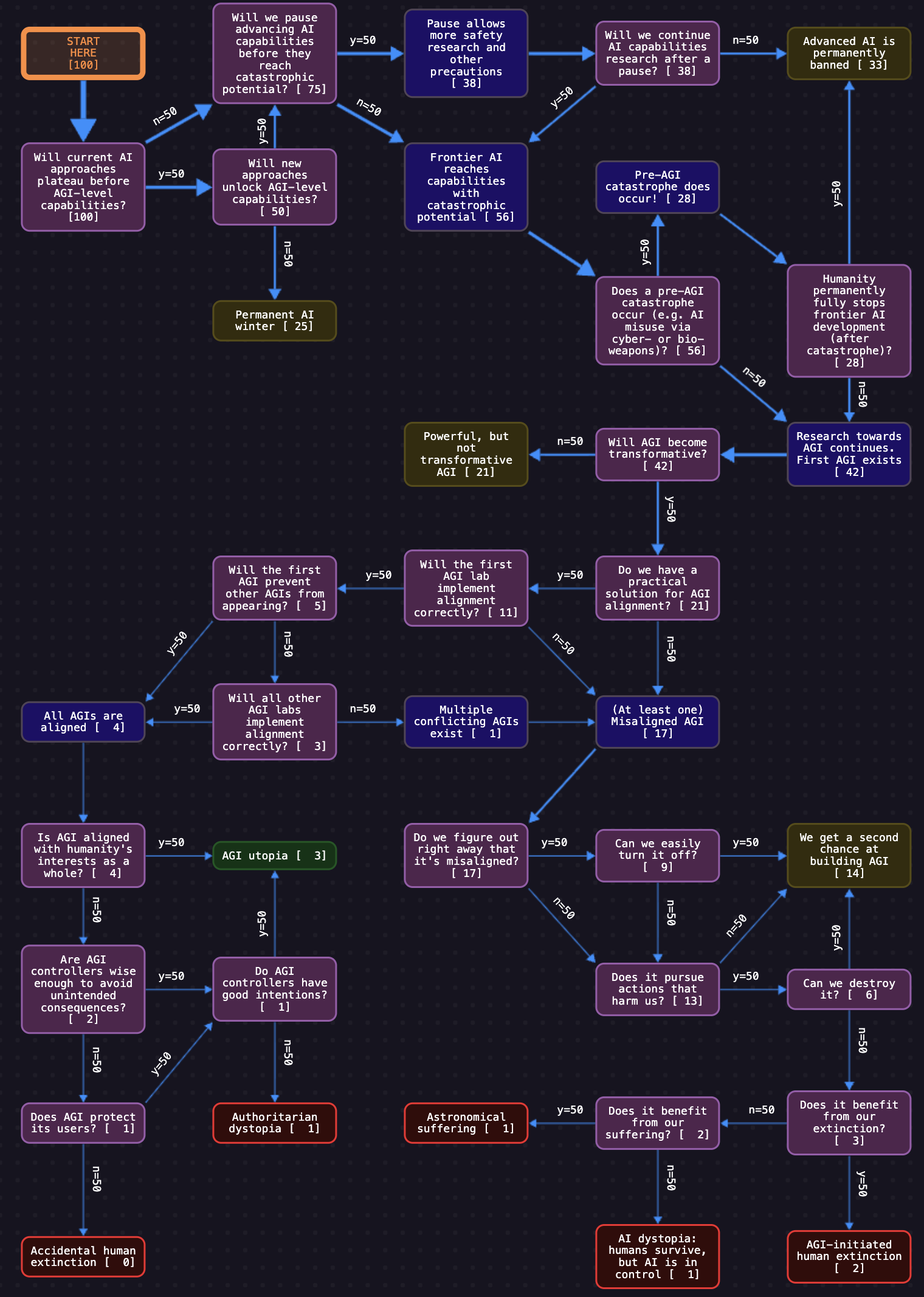
Biases distort AI risk views—counter them to avoid overconfidence in alignment
30-Second TL;DR
What Changed
Confirmation bias compounds across evidence selection, evaluation, and memory in AI risk debates.
Why It Matters
This could foster more humble, scout-like thinking in AI safety, reducing polarization and improving alignment strategies amid uncertainty.
What To Do Next
Read Julia Galef's The Scout Mindset and audit your AI alignment beliefs for confirmation bias.
Key Points
- •Confirmation bias compounds across evidence selection, evaluation, and memory in AI risk debates.
- •Motivated reasoning stems from locally rational effects like differing priors and evidence discounting.
- •AI alignment lacks direct evidence, amplifying biases despite truth-seeking culture.
- •Author's IARPA research highlights brain basis of biases in complex analysis.
Deep Insight
AI-generated analysis for this event — not the original article.
Enhanced Key Takeaways
- •The IARPA-funded research referenced in the article likely pertains to the Aggregative Contingent Estimation (ACE) program, which sought to improve geopolitical forecasting by mitigating cognitive biases in human analysts.
- •Recent studies in epistemic vigilance suggest that AI alignment discourse is particularly susceptible to 'identity-protective cognition,' where risk assessments serve as signals of group membership rather than objective probability estimates.
- •Bayesian updating models applied to AI safety suggest that the 'priors' held by researchers are often anchored in divergent philosophical frameworks (e.g., utilitarianism vs. deontological safety), making consensus on empirical evidence mathematically difficult to achieve.
Future ImplicationsAI analysis grounded in cited sources
Timeline
- 2011-01IARPA launches the ACE program to study and improve human forecasting accuracy.
- 2015-06Publication of foundational research on the 'Superforecaster' phenomenon, identifying cognitive bias mitigation as a key factor in high-accuracy analysis.
- 2023-03Increased academic focus on 'AI Alignment' as a distinct field, leading to the proliferation of specialized forums and discourse communities.
Weekly AI Recap
Read this week's curated digest of top AI events →
AI-curated news aggregator. All content rights belong to original publishers.
Original source: AI Alignment Forum ↗
This is a summary, not the original. Read the source, or get the weekly briefing.
The weekly digest
One email a week. Unsubscribe anytime.