Comprehensive observability for Amazon SageMaker LLM inference
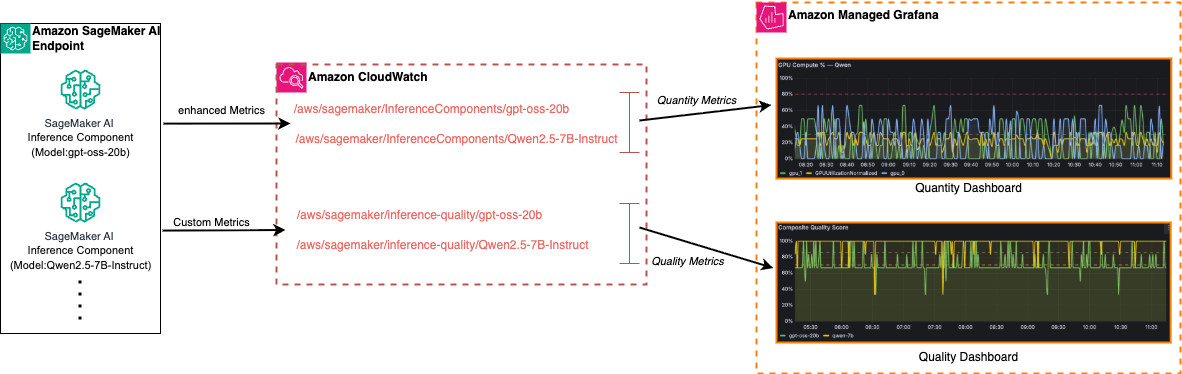
💡Learn how to monitor both GPU efficiency and LLM output quality in one unified dashboard on AWS.
⚡ 30-Second TL;DR
What Changed
Integrates Amazon Managed Grafana for real-time LLM monitoring
Why It Matters
This solution reduces the operational complexity of managing production LLMs by centralizing performance and quality data. It enables teams to quickly identify bottlenecks in both hardware resource allocation and model inference accuracy.
What To Do Next
Set up an Amazon Managed Grafana dashboard for your existing SageMaker endpoints to start tracking model quality alongside GPU metrics.
Key Points
- •Integrates Amazon Managed Grafana for real-time LLM monitoring
- •Tracks both quantitative GPU utilization and qualitative LLM performance metrics
- •Designed specifically for LLMs served via Amazon SageMaker inference components
🧠 Deep Insight
Background and context from public sources — not the original article. 11 sources cited.
🔑 Enhanced Key Takeaways
- •The solution leverages Amazon CloudWatch as a central service for metric collection, maintaining distinct namespaces for LLM quality signals (e.g., composite quality scores, safety scores, evaluation latency) and operational metrics.
- •It directly addresses the unique challenges of monitoring Large Language Models, including output variability, prompt sensitivity, potential for hallucinations, safety and toxicity concerns, and managing unpredictable token consumption and latency spikes.
- •The observability framework differentiates between 'quantity' monitoring, which focuses on the operational health of inference infrastructure like request throughput and GPU utilization, and 'quality' monitoring, which evaluates LLM response accuracy, compliance, and consistency over time.
- •Organizations typically adopt this LLM observability in a staged approach, beginning with core operational metrics, then integrating LLM quality monitoring through output sampling and evaluation, and finally implementing combined alerts and comparative analysis across models.
- •The solution utilizes Amazon SageMaker's built-in data capture capabilities to automatically log real-time inference request and response payloads, along with metadata, to Amazon S3 in JSON Lines format, enabling detailed post-inference analysis.
🛠️ Technical Deep Dive
- The solution integrates three core AWS services: Amazon SageMaker AI endpoints with inference components, Amazon CloudWatch for metric storage, and Amazon Managed Grafana for visualization.
- Custom quality metrics for LLMs, such as composite quality scores, safety scores, and evaluation latency, are published to a dedicated user-configured CloudWatch namespace at
/aws/sagemaker/inference-quality/<model-name>, ensuring separation from standard operational metrics. - SageMaker's data capture functionality automatically records real-time inference request and response payloads, including metadata, to Amazon S3 buckets as JSON Lines (.jsonl) files.
- The broader Amazon SageMaker Model Monitor service provides capabilities for monitoring data quality, model quality, bias drift, and feature attribution drift, which can be extended and customized for LLM-specific use cases.
- Automated pipelines for near real-time LLM inference monitoring can be built using AWS Step Functions and AWS Lambda to process captured data.
- Amazon Managed Grafana connects to CloudWatch via AWS integrations, authenticating through IAM roles or federated OIDC providers, and can map tags and labels from SageMaker resources to create granular dashboards.
- SageMaker MLflow Apps offer a managed tracking service within SageMaker Studio for logging LLM traces and evaluations, including metrics like toxicity scores, hallucination rates, and latency percentiles.
🔮 Future ImplicationsAI analysis grounded in cited sources
⏳ Timeline
📎 Sources (11)
Factual claims are grounded in the sources below. Forward-looking analysis is AI-generated interpretation.
Weekly AI Recap
Read this week's curated digest of top AI events →
👉Related Updates
AI-curated news aggregator. All content rights belong to original publishers.
Original source: AWS Machine Learning Blog ↗
This is a summary, not the original. Read the source, or get the weekly briefing.
The weekly digest
One email a week. Unsubscribe anytime.