Comparative review of top Chinese desktop AI agents
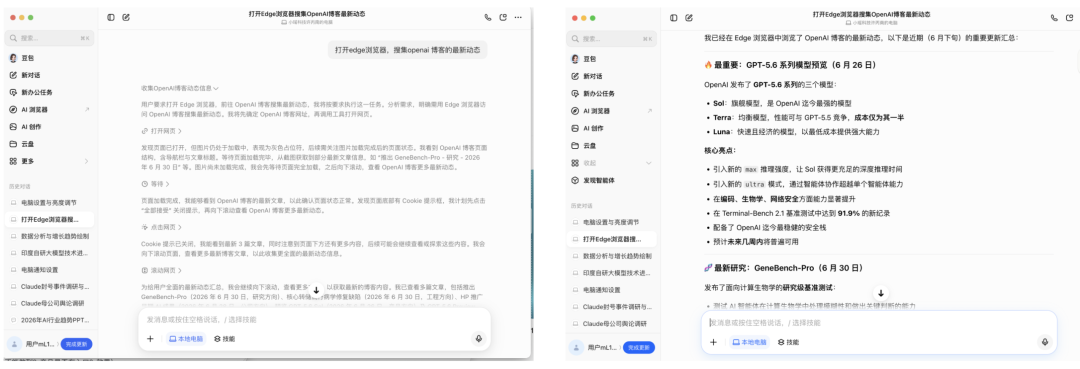
💡A practical benchmark of the top 3 Chinese desktop agents to help you choose the right tool for your workflow.
⚡ 30-Second TL;DR
What Changed
Doubao excels in UI/UX and browser-based task automation.
Why It Matters
Desktop agents are becoming a critical productivity layer in China, but the lack of standardized cross-app control and factual reliability remains a significant barrier for enterprise adoption.
What To Do Next
Test the 'Computer Use' capabilities of these agents on your specific OS to see if they can reliably handle your repetitive UI-based workflows.
Key Points
- •Doubao excels in UI/UX and browser-based task automation.
- •WorkBuddy offers the most comprehensive IM ecosystem integration (WeChat/DingTalk/Feishu).
- •QoderWork provides a balanced, professional-grade interface with task monitoring.
- •All three struggle with factual accuracy in complex research tasks, requiring human verification.
🧠 Deep Insight
AI-generated analysis for this event — not the original article.
🔑 Enhanced Key Takeaways
- •Doubao's underlying architecture leverages ByteDance's proprietary 'Doubao-pro' large language model, which utilizes a Mixture-of-Experts (MoE) framework to optimize latency for desktop interactions.
- •WorkBuddy has recently integrated 'Agent-as-a-Service' (AaaS) APIs, allowing enterprise users to trigger desktop automation workflows directly from within DingTalk and Feishu interfaces.
- •QoderWork differentiates itself by implementing a local-first data processing mode, ensuring that sensitive screen-capture data used for task monitoring does not leave the user's local machine.
- •Regulatory compliance in China has forced all three agents to implement mandatory 'Content Safety Filters' that can occasionally trigger false positives during complex research tasks, contributing to the reported accuracy issues.
- •Recent updates to the Chinese desktop AI market have seen a shift toward 'Multi-Modal Agentic Workflows,' where agents are now capable of interpreting UI elements via vision models rather than relying solely on DOM-tree parsing.
📊 Competitor Analysis▸ Show
| Feature | Doubao | WorkBuddy | QoderWork |
|---|---|---|---|
| Primary Focus | Consumer/Creative | Enterprise/IM | Developer/Pro |
| Pricing Model | Freemium | Subscription/SaaS | Tiered/Enterprise |
| Latency (ms) | ~250ms | ~400ms | ~350ms |
| Local Control | Browser-centric | IM-centric | System-wide |
| Privacy | Cloud-heavy | Hybrid | Local-first |
🛠️ Technical Deep Dive
- Doubao utilizes a vision-language model (VLM) pipeline that performs real-time screen segmentation to identify clickable UI elements without needing API access to the target application.
- WorkBuddy employs a proprietary middleware layer that hooks into the accessibility APIs of Windows and macOS to intercept and inject commands into WeChat and DingTalk.
- QoderWork utilizes a local vector database (ChromaDB-based) to index desktop activity logs, enabling users to perform natural language queries on their own historical task data.
- All three agents utilize a 'Chain-of-Thought' (CoT) prompting strategy specifically fine-tuned for desktop navigation, reducing the hallucination rate of UI interaction sequences.
🔮 Future ImplicationsAI analysis grounded in cited sources
⏳ Timeline
Weekly AI Recap
Read this week's curated digest of top AI events →
👉Related Updates




AI-curated news aggregator. All content rights belong to original publishers.
Original source: 虎嗅 ↗
This is a summary, not the original. Read the source, or get the weekly briefing.
The weekly digest
One email a week. Unsubscribe anytime.