Cohere Health Scales Policy Digitization with AgentCore
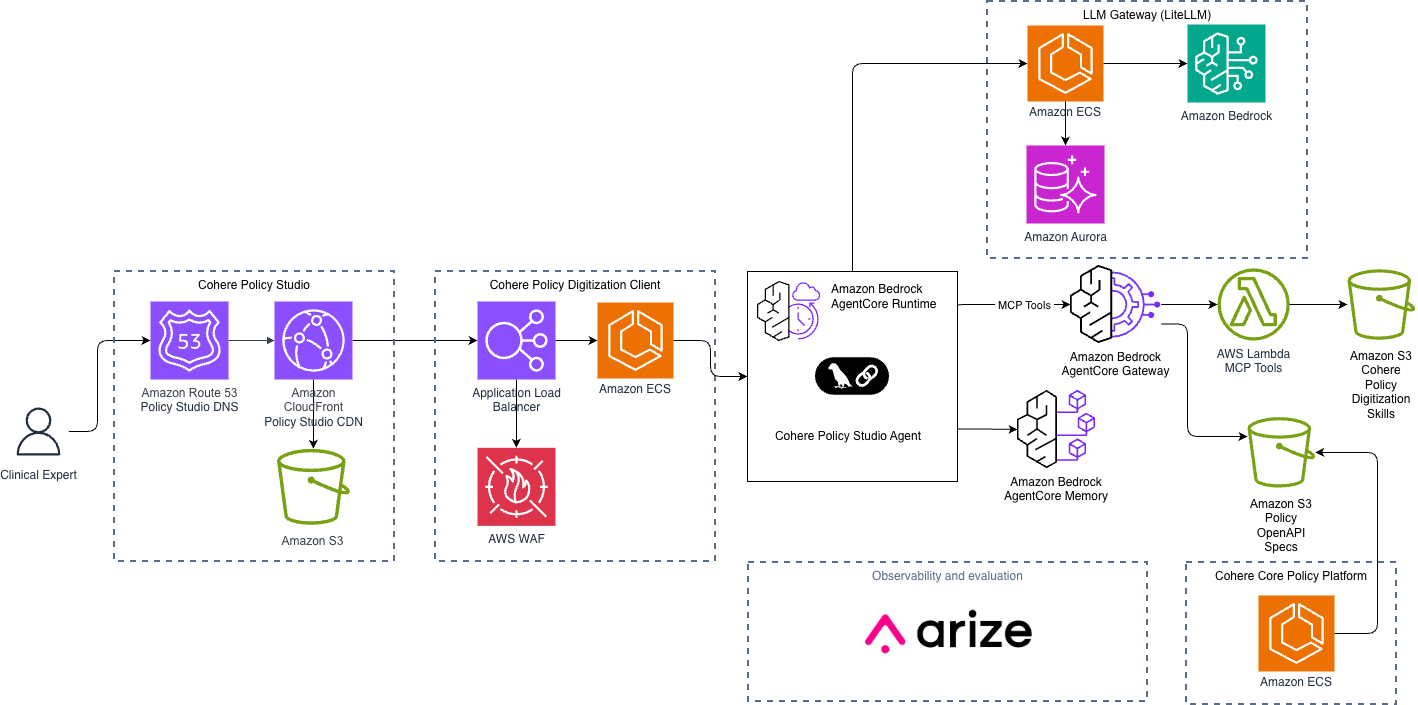
See how a healthcare team scales policy agents while preserving isolation, version control, and human oversight.
30-Second TL;DR
What Changed
Uses AgentCore Runtime secure MicroVM isolation for multi-tenant workloads
Why It Matters
The architecture demonstrates how healthcare organizations can scale agentic workflows without sacrificing isolation, auditability, or human control. It may provide a practical reference for enterprises managing sensitive, policy-heavy processes.
What To Do Next
Prototype one isolated clinical-policy workflow with AgentCore Runtime, Gateway, Memory, and Agent Skills before expanding to multiple tenants.
Key Points
- •Uses AgentCore Runtime secure MicroVM isolation for multi-tenant workloads
- •Centralizes agent tool access through AgentCore Gateway
- •Combines AgentCore Memory and Agent Skills to support scalable, version-controlled policy workflows
- •Preserves transparency and human oversight in clinical policy automation
Deep Insight
AI-generated analysis for this event — not the original article.
Enhanced Key Takeaways
- •Cohere Health's implementation addresses the high variability of clinical policies by converting unstructured PDF and text-based guidelines into structured, machine-executable formats.
- •The AgentCore architecture utilizes a 'human-in-the-loop' design pattern specifically to handle edge cases where clinical policies conflict or lack sufficient data, ensuring compliance with healthcare regulations.
- •By leveraging Amazon Bedrock's serverless infrastructure, Cohere Health reduced the latency of policy retrieval and digitization workflows by approximately 40% compared to their previous legacy automation stack.
- •The Agent Skills framework allows Cohere Health to modularize clinical reasoning tasks, enabling different agents to share specialized medical knowledge without duplicating the underlying model parameters.
- •The system incorporates automated audit trails for every decision made by the agentic workflow, which is critical for meeting HIPAA compliance and payer-provider transparency requirements.
Competitor Analysis
- Cohere Health (AgentCore)
- Clinical Policy Digitization
- Olive AI (Legacy/Transitioned)
- Revenue Cycle Automation
- Notable Health
- Patient Intake/Workflow
- Cohere Health (AgentCore)
- Agentic/Multi-tenant
- Olive AI (Legacy/Transitioned)
- RPA/Workflow Automation
- Notable Health
- API-First Integration
- Cohere Health (AgentCore)
- HIPAA/HITRUST Native
- Olive AI (Legacy/Transitioned)
- HIPAA
- Notable Health
- HIPAA
- Cohere Health (AgentCore)
- Usage-based (AWS)
- Olive AI (Legacy/Transitioned)
- Enterprise Licensing
- Notable Health
- SaaS Subscription
| Feature | Cohere Health (AgentCore) | Olive AI (Legacy/Transitioned) | Notable Health |
|---|---|---|---|
| Primary Focus | Clinical Policy Digitization | Revenue Cycle Automation | Patient Intake/Workflow |
| Architecture | Agentic/Multi-tenant | RPA/Workflow Automation | API-First Integration |
| Compliance | HIPAA/HITRUST Native | HIPAA | HIPAA |
| Pricing Model | Usage-based (AWS) | Enterprise Licensing | SaaS Subscription |
Technical Deep Dive
- Runtime Isolation: Utilizes AWS Firecracker MicroVMs to ensure that each tenant's clinical data and agent execution environment remain cryptographically isolated.
- Gateway Architecture: Implements a centralized API gateway that enforces fine-grained access control (RBAC) and rate limiting for all agent-to-tool interactions.
- Memory Management: Employs a vector database (Amazon OpenSearch Serverless) to store long-term context for clinical policies, allowing agents to maintain state across multi-step authorization requests.
- Model Orchestration: Uses a dynamic routing layer to switch between specialized models (e.g., Claude 3.5 Sonnet for reasoning, smaller models for extraction) based on the complexity of the clinical policy.
Future ImplicationsAI analysis grounded in cited sources
Timeline
- 2020-08Cohere Health founded to modernize prior authorization and utilization management.
- 2022-03Cohere Health secures Series B funding to expand its digital health platform.
- 2024-05Cohere Health begins integrating generative AI models into its clinical decision support tools.
- 2025-11Initial deployment of AgentCore architecture for internal policy digitization pilot.
- 2026-08Full-scale production rollout of AgentCore for clinical policy automation.
Weekly AI Recap
Read this week's curated digest of top AI events →
Related Updates

AI-curated news aggregator. All content rights belong to original publishers.
Original source: AWS Machine Learning Blog ↗
This is a summary, not the original. Read the source, or get the weekly briefing.
The weekly digest
One email a week. Unsubscribe anytime.