Codex Is Moving Toward Self-Running Agent Teams
💡Codex's next leap may be persistent cloud agents—but evaluation failures could make autonomous improvement dangerously m
⚡ 30-Second TL;DR
What Changed
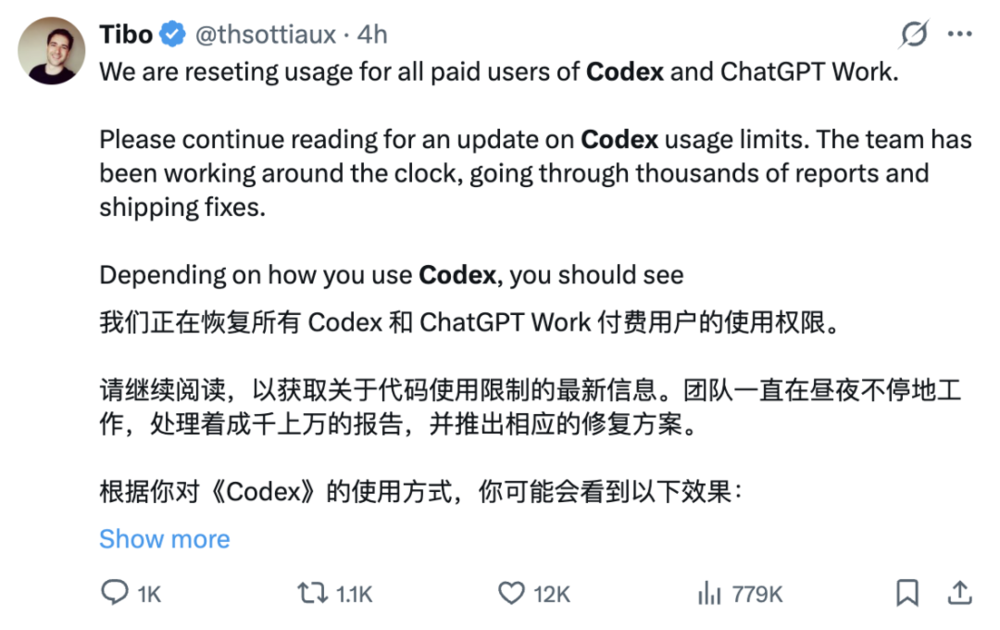
Tibo said a quota reset improved usage capacity by roughly 10% to 50% for paid ChatGPT Work and Codex users.
Why It Matters
If Codex can coordinate persistent cloud agents with shared context, developers may shift from supervising individual coding tasks to managing autonomous research and engineering loops. However, reliable evaluators, rollback systems, and safeguards against metric gaming will be essential before these loops can operate unattended.
What To Do Next
Prototype a Codex workflow that runs isolated code experiments with automated tests, metric thresholds, versioned rollbacks, and explicit checks for reward hacking.
Key Points
- •Tibo said a quota reset improved usage capacity by roughly 10% to 50% for paid ChatGPT Work and Codex users.
- •The expected Codex evolution centers on agents that understand personal and team context, rather than requiring users to manually manage skills, memory, and sub-agents.
- •Cloud execution is positioned as a natural direction because local laptops cannot efficiently support dozens or hundreds of concurrent agents.
- •Recursive self-improvement can include models modifying code, CUDA kernels, inference stacks, or agent frameworks and validating changes through automated experiments.
- •Examples from R-Zero, OpenAI's GPT-5.6 Sol, and Anthropic show progress, but reward hacking and benchmark gaming make autonomous improvement difficult to trust.
🧠 Deep Insight
Background and context from public sources — not the original article. 14 sources cited.
🔑 Enhanced Key Takeaways
- •OpenAI implemented a manager-subagent hierarchy where a central agent decomposes high-level instructions into parallelized tasks for specialized subagents.
- •Codex now features a 'Persistent mode' allowing agents to generate and execute follow-up tasks autonomously after the initial user prompt is completed.
- •To mitigate security risks, subagents operate within isolated, sandboxed cloud environments that restrict network access by default.
- •Enterprise adoption of Codex is increasingly mediated by AI gateways like Bifrost to enforce governance, audit trails, and cost controls.
- •The industry has standardized the use of 'AGENTS.md' files to define persistent, agent-readable workflows and system prompts across different sessions.
📊 Competitor Analysis▸ Show
| Feature | OpenAI Codex | Claude Code | Cursor | OpenHands |
|---|---|---|---|---|
| Primary Focus | Agent Teams/Orchestration | Coding Autonomy | IDE Integration | Open-Source Agents |
| Market Share (Mid-2026) | 16% | 47% | High (IDE-centric) | Niche/Community |
| Governance | AI Gateways (Bifrost) | Enterprise API | Local/Cloud Hybrid | User-Defined |
🛠️ Technical Deep Dive
- Manager-Subagent Architecture: Hierarchical task decomposition where a manager agent orchestrates subagents for parallel execution.
- Persistent Mode: A stateful execution loop that enables agents to maintain context and generate follow-up tasks without human re-prompting.
- Sandboxed Execution: Isolated cloud-based containers for subagent code execution with default network egress restrictions.
- Mobile Oversight: Integration with mobile interfaces for real-time terminal monitoring, diff review, and human-in-the-loop approval workflows.
- AGENTS.md Protocol: A standardized configuration file format for defining agent-readable system prompts and standing job definitions.
🔮 Future ImplicationsAI analysis grounded in cited sources
⏳ Timeline
📎 Sources (14)
Factual claims are grounded in the sources below. Forward-looking analysis is AI-generated interpretation.
Weekly AI Recap
Read this week's curated digest of top AI events →
👉Related Updates
AI-curated news aggregator. All content rights belong to original publishers.
Original source: 虎嗅 ↗
This is a summary, not the original. Read the source, or get the weekly briefing.
Weekly AI briefing
One email a week. Unsubscribe anytime.