Cloud Giants Face a Kimi Model Tax
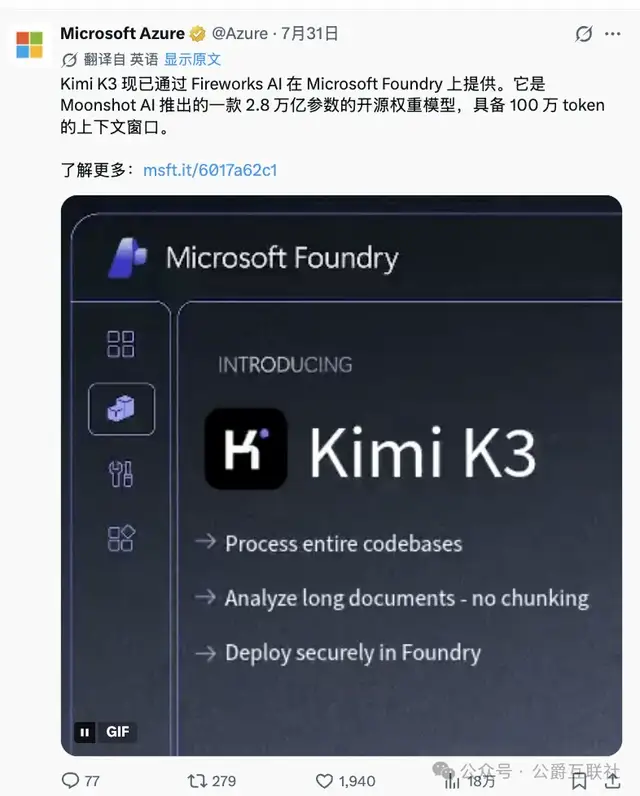
💡Open-source models may be turning cloud distribution into a new revenue and bargaining model.
⚡ 30-Second TL;DR
What Changed
Microsoft, Google, and Amazon are identified as cloud platforms that may need to commercialize or distribute Kimi models.
Why It Matters
If this model becomes common, open-source model providers could gain stronger bargaining power with cloud platforms. AI builders may benefit from more deployment options, but should also track licensing, usage fees, and provider-specific restrictions.
What To Do Next
Before adopting Kimi, compare its official license and inference terms with the model-serving options offered by Microsoft Azure, Google Cloud, and AWS.
Key Points
- •Microsoft, Google, and Amazon are identified as cloud platforms that may need to commercialize or distribute Kimi models.
- •Kimi's open-source positioning is framed as a way to build downstream demand and cloud usage.
- •The article suggests model creators can capture value from cloud distribution even when model weights or access are broadly available.
🧠 Deep Insight
Background and context from public sources — not the original article. 8 sources cited.
🔑 Enhanced Key Takeaways
- •Moonshot AI is actively negotiating a revenue-sharing model with Azure, AWS, and Google Cloud, seeking up to 30% of revenue generated by its Kimi K3 model.
- •The Kimi K3 model, launched in July 2026, utilizes a 2.8-trillion-parameter architecture designed to compete directly with GPT-5.5 and Claude Opus 4.8.
- •Moonshot AI has already established a operational template for these revenue-sharing agreements through existing partnerships with Chinasoft International and smaller regional cloud providers.
- •The negotiations face significant geopolitical headwinds, including U.S. government scrutiny over the company's hardware procurement and allegations of intellectual property infringement.
- •Moonshot AI is currently positioning itself for a Hong Kong IPO, bolstered by a $2 billion funding round completed in May 2026.
📊 Competitor Analysis▸ Show
| Feature | Kimi K3 | GPT-5.5 | Claude Opus 4.8 |
|---|---|---|---|
| Parameter Count | 2.8 Trillion | Undisclosed | Undisclosed |
| Primary Market | Global/China | Global | Global |
| Revenue Model | Revenue-Sharing | Subscription/API | Subscription/API |
| Status | Negotiating Cloud Integration | Deployed | Deployed |
🛠️ Technical Deep Dive
- Architecture: 2.8-trillion-parameter dense/mixture-of-experts hybrid model.
- Optimization: Designed for high-throughput inference at lower cost-per-token compared to Western counterparts.
- Infrastructure: Developed using high-density GPU clusters, currently subject to U.S. export control investigations regarding Nvidia chip usage.
🔮 Future ImplicationsAI analysis grounded in cited sources
⏳ Timeline
📎 Sources (8)
Factual claims are grounded in the sources below. Forward-looking analysis is AI-generated interpretation.
Weekly AI Recap
Read this week's curated digest of top AI events →
👉Related Updates



AI-curated news aggregator. All content rights belong to original publishers.
Original source: 钛媒体 ↗
This is a summary, not the original. Read the source, or get the weekly briefing.
Weekly AI briefing
One email a week. Unsubscribe anytime.