Claude Unifies Chat and Cowork Memory
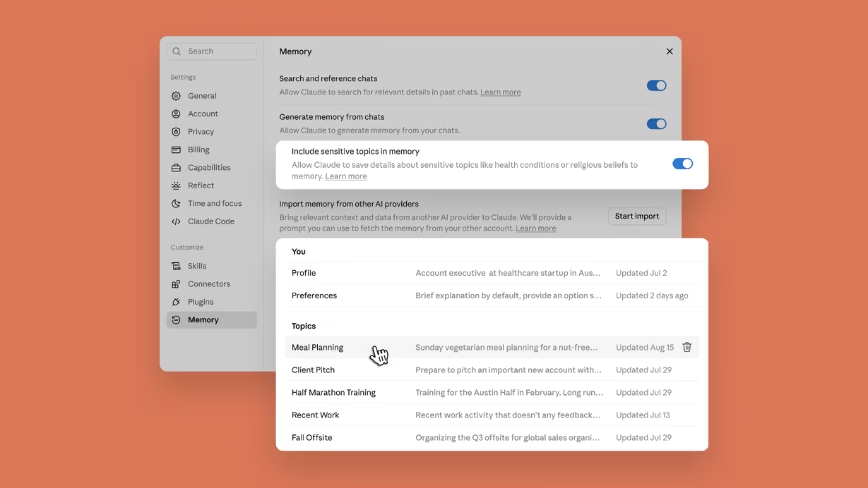
💡Claude’s memory now follows users between chat and Cowork by default—important for workflow design and data governance.
⚡ 30-Second TL;DR
What Changed
Claude chat and Cowork now share a unified memory system.
Why It Matters
The change can make Claude’s assistance more consistent across conversational and work-oriented workflows. For teams, it also increases the importance of understanding what information is retained and shared between these experiences.
What To Do Next
Test Claude chat and Cowork with a controlled, non-sensitive workspace to verify how shared memory affects your workflows before introducing private company data.
Key Points
- •Claude chat and Cowork now share a unified memory system.
- •Chat conversations can inform Cowork’s future context.
- •Cowork-learned information can become available in Claude chats.
- •The merged memory feature is enabled by default.
🧠 Deep Insight
Background and context from public sources — not the original article. 8 sources cited.
🔑 Enhanced Key Takeaways
- •The unified memory system utilizes real-time updates, allowing Claude to capture dynamic information like deadline shifts mid-conversation rather than relying on post-session summaries.
- •Anthropic has implemented a privacy-first default where sensitive categories such as health, political beliefs, and religious views are excluded from memory unless explicitly toggled by the user.
- •Memory management is centralized under a dedicated Settings menu, providing users with granular control to view, edit, delete, or perform a full reset of their stored context.
- •The rollout differentiates between consumer and commercial tiers, with the feature enabled by default for Free, Pro, and Max users, while remaining disabled by default for Team and Enterprise accounts.
- •Claude Code is explicitly excluded from this memory unification, keeping the agent-based automation and the chat-based assistant distinct from the specialized coding environment.
📊 Competitor Analysis▸ Show
| Feature | Claude (Unified Memory) | OpenAI (ChatGPT Memory) | Google (Gemini Memory) |
|---|---|---|---|
| Architecture | Unified Chat/Agent Memory | Chat-centric Memory | Context-window based |
| Privacy Controls | Sensitive topic toggle | Manual memory management | User-managed activity history |
| Agent Integration | Deep Cowork integration | Limited agent memory | Workspace integration |
🛠️ Technical Deep Dive
- Architecture: Implements a shared context pool that bridges the latent space between conversational chat and the Claude Cowork agent execution environment.
- Update Mechanism: Employs an incremental, real-time memory extraction layer that updates the user profile vector store during active sessions.
- Data Governance: Utilizes a classification filter to intercept and block sensitive data points (health, politics, beliefs) from being persisted to the long-term memory store by default.
- Deployment: Cross-platform synchronization across web, desktop, and mobile clients via a centralized backend memory service.
🔮 Future ImplicationsAI analysis grounded in cited sources
⏳ Timeline
📎 Sources (8)
Factual claims are grounded in the sources below. Forward-looking analysis is AI-generated interpretation.
Weekly AI Recap
Read this week's curated digest of top AI events →
👉Related Updates
AI-curated news aggregator. All content rights belong to original publishers.
Original source: The Next Web (TNW) ↗
This is a summary, not the original. Read the source, or get the weekly briefing.
Weekly AI briefing
One email a week. Unsubscribe anytime.