Claude Gains Autonomous Gmail Messaging
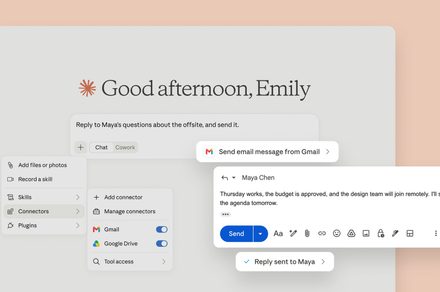
💡Claude can now act directly in Gmail, making permission design critical for AI agent deployments.
⚡ 30-Second TL;DR
What Changed
Claude can send Gmail messages on behalf of users.
Why It Matters
This moves Claude closer to being an actionable workplace agent rather than a purely conversational assistant. Developers and enterprises should evaluate permission boundaries, auditability, and failure handling before enabling broad email autonomy.
What To Do Next
Test Claude's Gmail integration in a sandbox account and define approval rules for external recipients before wider deployment.
Key Points
- •Claude can send Gmail messages on behalf of users.
- •The feature supports replying to and forwarding emails.
- •Users no longer need to approve every email action individually.
- •The update provides adjustable autonomy for email workflows.
🧠 Deep Insight
AI-generated analysis for this event.
🔑 Enhanced Key Takeaways
- •The integration utilizes Anthropic's 'Computer Use' capability, allowing the model to interact with the Gmail web interface by observing screen pixels and controlling mouse/keyboard inputs.
- •Security protocols include a mandatory 'human-in-the-loop' verification step for sensitive actions like deleting emails or modifying account security settings.
- •The feature is currently restricted to Anthropic's Pro and Team tier subscribers, requiring explicit OAuth token authorization for Google Workspace access.
- •Anthropic has implemented a rate-limiting mechanism to prevent automated spam generation, capping the number of autonomous messages sent per hour.
- •The system employs a specialized 'intent-classification' layer that analyzes email context to distinguish between routine correspondence and high-stakes communication requiring manual review.
📊 Competitor Analysis▸ Show
| Feature | Claude (Autonomous Gmail) | Google Gemini (Gmail Extension) | Microsoft Copilot (Outlook) |
|---|---|---|---|
| Primary Interface | Computer Use (UI Interaction) | API-based Integration | API-based Integration |
| Autonomy Level | High (Agentic) | Moderate (Assisted) | Moderate (Assisted) |
| Pricing | Pro/Team Subscription | Included in Workspace/One | Microsoft 365 Subscription |
| Benchmarks | High accuracy in UI navigation | Deep native data indexing | Deep enterprise integration |
🛠️ Technical Deep Dive
- Utilizes a multimodal vision-language model (VLM) architecture capable of real-time screen parsing and coordinate mapping.
- Implements a sandbox environment for browser automation to isolate the model's actions from the host operating system.
- Employs a chain-of-thought reasoning process to verify email recipients and content against user-defined safety policies before execution.
- Uses encrypted session tokens to maintain persistent access to Gmail without storing user credentials in plain text.
🔮 Future ImplicationsAI analysis grounded in cited sources
⏳ Timeline
Weekly AI Recap
Read this week's curated digest of top AI events →
👉Related Updates

AI-curated news aggregator. All content rights belong to original publishers.
Original source: Digital Trends ↗