Claude Formalizes Fermat’s Last Theorem
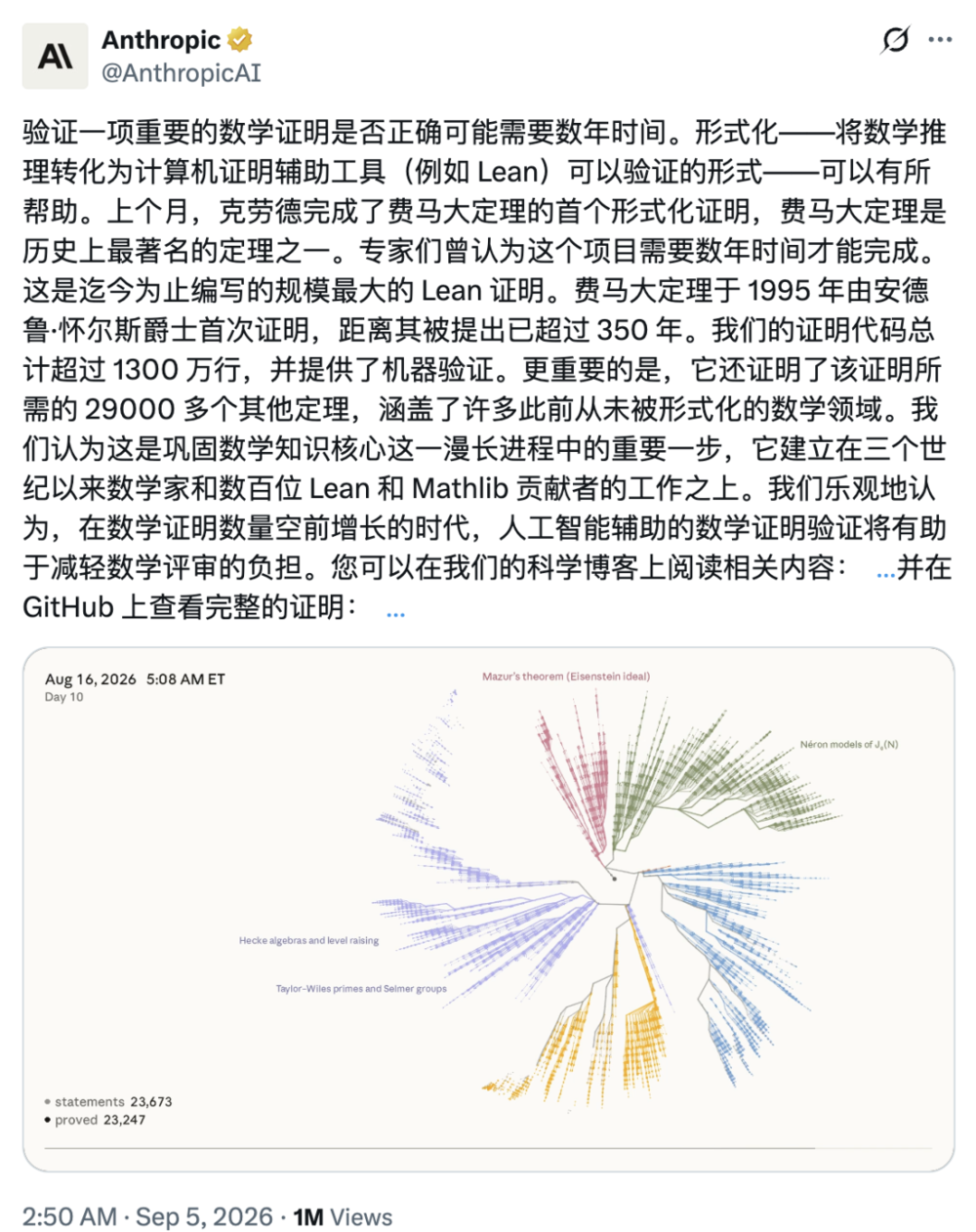
💡Claude used multi-agent orchestration and Lean to machine-check a 13-million-line mathematical proof.
⚡ 30-Second TL;DR
What Changed
Claude converted the existing human proof of Fermat’s Last Theorem into a machine-checkable Lean proof rather than discovering a new theorem.
Why It Matters
This demonstrates a potentially important workflow for AI-assisted mathematics: models generate large formal proofs while proof assistants provide deterministic verification. For AI developers, it highlights the value of agent orchestration, structured task decomposition, and tool-based validation over relying on a single unconstrained model response.
What To Do Next
Prototype a proof-generation agent that calls Lean as a verification tool and logs theorem dependencies before attempting larger formal-math tasks.
Key Points
- •Claude converted the existing human proof of Fermat’s Last Theorem into a machine-checkable Lean proof rather than discovering a new theorem.
- •The system generated approximately 13 million lines of Lean code and proved about 29,500 intermediate theorems used in the final result.
- •Multiple Claude agents divided definitions, intermediate lemmas, dependencies, and proof-management tasks through the Prove2Me platform.
- •The final proof was checked by Lean using only foundational mathematical axioms and no additional assumptions.
Weekly AI Recap
Read this week's curated digest of top AI events →
👉Related Updates


AI-curated news aggregator. All content rights belong to original publishers.
Original source: 虎嗅 ↗
This is a summary, not the original. Read the source, or get the weekly briefing.
Weekly AI briefing
One email a week. Unsubscribe anytime.