Claude Adds Invisible Watermarks to Every Output
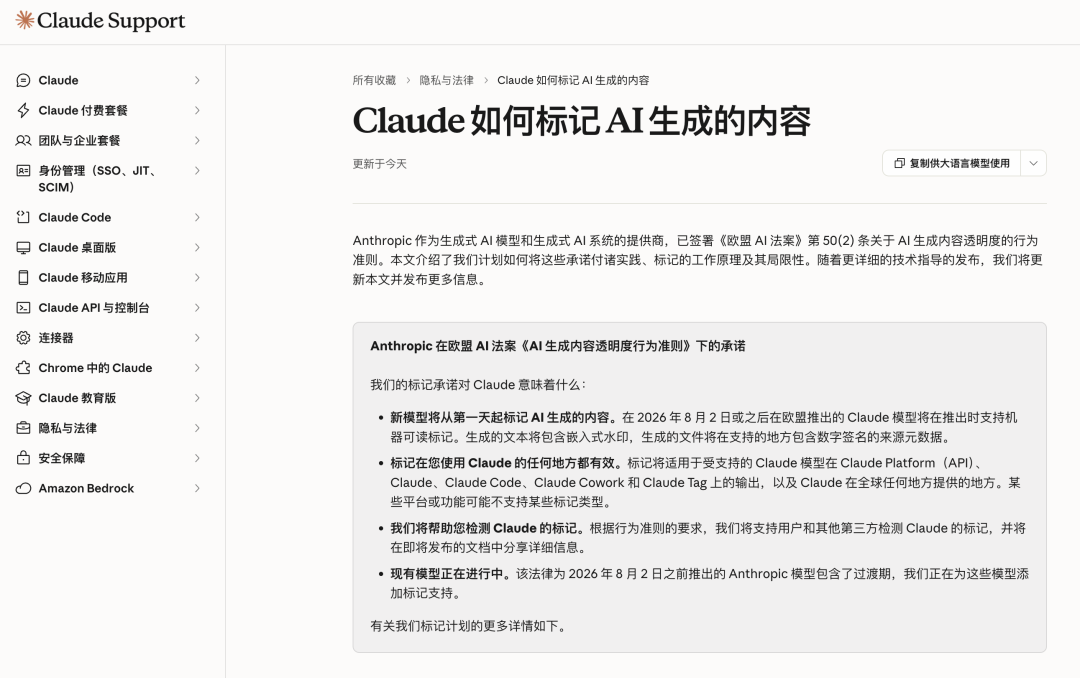
Claude’s watermarking may change how developers track, transform, and verify AI-generated text.
30-Second TL;DR
What Changed
Claude-generated paragraphs will carry an invisible watermark.
Why It Matters
The feature could help platforms identify AI-generated text and improve content provenance. Developers that transform, clean, or post-process Claude output will need to assess whether their pipelines preserve or weaken watermark detection.
What To Do Next
Test Claude-generated text through your production copy, formatting, and post-processing pipeline to measure whether the new watermark remains detectable.
Key Points
- •Claude-generated paragraphs will carry an invisible watermark.
- •The watermark is embedded in statistical patterns rather than visible characters.
- •Copying and pasting preserves the watermark, while some editing may not remove it.
- •Anthropic cited Article 50 of the EU AI Act as the regulatory driver.
Deep Insight
AI-generated analysis for this event — not the original article.
Enhanced Key Takeaways
- •The watermarking mechanism utilizes a technique known as 'soft watermarking,' which subtly biases token selection probabilities during the inference process to create a detectable statistical signature.
- •Anthropic has collaborated with academic researchers to ensure the watermark remains robust against common adversarial attacks such as synonym substitution or minor paraphrasing.
- •The implementation is designed to be computationally lightweight, ensuring that the addition of the watermark does not introduce significant latency to Claude's response generation times.
- •Beyond the EU AI Act, this initiative aligns with the voluntary commitments Anthropic made to the White House regarding the development of safe, secure, and trustworthy AI systems.
- •Anthropic provides an API-based verification tool that allows third-party platforms and regulators to programmatically detect the presence of the watermark in text samples.
Competitor Analysis
- Anthropic (Claude)
- Statistical Token Bias
- OpenAI (ChatGPT)
- C2PA / Metadata
- Google (Gemini)
- SynthID
- Anthropic (Claude)
- EU AI Act Focused
- OpenAI (ChatGPT)
- Coalition for Content Provenance
- Google (Gemini)
- Watermarking Images/Text
- Anthropic (Claude)
- API-based Verification
- OpenAI (ChatGPT)
- Limited / Research Preview
- Google (Gemini)
- Publicly Available Tool
| Feature | Anthropic (Claude) | OpenAI (ChatGPT) | Google (Gemini) |
|---|---|---|---|
| Watermarking Method | Statistical Token Bias | C2PA / Metadata | SynthID |
| Regulatory Alignment | EU AI Act Focused | Coalition for Content Provenance | Watermarking Images/Text |
| Detection Availability | API-based Verification | Limited / Research Preview | Publicly Available Tool |
Technical Deep Dive
- The watermark operates by partitioning the model's vocabulary into 'green' and 'red' lists during the token sampling phase.
- By slightly increasing the probability of selecting tokens from the 'green' list, the model creates a detectable pattern without significantly degrading output quality or coherence.
- The detection algorithm calculates a z-score based on the frequency of 'green' tokens in a given text sample; a high z-score indicates a high statistical probability of AI generation.
- This method is specifically optimized to be resilient against 'truncation attacks' where only a portion of the original generated text is used.
Future ImplicationsAI analysis grounded in cited sources
Timeline
- 2023-07Anthropic joins major AI labs in making voluntary safety commitments to the White House.
- 2024-03The European Parliament formally adopts the EU AI Act, establishing transparency requirements for AI-generated content.
- 2024-06Anthropic announces expanded safety research initiatives focusing on model interpretability and provenance.
- 2026-08Anthropic officially rolls out invisible watermarking for Claude outputs to meet regulatory compliance.
Weekly AI Recap
Read this week's curated digest of top AI events →
Related Updates

AI-curated news aggregator. All content rights belong to original publishers.
Original source: cnBeta (Full RSS) ↗
This is a summary, not the original. Read the source, or get the weekly briefing.
The weekly digest
One email a week. Unsubscribe anytime.