Chrome AI Mode Upgrades Transform Web Exploration
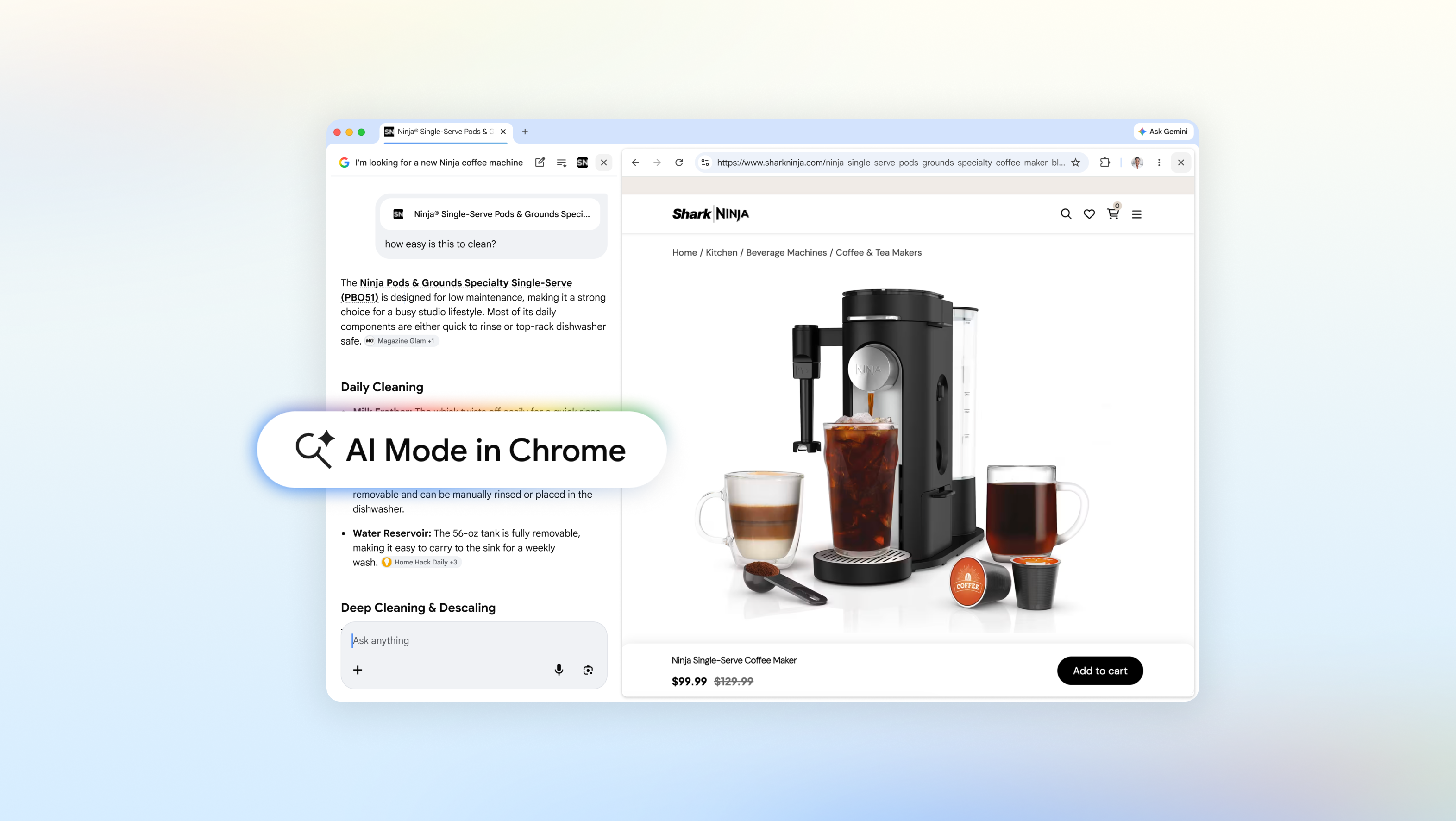
Google's Chrome AI Mode upgrade revolutionizes web interaction—key for AI devs building web apps.
30-Second TL;DR
What Changed
Upgrades rolled out for AI Mode in Chrome
Why It Matters
Enhances Chrome's AI capabilities, positioning Google ahead in AI-integrated browsers. AI practitioners gain a powerful tool for AI-assisted web tasks, potentially speeding up development workflows.
What To Do Next
Update Chrome to latest version and enable AI Mode to test new web exploration features.
Key Points
- •Upgrades rolled out for AI Mode in Chrome
- •New approach to web exploration introduced
- •Transforms overall web interaction experience
- •Announced on Google AI Blog
Deep Insight
AI-generated analysis for this event — not the original article.
Enhanced Key Takeaways
- •The update integrates Gemini Nano directly into the Chrome browser architecture, enabling on-device processing for privacy-sensitive web content analysis.
- •New 'Contextual Synthesis' capabilities allow Chrome to generate real-time summaries of multi-tab browsing sessions, reducing cognitive load for complex research tasks.
- •The rollout includes a proactive 'AI Insight' sidebar that identifies and highlights actionable data points, such as dates, prices, or technical specs, directly from static web pages.
Competitor Analysis
- Google Chrome (AI Mode)
- Gemini Nano (On-device)
- Microsoft Edge (Copilot)
- GPT-4o (Cloud-based)
- Arc Browser (Max)
- GPT-4o / Claude 3.5
- Google Chrome (AI Mode)
- High (Local processing)
- Microsoft Edge (Copilot)
- Moderate (Cloud-reliant)
- Arc Browser (Max)
- Moderate (Cloud-reliant)
- Google Chrome (AI Mode)
- Deep OS/Browser integration
- Microsoft Edge (Copilot)
- Office 365 ecosystem
- Arc Browser (Max)
- UI/UX and tab management
| Feature | Google Chrome (AI Mode) | Microsoft Edge (Copilot) | Arc Browser (Max) |
|---|---|---|---|
| Core AI Model | Gemini Nano (On-device) | GPT-4o (Cloud-based) | GPT-4o / Claude 3.5 |
| Privacy Focus | High (Local processing) | Moderate (Cloud-reliant) | Moderate (Cloud-reliant) |
| Key Strength | Deep OS/Browser integration | Office 365 ecosystem | UI/UX and tab management |
Technical Deep Dive
- •Utilizes a distilled version of the Gemini Nano model optimized for the V8 JavaScript engine to minimize latency.
- •Implements a local vector database within the browser profile to index browsing history for personalized AI context retrieval.
- •Employs a new 'Web-to-Context' API that allows the AI to parse DOM structures more efficiently than traditional scraping methods.
- •Features a privacy-preserving 'Sandboxed Inference' layer that prevents AI models from accessing cross-site cookies without explicit user permission.
Future ImplicationsAI analysis grounded in cited sources
Timeline
- 2023-12Google introduces Gemini 1.0, laying the foundation for on-device AI integration.
- 2024-05Google I/O announces 'Project Astra' and initial AI features for Chrome.
- 2025-02Chrome integrates Gemini Nano for basic tab organization and writing assistance.
- 2026-04Google rolls out advanced AI Mode upgrades for comprehensive web exploration.
Weekly AI Recap
Read this week's curated digest of top AI events →
AI-curated news aggregator. All content rights belong to original publishers.
Original source: Google AI Blog ↗
This is a summary, not the original. Read the source, or get the weekly briefing.
The weekly digest
One email a week. Unsubscribe anytime.