Chip Shortage Drives Up Prices for Routers and Smart Devices
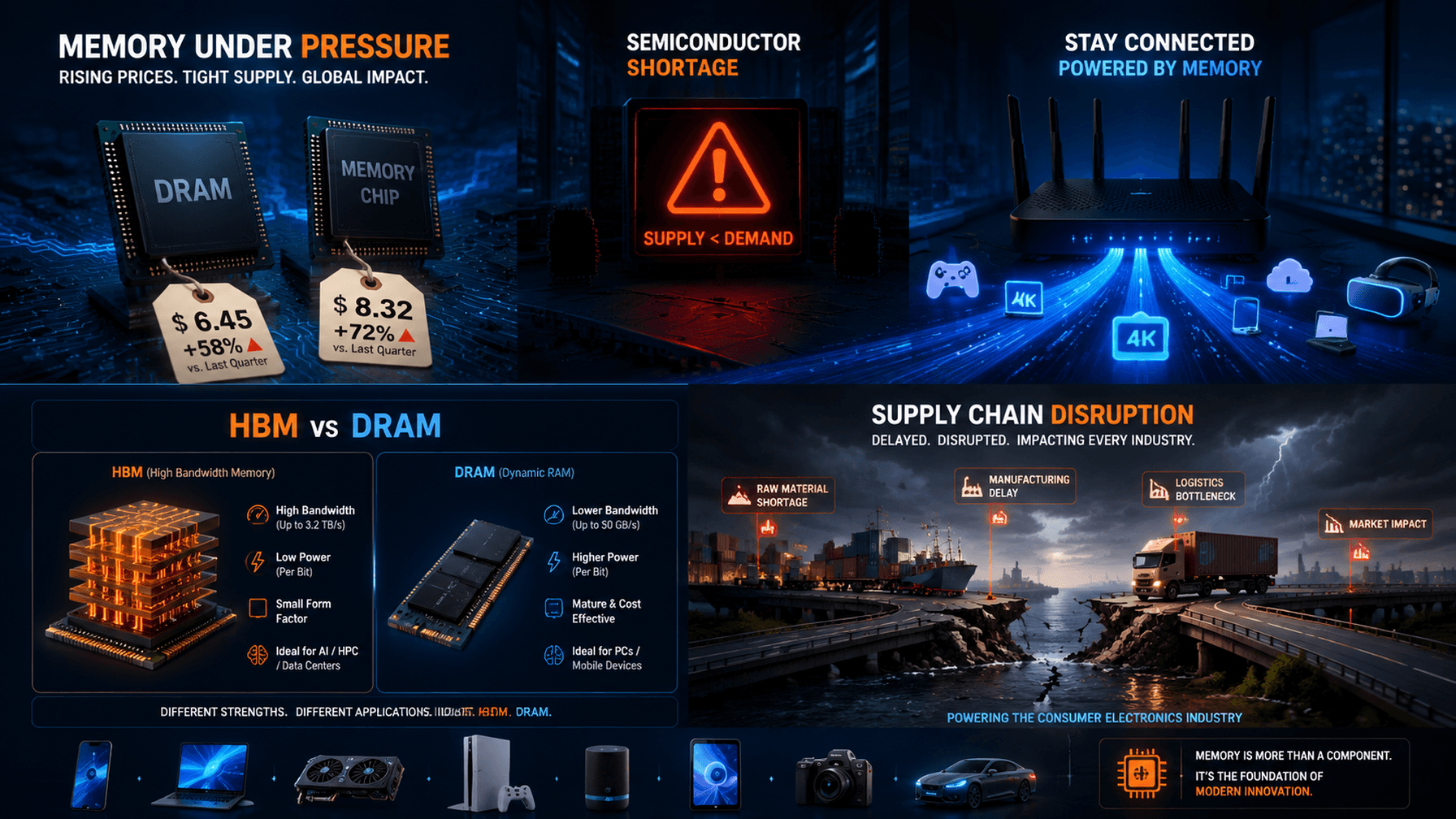
💡Understand how the AI chip boom is inflating costs for your edge hardware and smart device deployments.
⚡ 30-Second TL;DR
What Changed
HBM production is prioritizing AI hardware over consumer electronics memory
Why It Matters
AI infrastructure demand is creating a 'memory tax' on consumer hardware. Practitioners should anticipate potential supply chain delays for edge computing devices.
What To Do Next
Audit your hardware procurement pipeline for edge AI projects to account for potential DRAM price volatility and lead-time extensions.
Key Points
- •HBM production is prioritizing AI hardware over consumer electronics memory
- •DRAM supply constraints are rippling across the broader consumer tech ecosystem
- •Increased manufacturing costs for routers and smart home devices are being passed to consumers
🧠 Deep Insight
AI-generated analysis for this event — not the original article.
🔑 Enhanced Key Takeaways
- •Memory manufacturers are aggressively converting legacy DDR4 production lines to HBM3E and HBM4 to meet the insatiable demand from hyperscalers like NVIDIA and AMD.
- •The 'HBM tax' on consumer electronics is exacerbated by the high die size of HBM stacks, which reduces the total number of chips per wafer compared to standard DRAM.
- •Foundries are prioritizing high-margin AI-focused logic and memory wafers, leading to a 'capacity squeeze' for mature process nodes (28nm and above) typically used in IoT and networking controllers.
- •Major router OEMs are increasingly adopting 'just-in-case' inventory strategies, moving away from lean manufacturing models to buffer against volatile memory pricing.
- •The shift in capital expenditure toward AI-optimized memory has led to a stagnation in R&D investment for low-power DRAM (LPDDR) variants used in smart home sensors.
🛠️ Technical Deep Dive
- HBM (High Bandwidth Memory) utilizes a 3D-stacked architecture with TSVs (Through-Silicon Vias) to achieve bandwidths exceeding 1 TB/s, whereas standard DDR4/DDR5 relies on traditional planar layouts.
- The manufacturing process for HBM requires complex interposer integration and CoWoS (Chip-on-Wafer-on-Substrate) packaging, which consumes significantly more cleanroom time than standard memory packaging.
- Routers and smart devices typically utilize LPDDR4x or DDR4, which are now competing for the same raw silicon wafer capacity as HBM, despite having vastly different profit margins.
- The transition to HBM4 is expected to further tighten supply as it requires even more advanced logic-to-memory bonding techniques, potentially extending lead times for non-AI semiconductor components through 2027.
🔮 Future ImplicationsAI analysis grounded in cited sources
⏳ Timeline
Weekly AI Recap
Read this week's curated digest of top AI events →
👉Related Updates

AI-curated news aggregator. All content rights belong to original publishers.
Original source: Pandaily ↗
This is a summary, not the original. Read the source, or get the weekly briefing.
Weekly AI briefing
One email a week. Unsubscribe anytime.