Chinese Tech Giants Launch Rival AI Coding Agents
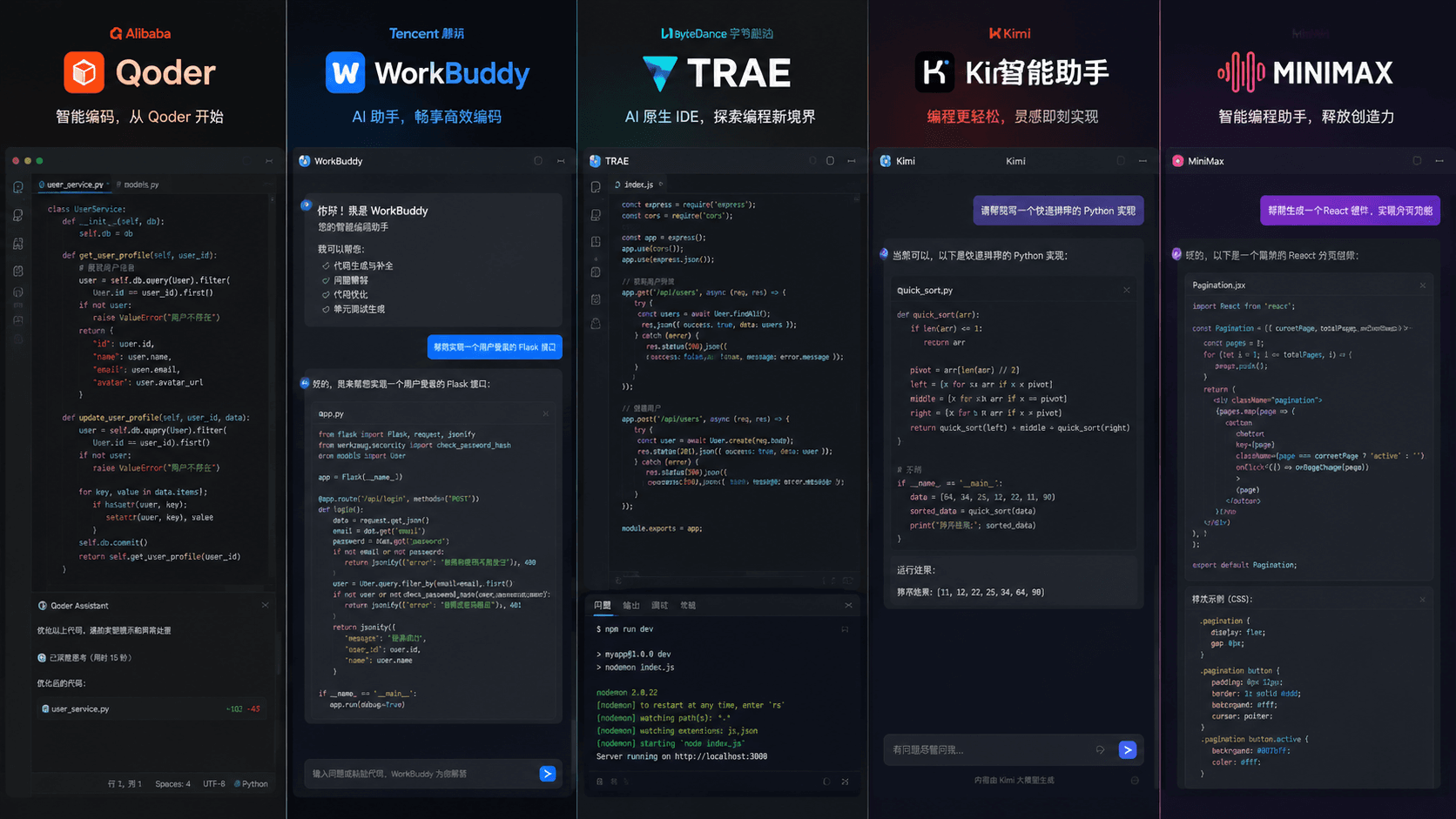
Major Chinese tech giants are launching coding agents to challenge Claude Code's dominance.
30-Second TL;DR
What Changed
Alibaba, Tencent, and ByteDance are entering the AI coding agent space.
Why It Matters
The proliferation of localized coding agents will likely accelerate AI adoption in software engineering across China. It forces global players to consider regional customization to maintain their competitive edge.
What To Do Next
Evaluate the latency and accuracy of these new Chinese coding agents against Claude Code to determine if they offer better performance for local infrastructure.
Key Points
- •Alibaba, Tencent, and ByteDance are entering the AI coding agent space.
- •New agents are designed to challenge the dominance of Anthropic and OpenAI in software development.
- •Focus is placed on localized workflows to better serve the Chinese developer ecosystem.
Deep Insight
AI-generated analysis for this event — not the original article.
Enhanced Key Takeaways
- •The new agents leverage proprietary Large Language Models (LLMs) such as Alibaba's Qwen-2.5-Coder, Tencent's Hunyuan-Code, and ByteDance's Doubao-Code, which are specifically fine-tuned on massive repositories of Chinese-language documentation and domestic open-source projects.
- •These tools incorporate strict data sovereignty features, allowing enterprises to deploy the coding agents within private cloud environments to comply with China's Data Security Law and Personal Information Protection Law.
- •Unlike Western counterparts, these agents feature deep integration with domestic development platforms like Gitee and DingTalk, streamlining CI/CD pipelines for local enterprise workflows.
- •The launch is part of a broader 'AI-Native Development' initiative supported by the Ministry of Industry and Information Technology (MIIT) to reduce reliance on foreign software development tools.
- •Early benchmarks indicate these models show superior performance in handling complex multi-file refactoring tasks specifically within environments using Chinese-language variable naming and localized API documentation.
Competitor Analysis
- Chinese AI Coding Agents
- Localized/Sovereign Dev
- Anthropic Claude Code
- Agentic Workflow/Reasoning
- OpenAI Cursor/o1
- IDE Integration/Reasoning
- Chinese AI Coding Agents
- Private Cloud/On-Prem
- Anthropic Claude Code
- Cloud-based (Enterprise API)
- OpenAI Cursor/o1
- Cloud-based (Enterprise API)
- Chinese AI Coding Agents
- Gitee/DingTalk/WeChat
- Anthropic Claude Code
- GitHub/GitLab/VS Code
- OpenAI Cursor/o1
- GitHub/GitLab/VS Code
- Chinese AI Coding Agents
- Enterprise Subscription
- Anthropic Claude Code
- Usage-based (API)
- OpenAI Cursor/o1
- Subscription/Usage-based
| Feature | Chinese AI Coding Agents | Anthropic Claude Code | OpenAI Cursor/o1 |
|---|---|---|---|
| Primary Focus | Localized/Sovereign Dev | Agentic Workflow/Reasoning | IDE Integration/Reasoning |
| Data Privacy | Private Cloud/On-Prem | Cloud-based (Enterprise API) | Cloud-based (Enterprise API) |
| Ecosystem | Gitee/DingTalk/WeChat | GitHub/GitLab/VS Code | GitHub/GitLab/VS Code |
| Pricing | Enterprise Subscription | Usage-based (API) | Subscription/Usage-based |
Technical Deep Dive
- Architecture utilizes Mixture-of-Experts (MoE) frameworks to optimize inference latency for real-time code completion.
- Implementation includes a specialized 'Context-Aware Retrieval' layer that prioritizes local project documentation over generic internet-based training data.
- Models utilize a multi-stage training pipeline: pre-training on code repositories, followed by supervised fine-tuning (SFT) on developer interaction logs, and Reinforcement Learning from Code Execution (RLCE) feedback.
- Support for 'Agentic Tool-Use' allows the models to autonomously execute shell commands, run unit tests, and perform git operations within a sandboxed container environment.
Future ImplicationsAI analysis grounded in cited sources
Timeline
- 2024-09Alibaba releases Qwen-2.5-Coder, establishing the foundational model for its agentic coding strategy.
- 2025-03Tencent upgrades Hunyuan model with specialized code-generation capabilities for enterprise internal use.
- 2025-11ByteDance integrates Doubao-Code into its internal development environment, significantly increasing developer productivity metrics.
- 2026-05MIIT issues guidelines encouraging the adoption of domestic AI tools in critical software infrastructure.
Weekly AI Recap
Read this week's curated digest of top AI events →
Related Updates




AI-curated news aggregator. All content rights belong to original publishers.
Original source: Pandaily ↗
This is a summary, not the original. Read the source, or get the weekly briefing.
The weekly digest
One email a week. Unsubscribe anytime.