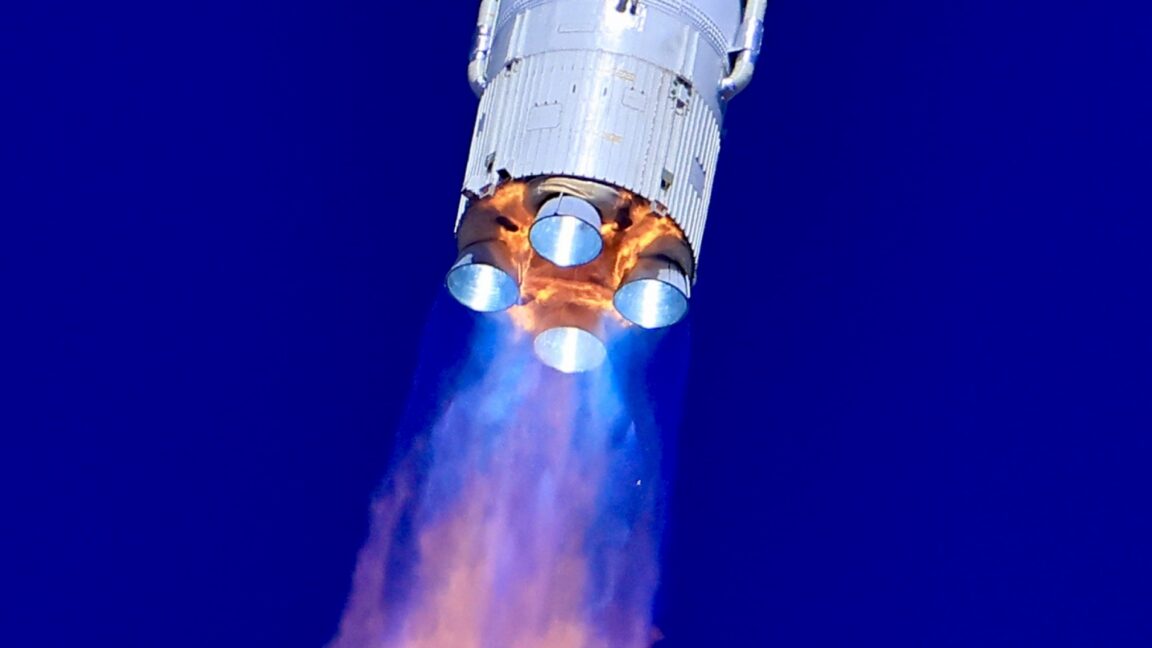
Chinese rocket breakup threatens Starlink constellation
💡Learn how orbital debris risks could impact the reliability of satellite-based AI and connectivity services.
⚡ 30-Second TL;DR
What Changed
Chinese rocket breakup generated 100-150 new pieces of space debris.
Why It Matters
Increased debris risks could lead to higher insurance costs and operational complexities for satellite-based AI networks. It may also trigger stricter international regulations on space traffic management.
What To Do Next
If you are building satellite-dependent AI applications, review your latency and uptime contingency plans for potential orbital service disruptions.
Key Points
- •Chinese rocket breakup generated 100-150 new pieces of space debris.
- •The debris field is dangerously close to active Starlink satellites.
- •Orbital congestion poses a threat to low-earth orbit infrastructure.
🧠 Deep Insight
Background and context from public sources — not the original article. 16 sources cited.
🔑 Enhanced Key Takeaways
- •The Chinese rocket involved in the breakup was identified as a Zhuque-2E rocket body, which disintegrated on June 9, 2026, at 0847 UTC, after being launched from the Jiuquan Satellite Launch Center.
- •Starlink satellites are equipped with krypton-powered ion thrusters for precise orbital adjustments and feature an automated collision avoidance system that integrates data from the U.S. Department of Defense's debris tracking network.
- •SpaceX launched 'Stargaze' in January 2026, a Space Situational Awareness system utilizing nearly 30,000 in-orbit star trackers on Starlink satellites to provide near real-time orbit estimates and collision predictions, with data shared freely with other satellite operators.
- •The debris generated from the Zhuque-2E breakup is actively being incorporated into routine conjunction assessment to support overall spaceflight safety.
- •Starlink satellites are designed for complete disintegration upon re-entry into Earth's atmosphere, minimizing the amount of debris that could reach the ground, and employ controlled re-entries targeting remote ocean areas for safety.
📊 Competitor Analysis▸ Show
| Feature/Provider | Starlink (SpaceX) | Amazon Leo (Project Kuiper) | Viasat / HughesNet (GEO) |
|---|---|---|---|
| Constellation Size | ~10,413 satellites (as of June 2026) | 3,236 satellites planned | Fewer, larger satellites (Geostationary) |
| Orbital Altitude | Low Earth Orbit (LEO), primarily ~550 km | Low Earth Orbit (LEO), ~400 km (some sources say 100km above Starlink) | Geostationary Orbit (GEO), ~36,000 km |
| Download Speed | Up to 400 Mbps (scaling to 1 Gbps by 2026) | Up to 1 Gbps | 10-100 Mbps |
| Upload Speed | Up to 40 Mbps | Up to 400 Mbps | Typically 10-50% of download speeds |
| Latency | ~40 ms (median U.S. 25.7ms in 2025) | ~50 ms | 600-800 ms |
| Coverage | Global | Expanding global footprint | Broad, fixed regional coverage |
| Key Differentiator | First-mover advantage, established network, autonomous collision avoidance | Direct AWS integration, enterprise-grade terminals | Lower upfront costs, reliable rural connectivity (where LEO not available) |
🛠️ Technical Deep Dive
- Satellite Design: Starlink satellites have a flat design, weigh approximately 260 kg, and are equipped with solar panels for power.
- Propulsion: They utilize krypton-powered ion thrusters for precise orbit adjustments and controlled deorbiting.
- Communication: Phased array antennas are used for beam steering, and inter-satellite laser links enable communication between satellites.
- Debris Mitigation: Satellites are designed for complete disintegration during atmospheric re-entry, with controlled re-entries targeting remote ocean areas to minimize ground debris.
- Collision Avoidance System: Starlink satellites feature an autonomous collision avoidance system that processes data from the U.S. Department of Defense's debris tracking network.
- Space Situational Awareness (Stargaze): Introduced in January 2026, Stargaze uses nearly 30,000 in-orbit star trackers across the Starlink fleet, detecting approximately 30 million transits daily to generate near real-time orbit estimates and collision predictions. This system provides conjunction screening results within minutes, a significant improvement over conventional methods.
- Orbital Parameters: Starlink operates primarily in Ku- and Ka-band frequencies and maintains satellites at altitudes below 600 kilometers, with many in the ~550 km range.
🔮 Future ImplicationsAI analysis grounded in cited sources
⏳ Timeline
📎 Sources (16)
Factual claims are grounded in the sources below. Forward-looking analysis is AI-generated interpretation.
Weekly AI Recap
Read this week's curated digest of top AI events →
👉Related Updates
AI-curated news aggregator. All content rights belong to original publishers.
Original source: Ars Technica ↗
This is a summary, not the original. Read the source, or get the weekly briefing.
Weekly AI briefing
One email a week. Unsubscribe anytime.