Chinese Models Lead the Open-Weight AI Race
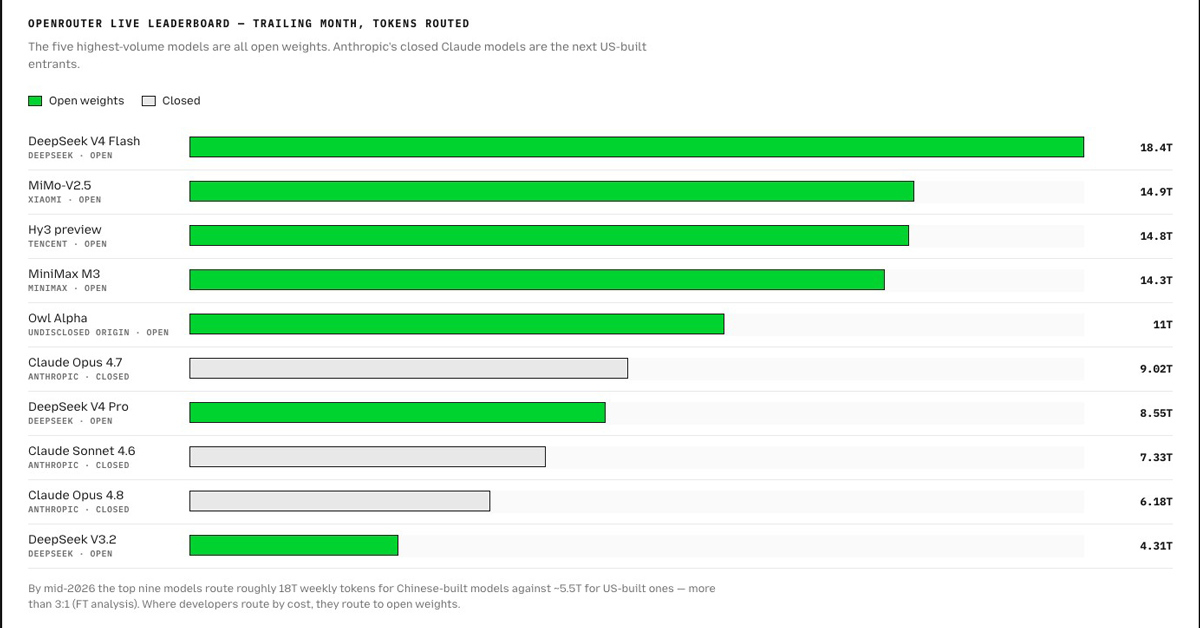
💡See why Chinese open-weight models dominate current rankings and what the data means for model selection.
⚡ 30-Second TL;DR
What Changed
Mozilla’s report focuses on the current adoption and competitive position of open-weight AI models.
Why It Matters
The findings could influence model-selection strategies for teams evaluating open-weight alternatives. They also reinforce the importance of comparing models across multiple public benchmarks and usage sources rather than relying on a single leaderboard.
What To Do Next
Use Chatbot Arena and OpenRouter data to benchmark at least three leading Chinese open-weight models against your current production model before switching.
Key Points
- •Mozilla’s report focuses on the current adoption and competitive position of open-weight AI models.
- •Chinese AI models occupy many of the top-ranked positions highlighted in the report.
- •The comparison suggests Chinese models have roughly a threefold advantage over US models in the reported rankings.
- •The analysis combines Mozilla and SlashData research with public data from Chatbot Arena and OpenRouter.
🧠 Deep Insight
Background and context from public sources — not the original article. 11 sources cited.
🔑 Enhanced Key Takeaways
- •Chinese labs have achieved a significant scale advantage, releasing open-weight models with parameter counts between 754B and 2.78 trillion, vastly exceeding the typical 130B parameter ceiling of U.S. open-weight counterparts.
- •Data from OpenRouter indicates that Chinese-origin models have shifted from negligible usage to representing the majority of total token consumption over the past 18 months.
- •A Bloomberg survey from August 2026 reveals that Chinese open-weight models achieve performance parity with U.S. models at an average cost reduction of 87%.
- •The DeepSeek V4 Flash model, released in April 2026, established a new benchmark for agentic utility by scoring 79.0% on SWE-bench Verified, enabling its use as a direct substitute for frontier-class closed models.
- •Chinese labs are leveraging sparse Mixture-of-Experts (MoE) architectures to achieve high performance while bypassing the massive computational overhead associated with dense model training.
📊 Competitor Analysis▸ Show
| Feature | Chinese Open-Weight Models | U.S. Open-Weight Models |
|---|---|---|
| Parameter Scale | Up to 2.78T | Generally < 130B |
| Cost Efficiency | ~87% lower than U.S. counterparts | Higher compute/training costs |
| Architecture | Advanced Sparse MoE | Mixed (Dense/MoE) |
| Market Positioning | "Kill-switch-free" / Sovereign | Safety-first / Guardrail-heavy |
| SWE-bench Performance | High (e.g., DeepSeek V4 Flash) | Variable |
🛠️ Technical Deep Dive
- Utilization of sparse Mixture-of-Experts (MoE) architectures to optimize inference latency and training efficiency.
- Implementation of massive parameter scaling (up to 2.78T) to enhance reasoning capabilities in open-weight environments.
- Optimization for agentic workflows, specifically targeting high performance on software engineering benchmarks like SWE-bench Verified.
- Development of models designed for local or private deployment to address enterprise requirements for data sovereignty.
🔮 Future ImplicationsAI analysis grounded in cited sources
⏳ Timeline
📎 Sources (11)
Factual claims are grounded in the sources below. Forward-looking analysis is AI-generated interpretation.
Weekly AI Recap
Read this week's curated digest of top AI events →
👉Related Updates
AI-curated news aggregator. All content rights belong to original publishers.
Original source: ITmedia AI+ (日本) ↗
This is a summary, not the original. Read the source, or get the weekly briefing.
Weekly AI briefing
One email a week. Unsubscribe anytime.