Chinese EV makers struggle to meet 2026 sales targets
💡Understand why China's EV market is cooling and how top brands are pivoting strategies in a saturated market.
⚡ 30-Second TL;DR
What Changed
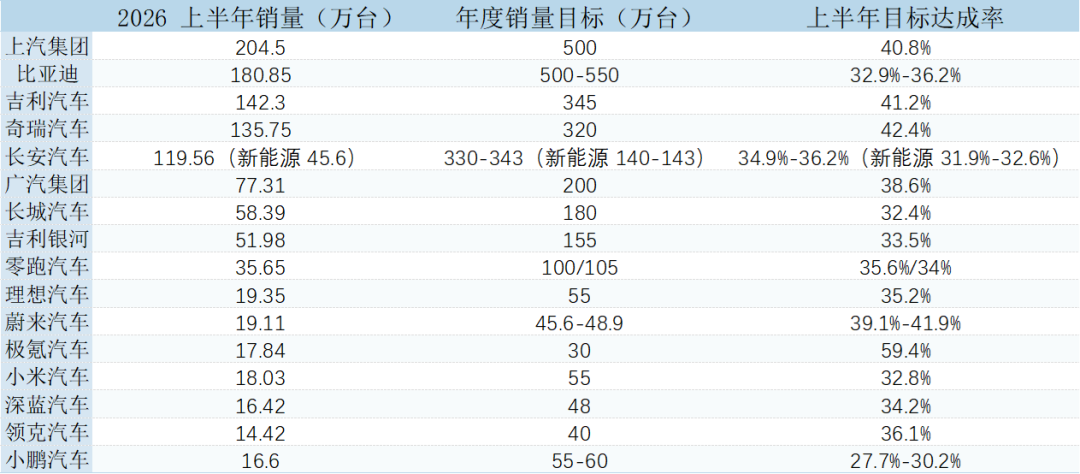
Average sales target completion rate for 16 automakers is only 35%.
Why It Matters
The shift from a growth market to a stock market in China's EV sector is forcing companies to prioritize profitability and product quality over raw volume. This will likely lead to further industry consolidation.
What To Do Next
Monitor the quarterly financial reports of major EV players to identify which companies are successfully pivoting to high-margin models.
Key Points
- •Average sales target completion rate for 16 automakers is only 35%.
- •Zeekr is the only brand to exceed 50% completion rate in H1 2026.
- •Traditional automakers are struggling to balance declining internal combustion engine sales with new energy vehicle growth.
- •Overseas market expansion is becoming a critical growth driver for major players like BYD and Chery.
🧠 Deep Insight
AI-generated analysis for this event — not the original article.
🔑 Enhanced Key Takeaways
- •The Chinese government has begun scaling back direct purchase subsidies for NEVs in 2026, forcing manufacturers to rely on organic demand rather than policy-driven growth.
- •Inventory turnover ratios for major Chinese EV brands have hit a three-year high, indicating a significant supply-demand mismatch in the domestic market.
- •Price wars initiated in early 2026 have severely compressed gross margins, with several Tier-2 EV makers reporting negative operating cash flow for the first time since 2023.
- •Regulatory scrutiny on 'range anxiety' marketing claims has led to a mandatory standardization of CLTC vs. WLTP reporting, causing a temporary dip in consumer confidence.
- •Strategic pivots toward 'Smart Cockpit' software-as-a-service (SaaS) revenue models are being accelerated to offset hardware sales stagnation.
📊 Competitor Analysis▸ Show
| Feature | Zeekr (Leader) | BYD (Volume) | Traditional OEMs (Struggling) |
|---|---|---|---|
| H1 2026 Completion | >50% | ~42% | <30% |
| Primary Strategy | Premium/Tech-focused | Vertical Integration | ICE-to-EV Transition |
| Pricing Strategy | Premium/Mid-High | Mass Market/Aggressive | Discount-heavy |
| Software Maturity | High (In-house OS) | High (Integrated) | Low (Outsourced/Legacy) |
🛠️ Technical Deep Dive
- Shift toward 800V silicon carbide (SiC) architectures to improve charging efficiency and reduce thermal management overhead.
- Integration of centralized E/E (Electrical/Electronic) architecture to support OTA updates for autonomous driving features.
- Adoption of cell-to-chassis (CTC) battery packaging technology to increase energy density and reduce vehicle curb weight.
- Implementation of AI-driven battery management systems (BMS) to optimize cell balancing and extend cycle life under rapid-charging conditions.
🔮 Future ImplicationsAI analysis grounded in cited sources
⏳ Timeline
Weekly AI Recap
Read this week's curated digest of top AI events →
👉Related Updates

AI-curated news aggregator. All content rights belong to original publishers.
Original source: 虎嗅 ↗
This is a summary, not the original. Read the source, or get the weekly briefing.
Weekly AI briefing
One email a week. Unsubscribe anytime.