💰钛媒体•Stalecollected in 4h
Chinese Big Tech Races in AI App Gen
💡China's tech giants eye AI no-code apps; watch retention fixes for builder tools.
⚡ 30-Second TL;DR
What Changed
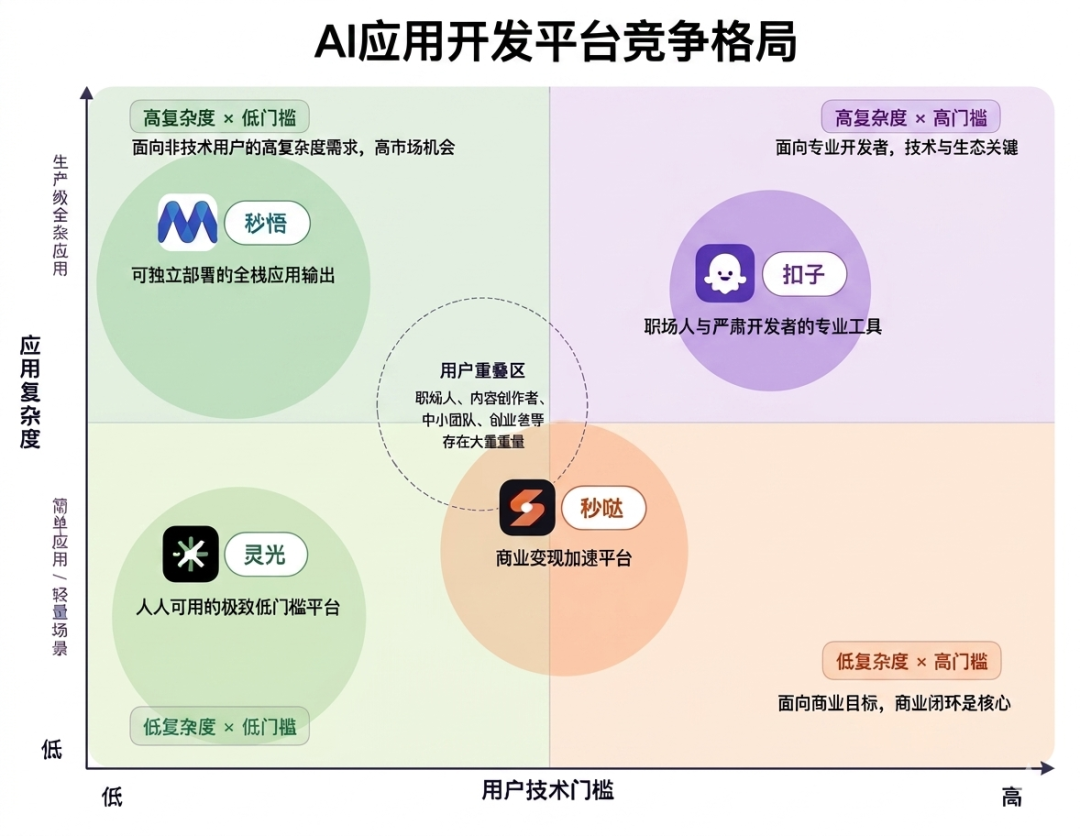
Chinese big tech intensifying AI app generation competition
Why It Matters
Signals growing accessibility of AI for app building, potentially lowering barriers for developers but highlighting scalability issues in consumer adoption.
What To Do Next
Test emerging AI no-code app builders from Alibaba or Baidu for prototyping efficiency.
Who should care:Developers & AI Engineers
Key Points
- •Chinese big tech intensifying AI app generation competition
- •Focus period: 2025-2026
- •Key challenges: user retention and monetization
- •Shift toward no-code/low-code AI tools
🧠 Deep Insight
AI-generated analysis for this event.
🔑 Enhanced Key Takeaways
- •Chinese tech giants are shifting from general-purpose LLM development to 'Agent-as-a-Service' models, prioritizing the integration of autonomous agents that can execute multi-step workflows rather than just generating text.
- •The 'hand-rolled' app trend is heavily driven by the adoption of RAG (Retrieval-Augmented Generation) frameworks that allow non-technical users to ground AI outputs in proprietary corporate or personal data without fine-tuning models.
- •Regulatory compliance in China, specifically regarding data security and content moderation for user-generated AI applications, has become a primary barrier to entry, forcing platforms to implement rigid, automated guardrails for all 'no-code' app builders.
📊 Competitor Analysis▸ Show
| Feature | ByteDance (Coze) | Alibaba (ModelScope) | Baidu (AgentBuilder) |
|---|---|---|---|
| Primary Focus | Consumer/Social Agent Creation | Developer/Enterprise Ecosystem | Search/Knowledge Base Integration |
| Pricing Model | Freemium (Token-based) | Pay-as-you-go (API) | Tiered Subscription |
| Key Benchmark | High ease-of-use/UI/UX | High model diversity/Open Source | Strongest Chinese language reasoning |
🛠️ Technical Deep Dive
- •Architecture relies on 'Agent Orchestration Layers' that manage memory, tool-use (API calling), and planning modules (ReAct or Plan-and-Solve prompting).
- •Implementation utilizes vector databases (e.g., Milvus, Pinecone) for real-time RAG, allowing users to upload documents that the agent indexes and queries dynamically.
- •Platforms employ 'Sandboxed Execution Environments' to run user-defined code snippets safely, preventing malicious execution within the broader AI application framework.
- •Integration of 'Multi-Agent Collaboration' protocols allows users to chain different specialized agents together to solve complex, multi-stage tasks.
🔮 Future ImplicationsAI analysis grounded in cited sources
Consolidation of the AI app-builder market will occur by Q4 2026.
High infrastructure costs for hosting thousands of custom agents will force smaller platforms to merge or exit, leaving only those with deep cloud-compute integration.
B2B revenue will overtake B2C revenue for AI app platforms.
Enterprises are increasingly adopting internal 'hand-rolled' agents for workflow automation, providing more stable monetization than consumer-facing entertainment apps.
⏳ Timeline
2023-11
ByteDance launches Coze, marking the start of the mainstream no-code AI agent platform race.
2024-03
Baidu upgrades its AgentBuilder platform to integrate deeply with the Ernie Bot ecosystem.
2024-09
Alibaba expands ModelScope to include simplified agent-building tools for enterprise developers.
2025-06
Major Chinese tech platforms introduce standardized 'Agent Store' marketplaces to facilitate monetization.
📰
Weekly AI Recap
Read this week's curated digest of top AI events →
👉Related Updates
AI-curated news aggregator. All content rights belong to original publishers.
Original source: 钛媒体 ↗