Chinese AI Models Gain Traction in US Market
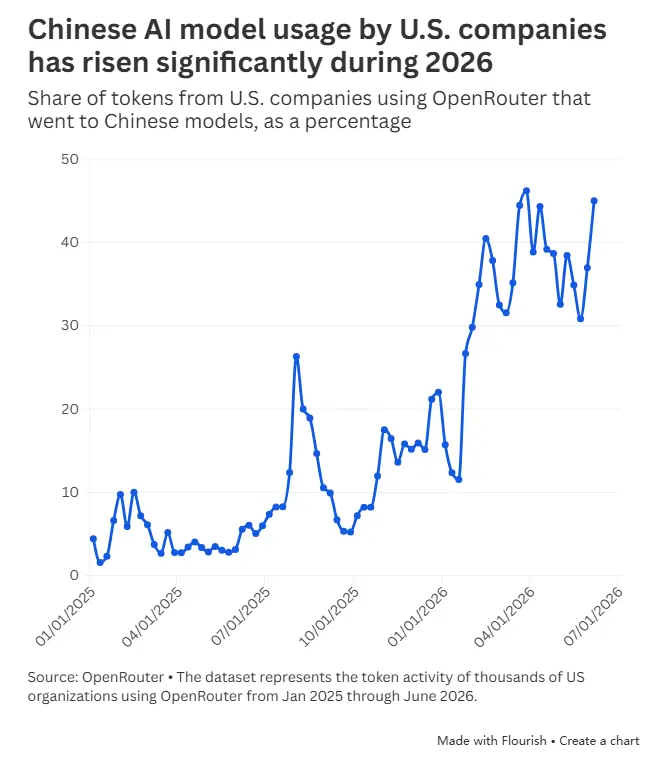
💡Chinese AI models are challenging US dominance by offering superior price-to-performance ratios for enterprises.
⚡ 30-Second TL;DR
What Changed
US companies are adopting Chinese AI models for cost efficiency
Why It Matters
The rise of cost-effective Chinese models could disrupt the current dominance of US-based AI providers. It forces a shift in market strategy toward pricing and efficiency for enterprise AI adoption.
What To Do Next
Benchmark DeepSeek or Zhipu APIs against your current LLM provider to evaluate potential cost savings for your production workloads.
Key Points
- •US companies are adopting Chinese AI models for cost efficiency
- •DeepSeek and Zhipu models are cited as highly competitive alternatives
- •Performance gaps between Chinese and US models are narrowing rapidly
🧠 Deep Insight
AI-generated analysis for this event — not the original article.
🔑 Enhanced Key Takeaways
- •Chinese AI firms are increasingly utilizing open-weights strategies to bypass US export restrictions on high-end GPUs, allowing US enterprises to deploy models on local infrastructure.
- •The adoption of DeepSeek and Zhipu is driven by the 'MoE' (Mixture-of-Experts) architecture, which significantly reduces inference costs compared to dense models used by early-generation US competitors.
- •US regulatory bodies are currently evaluating the security implications of 'model weight' accessibility, specifically regarding Chinese-developed models being integrated into critical enterprise supply chains.
- •Chinese AI developers have optimized training efficiency by leveraging specialized hardware interconnects that mitigate the impact of limited access to H100/B200-class chips.
- •Enterprise adoption is being facilitated by third-party 'model-as-a-service' platforms that provide API compatibility with OpenAI's standard, lowering the barrier for switching costs.
📊 Competitor Analysis▸ Show
| Feature | DeepSeek-V3/R1 | Zhipu GLM-4 | OpenAI GPT-4o | Anthropic Claude 3.5 |
|---|---|---|---|---|
| Architecture | MoE (Mixture-of-Experts) | Dense/MoE Hybrid | Dense/MoE | Dense |
| Pricing | Ultra-low (API-focused) | Competitive/Tiered | Premium | Premium |
| Primary Strength | Cost/Efficiency | Multimodal/Chinese NLP | Ecosystem/Reasoning | Coding/Nuance |
🛠️ Technical Deep Dive
- DeepSeek utilizes a Multi-head Latent Attention (MLA) mechanism which drastically reduces KV cache memory usage during inference.
- Zhipu's GLM-4 architecture employs a unique 'GLM' (General Language Model) objective that combines autoregressive blank-filling with standard causal language modeling.
- Both model families utilize advanced quantization techniques (INT8/FP8) as a native deployment standard to ensure high throughput on consumer-grade or older-generation enterprise GPUs.
- Training pipelines for these models have been optimized for heterogeneous clusters, allowing for effective scaling despite fragmented hardware availability.
🔮 Future ImplicationsAI analysis grounded in cited sources
⏳ Timeline
Weekly AI Recap
Read this week's curated digest of top AI events →
👉Related Updates


AI-curated news aggregator. All content rights belong to original publishers.
Original source: cnBeta (Full RSS) ↗
This is a summary, not the original. Read the source, or get the weekly briefing.
Weekly AI briefing
One email a week. Unsubscribe anytime.