Chinese AI Assistants Compete in World Cup Prediction Showdown
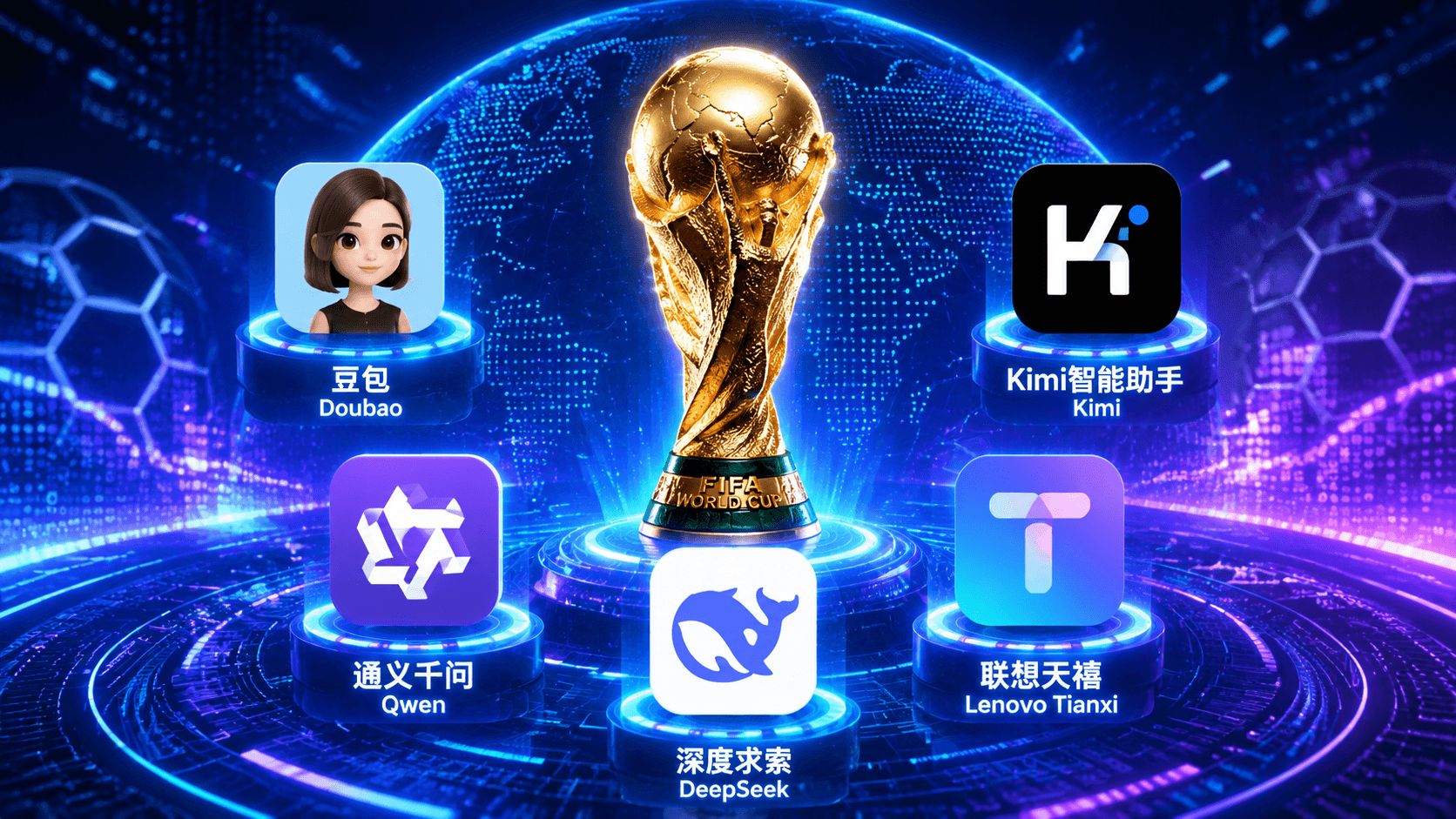
💡See how 5 top Chinese LLMs handle creative reasoning and persona-based forecasting in a head-to-head comparison.
⚡ 30-Second TL;DR
What Changed
Five models (Doubao, Qwen, DeepSeek, Kimi, Lenovo Tianxi) tested predictive reasoning.
Why It Matters
This experiment demonstrates how LLMs can be tuned for specific personas in predictive tasks. It provides insights into the creative and analytical variance between major Chinese LLMs.
What To Do Next
Experiment with system prompts to define specific personas for your LLM to see how it impacts the reasoning quality of your specific use case.
Key Points
- •Five models (Doubao, Qwen, DeepSeek, Kimi, Lenovo Tianxi) tested predictive reasoning.
- •Models were assigned distinct 'fan personalities' to influence output style.
- •The experiment highlights differences in how LLMs process data versus creative roleplay.
🧠 Deep Insight
Background and context from public sources — not the original article. 33 sources cited.
🔑 Enhanced Key Takeaways
- •The experiment's use of 'fan personalities' aligns with advanced research into LLM persona simulation, which explores conditioning models to express specific personality traits for user modeling, role-playing, and socio-empathic behavior evaluation, though studies also highlight potential biases in such simulations.
- •Doubao, developed by ByteDance, has emerged as a dominant AI assistant in China, with over 159 million monthly active users by November 2024, and operates internationally as 'Cici,' supporting 18 languages and offering multimodal capabilities including text, image, audio, and video processing.
- •DeepSeek-V2 is an open-source Mixture-of-Experts (MoE) language model with 236 billion total parameters, activating only 21 billion per token for efficient inference, and incorporates innovative architectures like Multi-head Latent Attention (MLA) and DeepSeekMoE to optimize training costs and throughput.
- •Kimi, from Moonshot AI, is notable for its industry-leading long context window, supporting up to 2 million Chinese characters, and its K2.5 version, released in January 2026, introduced 'Agent Swarm' technology for coordinating up to 100 specialized AI agents simultaneously.
- •Lenovo's Tianxi AI assistant is positioned as a 'Personal AI Super Agent' integrated across its ecosystem of AI PCs, mobile phones, tablets, and AIoT devices, focusing on multimodal perception, intent-driven interaction, personalized knowledge bases, and autonomous task execution.
📊 Competitor Analysis▸ Show
| Feature/Aspect | Doubao (ByteDance) | Qwen (Alibaba Cloud) | DeepSeek (DeepSeek AI) | Kimi (Moonshot AI) | Lenovo Tianxi (Lenovo) |
|---|---|---|---|---|---|
| Model Type | Proprietary LLM, Multimodal | Family of LLMs & MLLMs (Open-source & Commercial) | Mixture-of-Experts (MoE) LLM (Open-source) | LLM, Multimodal, Agentic | Personal AI Super Agent (Device-integrated) |
| Key Capabilities | NLP, content generation, image creation, multimodal understanding, code generation, real-time search, voice-to-video chat. | NLP, text generation, vision/audio understanding, tool use, role play, agent capabilities, coding, math. | Logical reasoning, mathematical problem-solving, code generation, creative writing, Chinese language processing. | Ultra-long context, Chinese excellence, document processing, real-time web access, Agent Swarm. | Multimodal perception, intent-driven interaction, personalized knowledge base, autonomous actions, continuous learning. |
| Context Window | Up to 256K tokens (Doubao Pro 256K). | Up to 1M tokens (Qwen2.5-1M). | 128K tokens (DeepSeek-V2). | Up to 2,000,000 Chinese characters (Kimi Chat). | Contextual awareness across devices. |
| Architecture | Proprietary ByteDance AI models, transformer-based. | Transformer-based, RoPE, GQA, SwiGLU, RMSNorm, MoE in Qwen3. | MoE (236B total, 21B active), Multi-head Latent Attention (MLA), DeepSeekMoE. | 1 trillion parameters (K2.5), 32B active, trained on 15T mixed visual/textual tokens. | Proprietary Lenovo AI Agent Core/Development Framework. |
| Market Position | China's most popular AI chatbot (159M MAU Nov 2024), 2nd largest generative AI globally. | Leading market share in Chinese enterprise LLM usage (17.7% H1 2025). | Significant global market share surge (3% to 13% in 2 months). | Strong performer in coding benchmarks, #1 open-source LLM on LMSYS Arena (Kimi K2). | Integrated into Lenovo AI PCs, mobile phones, tablets, AIoT devices. |
| Open-source Status | Some open-source variants (e.g., Seed-OSS 36B). | Many models under Apache 2.0 or Qwen License. | Open-source strategy, code, tools, and design publicly available. | Kimi K2 is open-weight. | Proprietary system integrated into hardware. |
| Pricing (API) | Doubao Lite 32K: $0.044/1M input tokens. | Qwen-VL-Max: US$0.41 per million input tokens. | Chinese models are 1/6 to 1/4 the cost of US rivals (general statement). | Kimi K2.5: $0.60/1M input tokens, $2.50/1M output tokens. | Not directly applicable (device-integrated). |
🛠️ Technical Deep Dive
- Doubao (ByteDance): Powered by proprietary large language models with multimodal capabilities. Utilizes diverse training data including text, images, code, and multilingual content. Features advanced memory systems for maintaining conversation context and integrated systems for processing text, images, audio, and video. Employs built-in content filtering and safety measures, along with advanced prompt engineering and fine-tuning techniques.
- Qwen (Alibaba Cloud): Built on transformer-based architecture with innovations in attention mechanisms, training methodologies, and multilingual capabilities. Early models extended LLaMA-like Transformer architectures with rotary positional encoding (RoPE), grouped query attention (GQA), SwiGLU activation, and pre-norm RMSNorm. Qwen2 introduced aggressive scaling (up to 18T pretraining tokens) and advanced post-training alignment (DPO/GRPO). Qwen3 models reintroduce Mixture-of-Experts (MoE) architectures and adopt hybrid thinking modes ('Thinking' and 'Non-Thinking') for flexible control over reasoning performance, speed, and costs.
- DeepSeek-V2 (DeepSeek AI): A Mixture-of-Experts (MoE) model with 236 billion total parameters, activating 21 billion for each token. Features innovative architectures: Multi-head Latent Attention (MLA) for efficient inference by compressing the Key-Value (KV) cache into a latent vector, and DeepSeekMoE for economical training through sparse computation. Pretrained on an 8.1 trillion token corpus, followed by Supervised Fine-Tuning (SFT) and Reinforcement Learning (RL).
- Kimi (Moonshot AI): First version (2023) supported 128,000 tokens of context. Kimi K2.5 (January 2026) is a 1 trillion parameter Mixture-of-Experts model with 32 billion active parameters, trained on 15 trillion tokens that mixed visual and textual data from the start. Operates through four modes: Instant, Thinking, Agent (for autonomous workflows with 200-300 tool calls), and Agent Swarm (for coordinating 100 parallel agents simultaneously).
- Lenovo Tianxi (Lenovo): A personal AI Super Agent with three core independently developed technologies: 'perception and interaction' (multimodal perception, intent-driven natural interaction), 'cognition and decision-making' (leverages personalized knowledge base from cross-device data), and 'autonomy and evolution' (breaks down complex tasks, plans steps, and executes them proactively). Designed for cloud-edge collaboration and seamless integration across AI PCs, mobile phones, tablets, and AIoT devices.
🔮 Future ImplicationsAI analysis grounded in cited sources
⏳ Timeline
📎 Sources (33)
Factual claims are grounded in the sources below. Forward-looking analysis is AI-generated interpretation.
- emergentmind.com
- openreview.net
- harvard.edu
- stanford.edu
- neurips.cc
- aixsociety.com
- howaiworks.ai
- clawbot.ai
- arxiv.org
- substack.com
- nvidia.com
- arxiv.org
- github.com
- wikipedia.org
- llm-bento.com
- codecademy.com
- lenovo.com
- 36kr.com
- moomoo.com
- lenovo.com
- chinadaily.com.cn
- galileo.ai
- emergentmind.com
- alibabacloud.com
- readthedocs.io
- ourchinastory.com
- llmreference.com
- globaltimes.cn
- rand.org
- wikipedia.org
- intuitionlabs.ai
- newmr.org
- scmp.com
Weekly AI Recap
Read this week's curated digest of top AI events →
👉Related Updates

AI-curated news aggregator. All content rights belong to original publishers.
Original source: Pandaily ↗
This is a summary, not the original. Read the source, or get the weekly briefing.
The weekly digest
One email a week. Unsubscribe anytime.