China's Tianwen-2 Probe Reaches Asteroid 2016 HO3
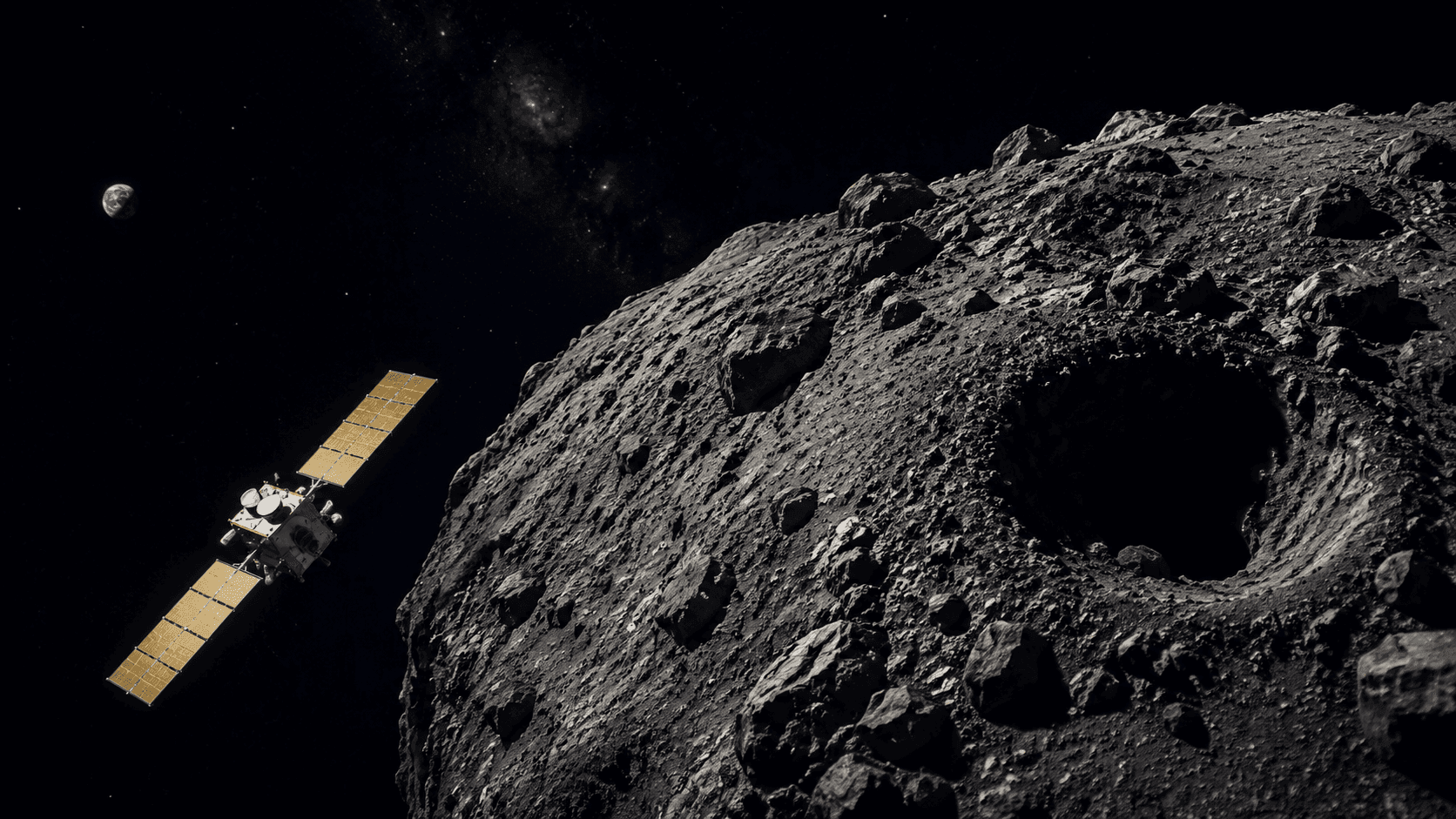
💡See how autonomous navigation systems handle long-duration, high-stakes deep space missions.
⚡ 30-Second TL;DR
What Changed
Successfully reached asteroid 2016 HO3 after 1 billion kilometers
Why It Matters
This mission demonstrates advanced autonomous navigation and deep space robotics capabilities, which are critical for future AI-driven planetary exploration.
What To Do Next
Review the autonomous navigation algorithms used in deep space probes to understand real-time obstacle avoidance in extreme environments.
Key Points
- •Successfully reached asteroid 2016 HO3 after 1 billion kilometers
- •Mission duration spanned 400 days of deep space navigation
- •Primary objectives include scientific exploration and sample return
🧠 Deep Insight
AI-generated analysis for this event — not the original article.
🔑 Enhanced Key Takeaways
- •The mission targets 2016 HO3 (also known as Kamoʻoalewa), a quasi-satellite of Earth, to conduct a multi-year proximity operation.
- •Tianwen-2 utilizes a unique 'touch-and-go' sampling mechanism designed to collect regolith from the asteroid's surface using a robotic arm and anchoring system.
- •The spacecraft is equipped with a suite of remote sensing instruments, including multispectral cameras and a laser altimeter, to map the asteroid's composition and structure.
- •Following the asteroid mission, the probe is planned to perform a gravity-assist maneuver to travel toward a second target, the main-belt comet 311P/PANSTARRS.
- •The mission serves as a critical testbed for China's deep-space autonomous navigation and precision landing technologies required for future crewed planetary exploration.
📊 Competitor Analysis▸ Show
| Feature | Tianwen-2 (China) | OSIRIS-REx (USA) | Hayabusa2 (Japan) |
|---|---|---|---|
| Target | 2016 HO3 / 311P | Bennu | Ryugu |
| Primary Goal | Sample Return | Sample Return | Sample Return |
| Status | Active (2026) | Completed (2023) | Completed (2020) |
| Key Tech | Dual-target mission | Touch-and-go | Impactor/Sampling |
🛠️ Technical Deep Dive
- Propulsion: Employs a combination of chemical thrusters for major maneuvers and high-efficiency ion engines for deep-space cruise phases.
- Sampling Mechanism: Features a dual-mode collection system capable of both surface contact sampling and potential subsurface drilling.
- Navigation: Utilizes autonomous optical navigation (OpNav) to maintain proximity to the asteroid, compensating for the significant light-speed delay between Earth and the target.
- Power: Equipped with high-efficiency flexible solar arrays designed to maintain power generation at varying distances from the Sun during the multi-target mission profile.
🔮 Future ImplicationsAI analysis grounded in cited sources
⏳ Timeline
Weekly AI Recap
Read this week's curated digest of top AI events →
👉Related Updates
AI-curated news aggregator. All content rights belong to original publishers.
Original source: Pandaily ↗
This is a summary, not the original. Read the source, or get the weekly briefing.
Weekly AI briefing
One email a week. Unsubscribe anytime.