China’s shift to AI-defined vehicles for personalized driving
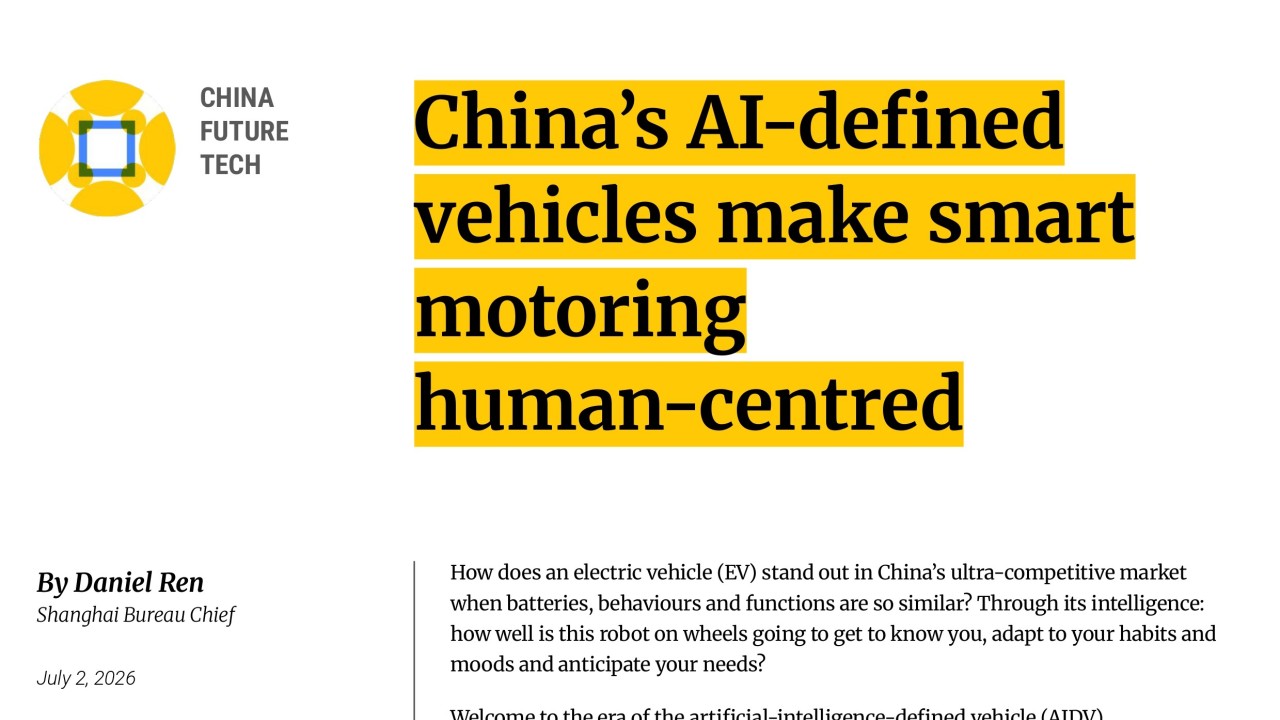
💡Understand how Chinese EV makers are using AI to move beyond software-defined features into personalized robotics.
⚡ 30-Second TL;DR
What Changed
Transition from software-defined to AI-defined vehicle (AIDV) architecture.
Why It Matters
The rise of AIDVs signals a shift in automotive R&D toward edge AI and affective computing. Manufacturers must now prioritize deep integration of LLMs and sensor fusion to maintain competitive advantages.
What To Do Next
Explore edge-based affective computing frameworks to implement driver-state monitoring and adaptive cabin environments.
Key Points
- •Transition from software-defined to AI-defined vehicle (AIDV) architecture.
- •Focus on human-centric features that anticipate driver moods and habits.
- •Differentiation strategy for Chinese EV manufacturers in a commoditized market.
🧠 Deep Insight
AI-generated analysis for this event — not the original article.
🔑 Enhanced Key Takeaways
- •Chinese manufacturers are increasingly integrating Large Multimodal Models (LMMs) directly into vehicle cockpits to process real-time sensor data for emotional recognition.
- •The shift to AIDVs is being driven by the adoption of centralized E/E (Electrical/Electronic) architectures that decouple hardware from AI-driven software layers.
- •Regulatory bodies in China have begun drafting specific safety standards for 'AI-agent' driving assistants to govern how vehicles handle autonomous decision-making based on user behavioral data.
- •Leading Chinese EV firms are shifting R&D investment from traditional ADAS (Advanced Driver Assistance Systems) toward end-to-end neural network models that mimic human driving patterns.
- •The transition is heavily supported by domestic semiconductor advancements, specifically the mass production of high-TOPS AI chips designed to run local LLMs without relying on cloud latency.
📊 Competitor Analysis▸ Show
| Feature | Chinese AIDV (e.g., NIO/XPeng) | Tesla (FSD/AI) | Legacy Auto (Traditional) |
|---|---|---|---|
| AI Architecture | End-to-End Neural Networks | End-to-End Neural Networks | Modular/Rule-based |
| Personalization | High (Mood/Habit Adaptation) | Moderate (Driving Profile) | Low (Static Settings) |
| Compute Strategy | Localized Edge AI + Cloud | Cloud-heavy Training | Limited On-board AI |
| Market Focus | Human-Centric Experience | Autonomous Driving Focus | Hardware Performance |
🛠️ Technical Deep Dive
- Implementation of Transformer-based architectures within the vehicle's cockpit domain controller to enable real-time natural language interaction and intent prediction.
- Utilization of high-bandwidth, low-latency vehicle Ethernet (10Gbps+) to facilitate the massive data throughput required for AI-defined sensor fusion.
- Deployment of Vector Space perception models that allow the vehicle to interpret complex urban environments without relying solely on high-definition maps.
- Integration of NPU (Neural Processing Unit) clusters capable of exceeding 500+ TOPS to support on-device inference for generative AI features.
🔮 Future ImplicationsAI analysis grounded in cited sources
⏳ Timeline
Weekly AI Recap
Read this week's curated digest of top AI events →
👉Related Updates
AI-curated news aggregator. All content rights belong to original publishers.
Original source: SCMP Technology ↗
This is a summary, not the original. Read the source, or get the weekly briefing.
Weekly AI briefing
One email a week. Unsubscribe anytime.