China’s Robot IPO Wave Faces a Valuation Test
Unitree’s RMB 61 billion valuation forces every embodied-AI startup to prove what its revenue and models are truly worth
30-Second TL;DR
What Changed
Unitree launched its online subscription at RMB 150.80 per share, implying a market capitalization of about RMB 60.99 billion.
Why It Matters
For robotics founders and AI investors, the article suggests that the “embodied intelligence” label will not support uniform valuations. Companies must clearly separate mature hardware revenue from speculative model value and prove that AI improves unit economics or repeatable deployments.
What To Do Next
Build an investor-ready unit-economics dashboard that separates hardware revenue from AI revenue and tracks deployment success, inference or operation costs, customer retention, and repeat orders.
Key Points
- •Unitree launched its online subscription at RMB 150.80 per share, implying a market capitalization of about RMB 60.99 billion.
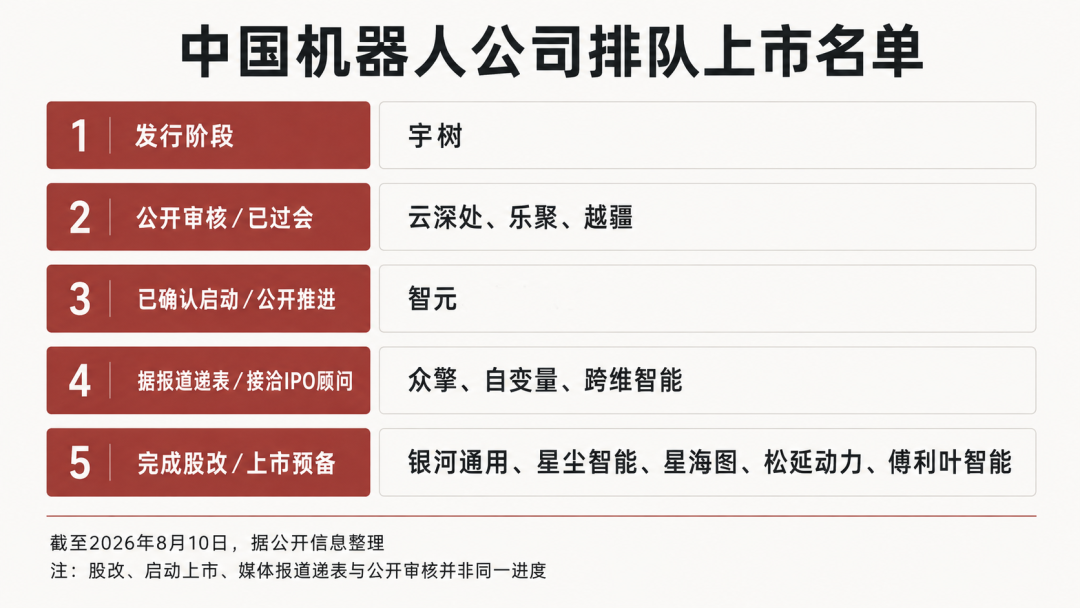
- •The emerging IPO pipeline includes Deep Robotics, Leju Robot, DOBOT, AgiBot, Booster Robotics, Kepler, and others at different filing stages.
- •Unitree combines scale revenue, positive cash flow, profitability, and humanoid-robot growth expectations, giving it both a financial floor and an AI upside narrative.
- •Deep Robotics and DOBOT have clearer valuation floors from quadruped inspection and collaborative-robot businesses, while their humanoid operations remain relatively small.
- •Public investors are likely to demand evidence that models and data reduce deployment costs, increase sales, or generate recurring customer payments.
Deep Insight
AI-generated analysis for this event — not the original article.
Enhanced Key Takeaways
- •Unitree's IPO strategy is heavily influenced by the 'AI-native' hardware trend, where the company is positioning its G1 and H1 humanoid platforms as data-collection engines for embodied AI foundation models.
- •Chinese regulatory bodies have recently tightened scrutiny on robotics IPOs, requiring companies to demonstrate 'hard technology' (hard tech) self-sufficiency and supply chain resilience amidst ongoing semiconductor export restrictions.
- •The valuation of RMB 61 billion reflects a shift in investor sentiment from pure hardware manufacturing multiples to software-as-a-service (SaaS) style recurring revenue potential derived from robot fleet management and remote operation software.
- •Unitree has successfully leveraged a dual-track business model, using high-volume, lower-margin consumer quadruped sales to subsidize the R&D costs of high-margin, enterprise-grade humanoid robotics.
- •Market analysts note that the 'valuation test' is exacerbated by a cooling venture capital environment in China, forcing robotics firms to seek public liquidity earlier than historical norms for deep-tech startups.
Competitor Analysis
- Unitree (H1/G1)
- Humanoid/Quadruped
- Deep Robotics (X30)
- Industrial Quadruped
- AgiBot (Expedition)
- Humanoid AI
- DOBOT (CR Series)
- Collaborative Arms
- Unitree (H1/G1)
- High (Consumer/Ent)
- Deep Robotics (X30)
- High (Industrial)
- AgiBot (Expedition)
- Emerging (R&D)
- DOBOT (CR Series)
- Mature (Industrial)
- Unitree (H1/G1)
- Cost-to-Performance
- Deep Robotics (X30)
- Rugged Inspection
- AgiBot (Expedition)
- Foundation Model Integration
- DOBOT (CR Series)
- Precision/Payload
| Feature | Unitree (H1/G1) | Deep Robotics (X30) | AgiBot (Expedition) | DOBOT (CR Series) |
|---|---|---|---|---|
| Primary Focus | Humanoid/Quadruped | Industrial Quadruped | Humanoid AI | Collaborative Arms |
| Market Maturity | High (Consumer/Ent) | High (Industrial) | Emerging (R&D) | Mature (Industrial) |
| Key Differentiator | Cost-to-Performance | Rugged Inspection | Foundation Model Integration | Precision/Payload |
Technical Deep Dive
- Unitree H1/G1 Architecture: Utilizes proprietary joint actuators with high torque density, integrated with a real-time operating system optimized for low-latency gait control.
- Embodied AI Integration: Employs transformer-based architectures for end-to-end motor control, allowing robots to learn complex manipulation tasks from human demonstration data.
- Sensor Fusion: Combines 3D LiDAR, depth cameras, and IMU data processed via onboard edge computing modules to enable autonomous navigation in unstructured environments.
- Modular Design: Hardware utilizes a standardized communication protocol, facilitating rapid swapping of end-effectors and sensor payloads for different industrial use cases.
Future ImplicationsAI analysis grounded in cited sources
Timeline
- 2017-08Unitree Robotics is founded by Wang Xingxing, focusing initially on quadruped locomotion.
- 2021-06Launch of the Go1 quadruped, marking the company's entry into the consumer robotics market.
- 2023-12Official release of the H1 humanoid robot, signaling a strategic pivot toward general-purpose robotics.
- 2024-05Introduction of the G1 humanoid agent, designed for mass production and AI-model training.
Weekly AI Recap
Read this week's curated digest of top AI events →
AI-curated news aggregator. All content rights belong to original publishers.
Original source: 虎嗅 ↗
This is a summary, not the original. Read the source, or get the weekly briefing.
The weekly digest
One email a week. Unsubscribe anytime.