China’s new outbound investment rules and AI translation
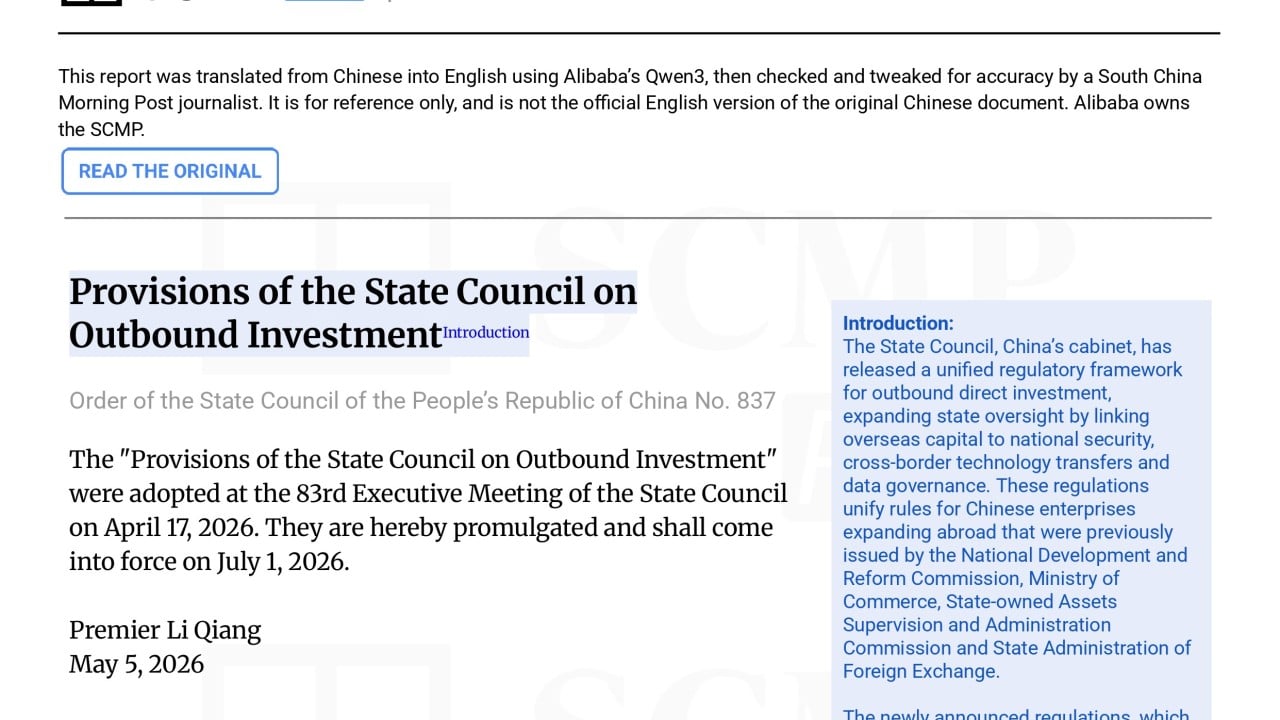
💡See how major media outlets are integrating Alibaba's Qwen3 for professional-grade regulatory translation.
⚡ 30-Second TL;DR
What Changed
SCMP utilized Alibaba's Qwen3 model for translation of regulatory documents.
Why It Matters
Demonstrates the increasing integration of LLMs like Qwen3 into professional news workflows for cross-lingual regulatory reporting.
What To Do Next
Evaluate Qwen3's performance on domain-specific regulatory texts compared to GPT-4o or Claude 3.5 Sonnet for your own localization workflows.
Key Points
- •SCMP utilized Alibaba's Qwen3 model for translation of regulatory documents.
- •The report focuses on the latest updates to China's outbound investment rules.
- •The translation was verified by SCMP journalists for accuracy.
🧠 Deep Insight
Background and context from public sources — not the original article. 27 sources cited.
🔑 Enhanced Key Takeaways
- •China's new outbound investment regulations, effective July 1, 2026, introduce a national security review mechanism and prohibit the unauthorized transfer of controlled technologies, services, or data through overseas investments, including via personnel deployment or training.
- •Alibaba's Qwen3 model series, used for the translation, features both dense and Mixture-of-Expert (MoE) architectures with parameter scales up to 235 billion, and supports a 'thinking mode' for complex reasoning alongside a 'non-thinking mode' for rapid responses, dynamically switching between them.
- •The Qwen3 series significantly expands multilingual support to 119 languages and dialects, having been pre-trained on over 30 trillion tokens, enhancing its cross-lingual understanding and generation capabilities for diverse global applications.
- •Beyond general translation, Alibaba has developed specialized Qwen3 variants like Qwen3-Coder for agentic AI coding and Qwen-MT for high-quality machine translation across 92 major languages, indicating a broader strategic focus on domain-specific AI applications.
- •The new Chinese regulations also empower the government to implement countermeasures against foreign entities that impose discriminatory investment barriers or sever business ties with Chinese firms, potentially including restrictions on trade, investment, and personnel entry.
📊 Competitor Analysis▸ Show
While the article specifically mentions SCMP using Qwen3 for regulatory document translation, the broader market for AI translation includes several major players. For general-purpose translation, Google Translate and DeepL are prominent. For enterprise and specialized (e.g., legal/regulatory) translation, solutions often combine AI with human expertise, focusing on accuracy, compliance, and terminology management.
| Feature/Model | Alibaba Qwen3 (Translation) | Google Translate / Cloud AutoML Translation | DeepL | Microsoft Azure AI Translator | Specialized Legal/Regulatory AI (e.g., Sonix, AppTek, TRADOS) |
|---|---|---|---|---|---|
| Core Technology | Transformer-based LLM (dense & MoE), multimodal variants | Neural Machine Translation (NMT), custom models via AutoML | NMT, focus on nuance and fluency | NMT, latest innovations in machine translation | NMT/Generative AI, specialized models trained on legal/regulatory data |
| Languages Supported | 119+ languages/dialects (Qwen3), 60 input/29 speech output (LiveTranslate-Flash), 92 major languages (Qwen-MT) | 50+ language pairs (AutoML), 100+ languages (Translate) | 30+ languages | 100+ languages | Varies, often 40-50+ with domain-specific focus |
| Key Strengths | High performance, efficiency, multilingual, thinking/non-thinking modes, agentic capabilities, real-time multimodal translation with voice cloning | Broad language coverage, widely accessible, custom model training | High quality, natural-sounding translations, especially for European languages | Real-time document/text translation, custom models, secure environment | High accuracy for specialized terminology, context awareness, compliance features, human QA integration |
| Use Cases | General text, code, complex reasoning, real-time interpretation, journalistic translation of regulatory documents | General translation, website localization, analytical purposes | Professional and personal use, document translation | Call centers, multilingual agents, in-app communication, document translation | Legal documents, contracts, regulatory filings, compliance checks, cross-border due diligence |
| Pricing | Qwen3.7 Max: $2.50/$7.50 per 1M input/output tokens (competitive with Claude Opus 4.7) | Varies by API usage, custom models, etc. | Tiered subscriptions, API usage | Pay-as-you-go, custom models | Custom quotes, enterprise licensing |
| Open-Source Status | Many Qwen3 models are Apache 2.0 licensed; some newer versions (e.g., Qwen3.7 Max, Qwen3.5-Omni) are proprietary. | Proprietary (though some underlying research is open) | Proprietary | Proprietary | Varies, often proprietary with API access or enterprise solutions |
🛠️ Technical Deep Dive
- Architecture: The Qwen3 series includes both dense and Mixture-of-Expert (MoE) models. The dense models are similar to Qwen2.5, utilizing Grouped Query Attention (GQA), SwiGLU activation, Rotary Positional Embeddings (RoPE), and RMSNorm with pre-normalization.
- Parameter Scale: Models range from 0.6 billion to 235 billion parameters. The flagship MoE model, Qwen3-235B-A22B, has 235 billion total parameters with 22 billion activated per token, ensuring high performance and efficient inference.
- Dual-Mode Reasoning: A key innovation is the integration of a 'thinking mode' for complex, multi-step reasoning and a 'non-thinking mode' for rapid, context-driven responses within a unified framework, allowing dynamic switching based on user queries.
- Multilingual Support: Qwen3 expands support to 119 languages and dialects, significantly enhancing cross-lingual understanding and generation.
- Training Data: Models are pre-trained on over 30 trillion tokens, with a sequence length of 4,096 tokens in the general stage. The reasoning stage optimizes the corpus with increased STEM, coding, reasoning, and synthetic data.
- Context Window: Qwen3 models offer enhanced 256K long-context understanding capabilities, extendable up to 1 million tokens, crucial for processing extensive documents.
- Tokenizer: The Qwen3 tokenizer uses a Byte Pair Encoding (BPE) approach with a vocabulary size of 151,646 tokens, supporting 119 languages and including special instruction tokens.
- Real-time Multimodal Translation (Qwen3.5-LiveTranslate-Flash): This model processes audio and video frames simultaneously, performs real-time voice cloning to replicate the original speaker's voice, and uses semantic unit prediction to reduce latency to 2.8 seconds for real-time interpretation.
🔮 Future ImplicationsAI analysis grounded in cited sources
⏳ Timeline
📎 Sources (27)
Factual claims are grounded in the sources below. Forward-looking analysis is AI-generated interpretation.
- geopolitechs.org
- morningstar.com
- aa.com.tr
- arxiv.org
- qwen3-next.com
- medium.com
- github.com
- datasciencedojo.com
- alibabagroup.com
- globaltimes.cn
- slator.com
- marktechpost.com
- slashdot.org
- sourceforge.net
- sonix.ai
- reddit.com
- aimagazine.com
- adverbum.com
- firmadapt.com
- uslegalsupport.com
- digitalapplied.com
- wikipedia.org
- huggingface.co
- pudaily.com
- chinadailyasia.com
- cctv.com
- www.gov.cn
Weekly AI Recap
Read this week's curated digest of top AI events →
👉Related Updates
AI-curated news aggregator. All content rights belong to original publishers.
Original source: SCMP Technology ↗
This is a summary, not the original. Read the source, or get the weekly briefing.
The weekly digest
One email a week. Unsubscribe anytime.