China's L3 Rules Raise the Bar for Sensor Fusion
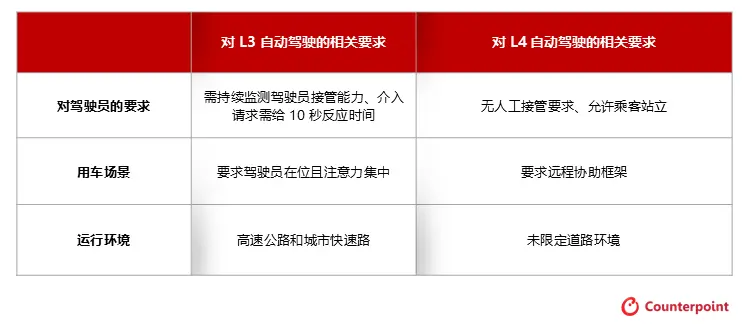
China's L3 rules may reshape sensor stacks and challenge camera-only autonomous-driving systems.
30-Second TL;DR
What Changed
GB 44721—2026 was published on July 30 as a mandatory national standard.
Why It Matters
The standard could materially influence sensor architectures, validation plans, and market-entry strategies for autonomous-driving companies in China. Teams pursuing camera-only systems may need to reassess their compliance evidence, redundancy design, and hardware roadmaps.
What To Do Next
Map your autonomous-driving stack against GB 44721—2026's multisensor-fusion requirements and identify any missing sensing or validation components before the 2027 deadline.
Key Points
- •GB 44721—2026 was published on July 30 as a mandatory national standard.
- •The standard applies to safety requirements for intelligent connected vehicle autonomous driving systems.
- •It becomes effective on July 1, 2027.
- •Counterpoint Research says multisensor fusion is a compliance prerequisite, challenging pure-vision strategies.
Deep Insight
AI-generated analysis for this event — not the original article.
Enhanced Key Takeaways
- •GB 44721—2026 mandates specific redundancy requirements for perception systems, effectively requiring at least two independent sensing modalities to ensure fail-safe operation in L3 scenarios.
- •The standard introduces strict 'Dynamic Driving Task' (DDT) fallback performance metrics, requiring vehicles to achieve a 'minimal risk condition' within a specified timeframe if the primary system fails.
- •Industry analysts suggest the regulation is designed to curb the rapid deployment of camera-only systems by domestic EV startups that prioritize cost-reduction over hardware redundancy.
- •The standard mandates that autonomous driving data must be stored in a secure, tamper-proof format compatible with China's national intelligent connected vehicle monitoring platforms.
- •Compliance testing will involve standardized 'corner case' scenarios, including adverse weather and low-visibility conditions, which are historically difficult for pure-vision systems to navigate without LiDAR or radar support.
Competitor Analysis
- Pure-Vision Approach (e.g., Tesla FSD)
- Cameras Only
- Multi-Sensor Fusion Approach (e.g., Huawei ADS, XPeng XNGP)
- LiDAR + Radar + Cameras
- Pure-Vision Approach (e.g., Tesla FSD)
- Software-based/Algorithmic
- Multi-Sensor Fusion Approach (e.g., Huawei ADS, XPeng XNGP)
- Hardware-based (Independent)
- Pure-Vision Approach (e.g., Tesla FSD)
- High Risk (Requires architectural shift)
- Multi-Sensor Fusion Approach (e.g., Huawei ADS, XPeng XNGP)
- Native Compliance
- Pure-Vision Approach (e.g., Tesla FSD)
- Lower (Hardware-light)
- Multi-Sensor Fusion Approach (e.g., Huawei ADS, XPeng XNGP)
- Higher (Sensor-heavy)
| Feature | Pure-Vision Approach (e.g., Tesla FSD) | Multi-Sensor Fusion Approach (e.g., Huawei ADS, XPeng XNGP) |
|---|---|---|
| Primary Sensors | Cameras Only | LiDAR + Radar + Cameras |
| Redundancy | Software-based/Algorithmic | Hardware-based (Independent) |
| GB 44721 Compliance | High Risk (Requires architectural shift) | Native Compliance |
| Cost Structure | Lower (Hardware-light) | Higher (Sensor-heavy) |
Technical Deep Dive
- Perception Architecture: The standard necessitates a 'Heterogeneous Redundancy' model where perception data from different physical principles (e.g., optical vs. electromagnetic) must be fused at the feature or object level.
- Fail-Safe Logic: Systems must implement a 'Heartbeat' monitoring mechanism between the primary autonomous driving controller and a secondary safety controller.
- Latency Requirements: Perception-to-actuation latency for emergency maneuvers is capped at a strict threshold to ensure safety during high-speed L3 operation.
- Data Integrity: Requires the integration of a hardware security module (HSM) to sign and encrypt sensor data streams, preventing injection attacks or data manipulation.
Future ImplicationsAI analysis grounded in cited sources
Timeline
- 2023-11Ministry of Industry and Information Technology (MIIT) releases pilot notice for L3 autonomous driving road tests.
- 2024-06MIIT and four other departments announce the first batch of intelligent connected vehicle 'access and road test' pilot companies.
- 2026-07GB 44721—2026 is officially published as a mandatory national standard for intelligent connected vehicle safety.
Weekly AI Recap
Read this week's curated digest of top AI events →
Related Updates


AI-curated news aggregator. All content rights belong to original publishers.
Original source: cnBeta (Full RSS) ↗
This is a summary, not the original. Read the source, or get the weekly briefing.
The weekly digest
One email a week. Unsubscribe anytime.