China's Humanoids Accelerate to Commercialization
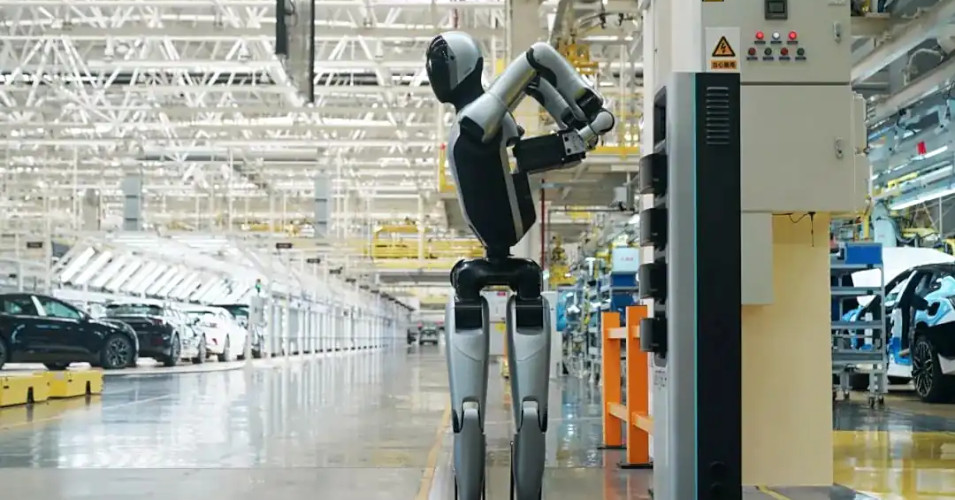
💡China's humanoids hit commercialization via robot-friendly factories—key for embodied AI race
⚡ 30-Second TL;DR
What Changed
Chinese humanoids entering commercialization phase
Why It Matters
China's fast humanoid rollout challenges global competitors in embodied AI. Emphasizes practical deployment over lab perfection, potentially lowering barriers for adoption.
What To Do Next
Assess your sites for robot-friendliness to accelerate embodied AI pilots.
Key Points
- •Chinese humanoids entering commercialization phase
- •Field trial-and-error accumulates real-world data
- •Robot-friendly sites enable rapid implementation
🧠 Deep Insight
AI-generated analysis for this event — not the original article.
🔑 Enhanced Key Takeaways
- •Chinese humanoid manufacturers are increasingly utilizing 'digital twin' simulation environments to train reinforcement learning models before deploying to physical factory floors, significantly reducing the hardware wear-and-tear during the initial learning phase.
- •The Chinese government has integrated humanoid robot development into its 'New Productive Forces' economic policy, providing direct subsidies and tax incentives to companies that achieve specific localization rates for core components like harmonic drives and sensors.
- •A major shift in the supply chain is the rapid vertical integration of actuator production, with leading Chinese humanoid firms now manufacturing their own high-torque density motors to bypass reliance on traditional Japanese and European suppliers.
📊 Competitor Analysis▸ Show
| Feature | Chinese Humanoids (e.g., Unitree, Fourier) | Tesla Optimus | Figure AI | Boston Dynamics (Atlas) |
|---|---|---|---|---|
| Primary Focus | Industrial/Manufacturing | Mass Production/Consumer | General Purpose/Logistics | R&D/Complex Mobility |
| Pricing Strategy | Aggressive (Targeting <$20k) | Target <$20k | Premium/Enterprise | High-end/Custom |
| Key Benchmark | Rapid iteration/Cost-efficiency | Scale/AI Integration | Foundation Model/Dexterity | Hardware Durability/Agility |
🛠️ Technical Deep Dive
- Actuator Architecture: Adoption of quasi-direct drive (QDD) actuators to achieve high back-drivability and force control, essential for safe human-robot interaction.
- Control Systems: Transition from traditional PID control to Whole-Body Control (WBC) frameworks combined with Transformer-based policy models for complex manipulation tasks.
- Sensor Fusion: Integration of multi-modal sensing including depth cameras, LiDAR, and tactile skin sensors to enable object recognition and precise grasping in unstructured environments.
- Compute: Utilization of high-performance edge computing modules (often based on NVIDIA Jetson or custom RISC-V architectures) to handle real-time inference for locomotion and vision.
🔮 Future ImplicationsAI analysis grounded in cited sources
⏳ Timeline
Weekly AI Recap
Read this week's curated digest of top AI events →
👉Related Updates
AI-curated news aggregator. All content rights belong to original publishers.
Original source: ITmedia AI+ (日本) ↗
This is a summary, not the original. Read the source, or get the weekly briefing.
The weekly digest
One email a week. Unsubscribe anytime.