China's Humanoid Robots Drive Export Boom
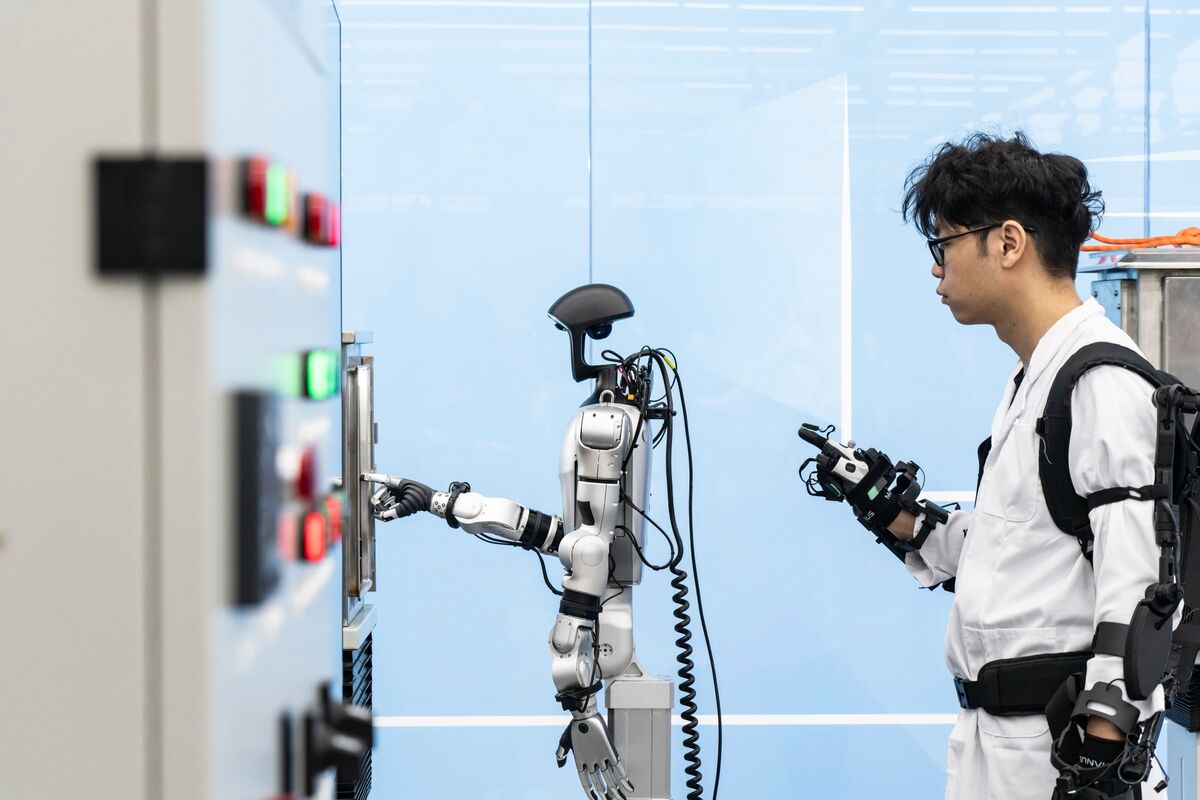
China's robot lead threatens West's manufacturing edge—key for AI hardware strategy
30-Second TL;DR
What Changed
China holds early lead in humanoid robot development
Why It Matters
Strengthens China's position in embodied AI, pressuring Western firms to accelerate robotics R&D. Could reshape global supply chains with cheaper robot exports.
What To Do Next
Review Morgan Stanley's humanoid robot report for market forecasts.
Key Points
- •China holds early lead in humanoid robot development
- •Morgan Stanley predicts export and manufacturing dominance boost
- •Humanoid robots key to next phase of China's global edge
- •Research focuses on robotics as export growth area
Deep Insight
AI-generated analysis for this event — not the original article.
Enhanced Key Takeaways
- •China's humanoid robot sector is heavily supported by local government subsidies and 'robotics industrial parks' in regions like Beijing and Shanghai, which provide infrastructure and tax incentives to accelerate commercialization.
- •The supply chain advantage is driven by the domestic production of core components such as harmonic drives, high-torque actuators, and specialized sensors, significantly lowering the bill of materials compared to Western counterparts.
- •Chinese humanoid developers are increasingly integrating large language models (LLMs) and multimodal AI to improve autonomous task planning and human-robot interaction, moving beyond pre-programmed movements.
Competitor Analysis
- Chinese Humanoid Robots (e.g., Unitree, UBTECH)
- Industrial automation, mass production, cost-efficiency
- US/Global Humanoid Robots (e.g., Tesla, Figure AI)
- General-purpose AI, complex reasoning, high-end autonomy
- Chinese Humanoid Robots (e.g., Unitree, UBTECH)
- Aggressive, targeting sub-$20k-$50k range
- US/Global Humanoid Robots (e.g., Tesla, Figure AI)
- Premium, targeting high-value industrial/service roles
- Chinese Humanoid Robots (e.g., Unitree, UBTECH)
- High degree of freedom (DoF) density, rapid iteration cycles
- US/Global Humanoid Robots (e.g., Tesla, Figure AI)
- Advanced neural network training, human-like dexterity
| Feature | Chinese Humanoid Robots (e.g., Unitree, UBTECH) | US/Global Humanoid Robots (e.g., Tesla, Figure AI) |
|---|---|---|
| Primary Focus | Industrial automation, mass production, cost-efficiency | General-purpose AI, complex reasoning, high-end autonomy |
| Pricing Strategy | Aggressive, targeting sub-$20k-$50k range | Premium, targeting high-value industrial/service roles |
| Key Benchmarks | High degree of freedom (DoF) density, rapid iteration cycles | Advanced neural network training, human-like dexterity |
Technical Deep Dive
- Actuation Systems: Heavy reliance on high-torque density brushless DC (BLDC) motors paired with custom-designed planetary or harmonic gearboxes to achieve high payload-to-weight ratios.
- Architecture: Transitioning from traditional control theory (PID/MPC) to end-to-end reinforcement learning (RL) models trained in high-fidelity simulation environments (e.g., NVIDIA Isaac Gym).
- Sensing: Integration of multi-modal sensor suites including solid-state LiDAR, depth cameras (RGB-D), and tactile skin sensors for force feedback and object manipulation.
- Compute: Utilization of domestic high-performance SoCs and AI accelerators to handle real-time inference for computer vision and motion planning on the edge.
Future ImplicationsAI analysis grounded in cited sources
Timeline
- 2023-11China's Ministry of Industry and Information Technology (MIIT) releases a national roadmap for humanoid robot development.
- 2024-05Beijing Humanoid Robot Innovation Center is established to standardize hardware and software interfaces.
- 2025-02Major Chinese manufacturers begin large-scale pilot deployments of humanoid robots in automotive assembly lines.
Weekly AI Recap
Read this week's curated digest of top AI events →
AI-curated news aggregator. All content rights belong to original publishers.
Original source: Bloomberg Technology ↗
This is a summary, not the original. Read the source, or get the weekly briefing.
The weekly digest
One email a week. Unsubscribe anytime.