🐯虎嗅•Freshcollected in 7m
China's H1 Economic Report: New Drivers Accelerate
#macro-economics#china-tech#industrial-upgradechina-macroeconomic-reportnational bureau of statistics
💡Understand the macro-economic shift toward high-tech and AI-driven sectors in China's latest economic report.
⚡ 30-Second TL;DR
What Changed
High-tech manufacturing and digital services are the primary engines of current economic growth.
Why It Matters
The shift toward high-tech and digital sectors suggests long-term opportunities for AI and automation-related investments in the Chinese market.
What To Do Next
Monitor high-tech manufacturing investment data to identify emerging sectors for AI-driven industrial upgrades.
Who should care:Enterprise & Security Teams
Key Points
- •High-tech manufacturing and digital services are the primary engines of current economic growth.
- •The economy is experiencing a 'K-shaped' divergence where new tech sectors outperform traditional real estate and consumption.
- •Policy focus is shifting toward 'new and superior' (向新向優) development, with increased emphasis on forward-looking monetary policy.
🧠 Deep Insight
AI-generated analysis for this event.
🔑 Enhanced Key Takeaways
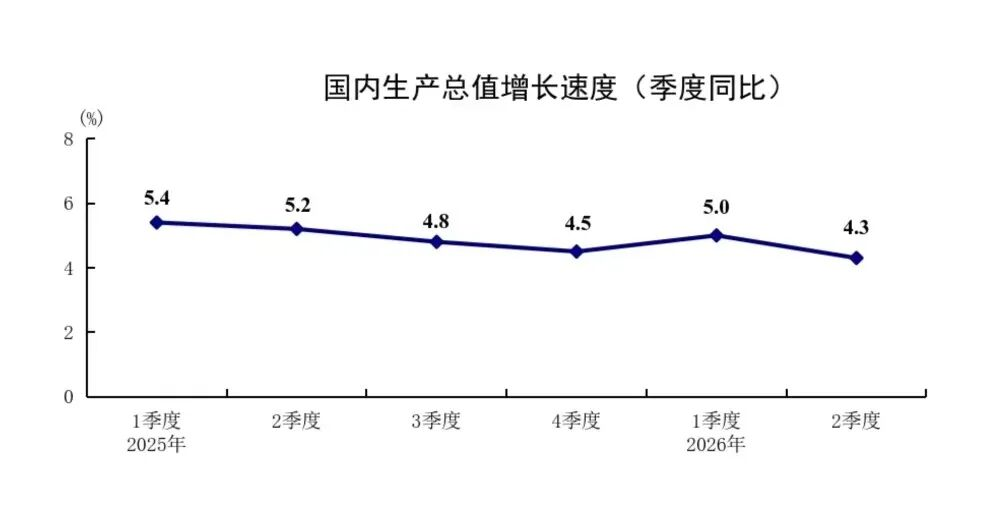
- •The 4.7% GDP growth rate in H1 2026 reflects a deceleration compared to the 5.0% target set during the 'Two Sessions' in March 2026, highlighting persistent challenges in domestic demand.
- •Investment in 'New Quality Productive Forces' (新質生產力) has surged by 12.4% year-on-year, specifically targeting breakthroughs in quantum computing, AI-driven materials science, and humanoid robotics.
- •Local government special bond issuance has been front-loaded to support infrastructure projects that integrate 6G testbeds and green energy grids, rather than traditional real estate development.
- •The 'K-shaped' divergence is exacerbated by a 15% contraction in traditional construction-related sectors, which has forced a massive labor reallocation program aimed at retraining workers for the digital services sector.
- •The People's Bank of China (PBOC) has transitioned to a 'structural monetary policy' framework, utilizing targeted relending facilities to lower financing costs for high-tech SMEs while maintaining a neutral stance on broad liquidity.
🔮 Future ImplicationsAI analysis grounded in cited sources
China will likely miss its annual 5% GDP growth target unless fiscal stimulus is significantly expanded in Q3 2026.
The H1 performance of 4.7% requires an acceleration in H2 that current consumption data does not support.
The 'K-shaped' economic structure will lead to permanent structural unemployment in legacy industrial hubs.
The rapid transition toward high-tech manufacturing creates a skills gap that cannot be bridged by short-term vocational training.
⏳ Timeline
2024-03
Introduction of 'New Quality Productive Forces' as a core economic policy pillar.
2025-12
Central Economic Work Conference prioritizes high-tech self-reliance over real estate stimulus.
2026-03
Government sets the 2026 annual GDP growth target at approximately 5%.
2026-06
PBOC implements targeted interest rate cuts for high-tech manufacturing sectors.
📰
Weekly AI Recap
Read this week's curated digest of top AI events →
👉Related Updates
AI-curated news aggregator. All content rights belong to original publishers.
Original source: 虎嗅 ↗