China's Commercial Space Sector Shifts Toward Mass Production
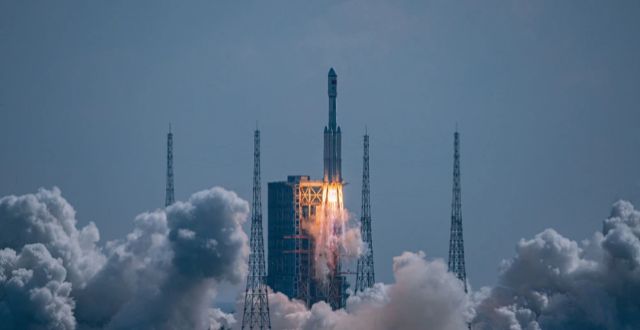
💡Mass production in space tech will drastically lower costs for satellite-based AI and edge computing infrastructure.
⚡ 30-Second TL;DR
What Changed
30 commercial rocket factories are currently in development across China.
Why It Matters
The shift to mass production will likely lower launch costs significantly, creating new opportunities for satellite-based AI applications and edge computing in orbit.
What To Do Next
Monitor the launch cadence of Chinese commercial space providers to identify potential low-cost satellite data streams for AI model training.
Key Points
- •30 commercial rocket factories are currently in development across China.
- •14 facilities are already operational, with 11 under construction and 5 planned.
- •The industry is transitioning from artisanal handcrafting to standardized mass production workflows.
🧠 Deep Insight
Background and context from public sources — not the original article. 23 sources cited.
🔑 Enhanced Key Takeaways
- •China's commercial space sector now comprises over 600 companies, with annual financing exceeding 18 billion yuan in 2025, driven by both national and local government funds and private venture capital.
- •The country is developing "mega factories" for satellites, with facilities like Geespace's factory aiming for an annual production capacity of 500 satellites by leveraging automotive manufacturing practices, and a joint venture in Hainan targeting 1,000 satellites per year.
- •Technological advancements include the mass production of key rocket components, such as propellant tank bottom domes, using domestically developed cryogenic forming technology, which reduces manufacturing time by over 90%.
- •Leading private rocket companies like LandSpace and Tianbing Technology have established intelligent manufacturing bases with significant annual production capacities, such as Tianbing's 50 rockets/year and iSpace's 20 liquid rockets/year and 100 engines/year.
- •The industry is moving towards modular rocket designs, exemplified by CAS Space's Lijian-2, which features standardized core stages, boosters, and interchangeable engines to streamline production, reduce delays, and enable high-frequency launches.
📊 Competitor Analysis▸ Show
| Feature/Company | LandSpace | Galactic Energy | i-Space | CAS Space |
|---|---|---|---|---|
| Primary Rocket(s) | Zhuque-2 (methalox), Zhuque-3 (reusable) | Ceres-1 (solid), Pallas-1 (methalox, reusable) | Hyperbola-1 (solid), Hyperbola-2 (liquid, reusable) | Lijian-1 (solid), Lijian-2 (liquid, reusable) |
| Fuel Type | Liquid Oxygen-Methane (methalox) | Solid, Liquid Oxygen-Kerosene (kerolox), Liquid Oxygen-Methane (methalox) | Solid, Liquid Oxygen-Methane (methalox) | Solid, Liquid Oxygen-Kerosene (kerolox) |
| Reusability Focus | Zhuque-2 (first methalox to orbit), Zhuque-3 (in development, VTVL) | Pallas-1 (in development, VTVL) | Hyperbola-2 (in development) | Lijian-2 (planned integrated recovery) |
| Notable Achievement | First methane-fueled rocket to reach orbit (Zhuque-2, July 2023) | Second private company to put a satellite in orbit (Ceres-1, Nov 2020) | First private company to put a satellite in orbit (Hyperbola-1, July 2019) | Lijian-1 is a solid rocket, Lijian-2 maiden flight April 2026 |
| Production Capacity (Stated) | Manufacturing bases in Jiaxing and Wuxi | Liquid rocket and engine production base, solid rocket assembly production base completed in 2024 | Super factory for 20 liquid rockets/year, 100 engines/year (Chengdu/Mianyang) | N/A |
Implicit Competitor: SpaceX - Chinese commercial space companies are often seen as aiming to catch up with or challenge SpaceX's dominance, particularly in areas like reusable rockets and large satellite constellations (e.g., China's "Starlink" version). SpaceX's revenue in 2025 was significantly higher than the combined revenue of eight Chinese space unicorns, highlighting a substantial gap in market-oriented funding and independent development capabilities.
🛠️ Technical Deep Dive
- Cryogenic Forming Technology: Chinese researchers have developed an internationally pioneering ultra-low-temperature forming technology for mass producing the bottom domes of rocket propellant tanks. This technology reduces manufacturing time from over a week to a few hours, cutting the production cycle by over 90%. It allows a 4-millimeter thick aluminum alloy sheet to be transformed into a finished tank bottom in a single forming process, maintaining a wall-thickness deviation of less than 0.3 millimeters.
- Modular Rocket Design: Rockets like CAS Space's Lijian-2 utilize a modular design with standardized core stages, boosters, and unified engine models. This allows for batch production of major components, flexible configurations (zero, two, or four boosters), and easy replacement of parts, streamlining manufacturing and enabling high-frequency launches.
- Liquid Oxygen-Methane (Methalox) Engines: Companies such as LandSpace and Galactic Energy are developing and utilizing methalox engines for their reusable rockets. LandSpace's Zhuque-2, powered by TQ-12A methalox engines, was the world's first methane-fueled launch vehicle to reach orbit. Methalox engines are considered environmentally friendly, non-toxic, and offer improved thrust and specific impulse for reusability.
- Automated Manufacturing and Supply Chain Integration: At LandSpace's smart manufacturing base in Jiaxing, automated logistics have significantly reduced component delivery times. The overall efficiency relies on a nationwide supply chain involving tens of thousands of components and over 600 suppliers across materials, precision engineering, and electronics.
- Automotive Industry Integration in Satellite Production: Geespace, a subsidiary of automotive company Geely, has leveraged its parent company's expertise in robotic assembly, materials science, and automated processes to build a satellite production line. This integration has reportedly reduced the production cost of a satellite unit by 45% and increased production speed by 300%, aiming for an annual capacity of up to 500 satellites.
- Reusable Rocket Technologies: Chinese companies are actively developing reusable first-stage boosters with features like grid fins for re-entry control and vertical landing capabilities, similar to SpaceX's Falcon 9. Examples include Galactic Energy's Pallas-1 and LandSpace's Zhuque-3.
🔮 Future ImplicationsAI analysis grounded in cited sources
⏳ Timeline
📎 Sources (23)
Factual claims are grounded in the sources below. Forward-looking analysis is AI-generated interpretation.
Weekly AI Recap
Read this week's curated digest of top AI events →
👉Related Updates


AI-curated news aggregator. All content rights belong to original publishers.
Original source: Pandaily ↗
This is a summary, not the original. Read the source, or get the weekly briefing.
The weekly digest
One email a week. Unsubscribe anytime.