China’s Brain-Computer Interface Moment
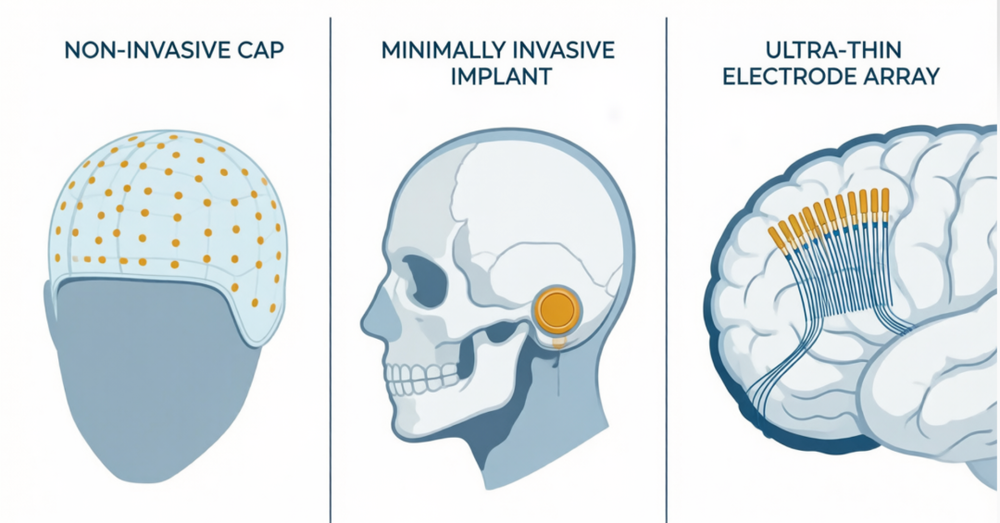
China’s first approved invasive BCI shows how regulation and data standards can move neural AI from labs to clinics.
30-Second TL;DR
What Changed
NMPA approved Borui康 NEO on March 13, 2026, and Shanghai completed the first implantation on July 13.
Why It Matters
The approval establishes a regulatory pathway that could accelerate clinical deployment and investment in neural-interface AI. For AI practitioners, standardized neural data formats may eventually enable cross-device algorithm reuse and larger multi-center datasets, although clinical validation and safety remain substantial constraints.
What To Do Next
For neural-interface projects, review the new Chinese system-architecture and multimodal-data standards before designing data schemas or cross-device model interfaces.
Key Points
- •NMPA approved Borui康 NEO on March 13, 2026, and Shanghai completed the first implantation on July 13.
- •NEO uses an epidural semi-invasive design with eight electrodes, avoiding direct penetration of brain tissue.
- •China introduced a clearer Class III medical-device classification and national standards for system architecture and multimodal data formats.
- •Domestic teams are pursuing distinct positions, including high-channel implants, flexible electrodes, clinical rehabilitation, and consumer-grade non-invasive products.
- •Commercialization still depends on reimbursement, clinical evidence, long-term safety, manufacturing, and interoperable data standards.
Deep Insight
AI-generated analysis for this event — not the original article.
Enhanced Key Takeaways
- •The NMPA's approval process for Borui康's NEO was accelerated through the 'Green Channel' for innovative medical devices, which prioritizes products with significant clinical value and independent intellectual property.
- •Borui康 has established a strategic partnership with several top-tier Chinese neurosurgery centers to create a standardized surgical protocol, aiming to reduce implantation time to under 90 minutes.
- •The NEO device utilizes a proprietary low-power ASIC (Application-Specific Integrated Circuit) that enables on-chip signal processing, significantly reducing the data transmission load compared to traditional high-bandwidth systems.
- •China's Ministry of Industry and Information Technology (MIIT) is reportedly drafting a 'Brain-Computer Interface Industry Development Roadmap' to align domestic manufacturing standards with international ISO/IEEE benchmarks.
- •The NEO system incorporates a unique biocompatible coating derived from synthetic polymers that has demonstrated a 30% reduction in glial scarring in pre-clinical primate models compared to standard silicone-based electrodes.
Competitor Analysis
- Borui康 NEO
- Epidural (Semi-invasive)
- Neuralink N1
- Intracortical (Invasive)
- Synchron Stentrode
- Endovascular (Minimally invasive)
- Borui康 NEO
- 8
- Neuralink N1
- 1024
- Synchron Stentrode
- 16
- Borui康 NEO
- Motor Rehabilitation
- Neuralink N1
- Motor/Cognitive
- Synchron Stentrode
- Motor/Communication
- Borui康 NEO
- NMPA Approved (2026)
- Neuralink N1
- FDA IDE (Clinical Trials)
- Synchron Stentrode
- FDA IDE (Clinical Trials)
| Feature | Borui康 NEO | Neuralink N1 | Synchron Stentrode |
|---|---|---|---|
| Invasiveness | Epidural (Semi-invasive) | Intracortical (Invasive) | Endovascular (Minimally invasive) |
| Electrode Count | 8 | 1024 | 16 |
| Primary Target | Motor Rehabilitation | Motor/Cognitive | Motor/Communication |
| Regulatory Status | NMPA Approved (2026) | FDA IDE (Clinical Trials) | FDA IDE (Clinical Trials) |
Technical Deep Dive
- Electrode Array: 8-channel epidural grid designed for placement on the dura mater without penetrating the cortex.
- Signal Processing: On-chip ASIC performs local filtering and spike detection to minimize power consumption and heat dissipation.
- Data Transmission: Wireless inductive coupling for power and high-speed RF link for data telemetry.
- Biocompatibility: Proprietary synthetic polymer coating designed to mitigate immune response and fibrous tissue encapsulation.
- System Architecture: Modular design separating the implantable unit from the external processing hub, allowing for future hardware upgrades without re-implantation.
Future ImplicationsAI analysis grounded in cited sources
Timeline
- 2024-05Borui康 completes Series B funding round to accelerate clinical trials.
- 2025-02NEO device receives breakthrough designation from the NMPA.
- 2026-03NMPA officially grants Class III medical device registration to NEO.
- 2026-07First successful human implantation of NEO performed in Shanghai.
Weekly AI Recap
Read this week's curated digest of top AI events →
AI-curated news aggregator. All content rights belong to original publishers.
Original source: 虎嗅 ↗
This is a summary, not the original. Read the source, or get the weekly briefing.
The weekly digest
One email a week. Unsubscribe anytime.