China's BCI Sector Shifts from Labs to Commercial Reality
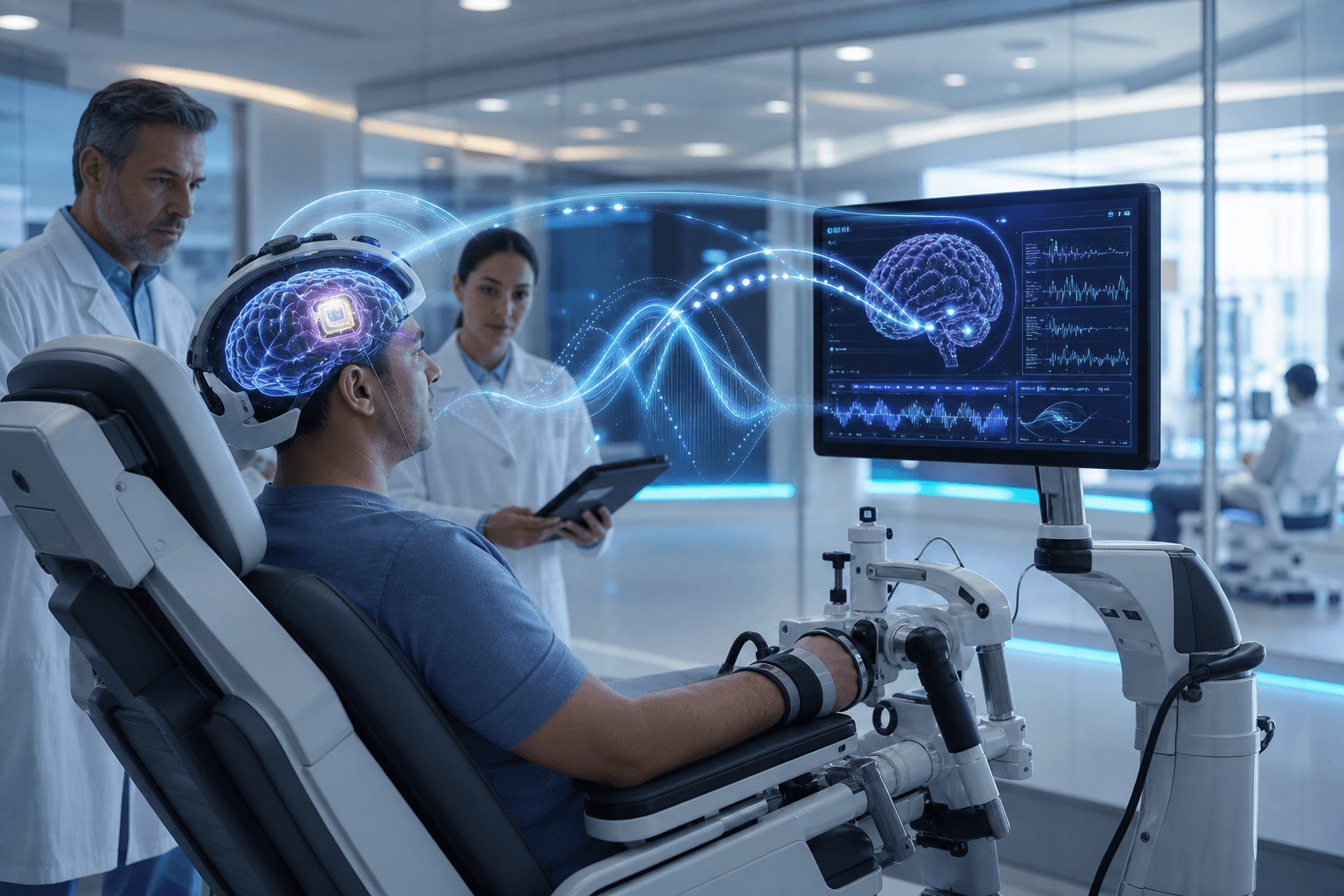
💡Understand the rapid commercialization of BCI in China and the emerging intersection of neuroscience and AI.
⚡ 30-Second TL;DR
What Changed
Record levels of venture capital funding are flowing into Chinese BCI startups.
Why It Matters
This shift indicates a maturing market for neuro-tech in China, potentially creating new hardware and software integration opportunities for AI developers working on signal processing.
What To Do Next
Research existing BCI signal processing libraries and explore how LLMs can be used to interpret neural data patterns.
Key Points
- •Record levels of venture capital funding are flowing into Chinese BCI startups.
- •Regulatory approvals are accelerating the path to market for neuro-tech devices.
- •The industry is moving beyond theoretical research into tangible clinical deployment.
🧠 Deep Insight
AI-generated analysis for this event — not the original article.
🔑 Enhanced Key Takeaways
- •The Chinese government integrated BCI technology into the '14th Five-Year Plan' and subsequent 'Future Industries' development guidelines, providing a top-down mandate for rapid industrialization.
- •Major Chinese tech hubs, specifically Beijing and Shanghai, have established dedicated neuro-tech industrial parks to provide subsidized infrastructure and clinical trial facilities for BCI startups.
- •Chinese BCI research is increasingly focusing on 'non-invasive' high-bandwidth EEG and hybrid BCI-AI systems to bypass the high surgical risks associated with invasive implants.
- •Strategic partnerships between BCI firms and domestic hospitals are creating a closed-loop data ecosystem, allowing for faster iterative training of neural decoding algorithms.
- •Standardization efforts are underway via the China Electronics Standardization Institute (CESI) to establish safety and data privacy protocols specifically for neural data, a critical hurdle for commercialization.
📊 Competitor Analysis▸ Show
| Feature | Chinese BCI Startups (e.g., NeuraMatrix, NeuroX) | Neuralink (US) | Synchron (US) |
|---|---|---|---|
| Primary Approach | Hybrid (Invasive/Non-invasive) | High-bandwidth Invasive | Minimally Invasive (Stentrode) |
| Market Focus | Clinical & Consumer/Gaming | Clinical (Paralysis/Vision) | Clinical (Endovascular) |
| Regulatory Status | Accelerated domestic approval | FDA Breakthrough/Clinical | FDA Breakthrough/Clinical |
| Pricing Model | Government-subsidized/Insurance | Premium/High-cost | Insurance-reimbursable |
🛠️ Technical Deep Dive
- Utilization of high-density CMOS-based neural probes that allow for simultaneous recording of thousands of neurons with lower power consumption than traditional silicon arrays.
- Implementation of edge-computing neural decoders that process signal spikes locally on the implant to reduce latency and bandwidth requirements for wireless transmission.
- Development of biocompatible, flexible polymer-based electrodes designed to minimize glial scarring and improve long-term signal stability in the brain.
- Integration of transformer-based deep learning models for real-time decoding of motor intent from noisy neural signals.
🔮 Future ImplicationsAI analysis grounded in cited sources
⏳ Timeline
Weekly AI Recap
Read this week's curated digest of top AI events →
👉Related Updates

AI-curated news aggregator. All content rights belong to original publishers.
Original source: Pandaily ↗
This is a summary, not the original. Read the source, or get the weekly briefing.
Weekly AI briefing
One email a week. Unsubscribe anytime.