China’s AI Compute Hits 2,185 EFLOPS
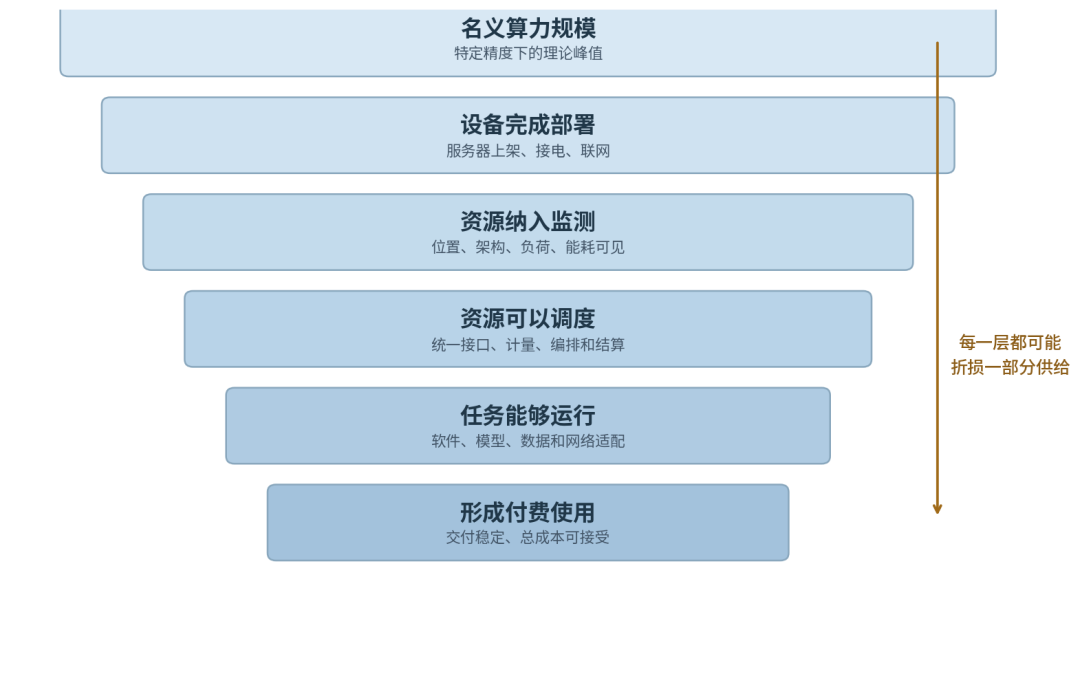
China’s compute boom is massive—but the real question is how much can actually run your workload.
30-Second TL;DR
What Changed
Nationally monitored intelligent compute grew to approximately 1.4 million PFLOPS, but utilization and paid usage remain poorly disclosed.
Why It Matters
AI builders should treat headline compute figures as infrastructure capacity, not guaranteed supply. The commercial winners will likely be platforms that expose reliable capacity, match workloads across heterogeneous hardware, and price end-to-end task completion rather than raw FLOPS.
What To Do Next
Instrument your inference or training platform with per-job metrics for queue time, hardware compatibility, network transfer, failure rate, and paid utilization instead of reporting only FLOPS.
Key Points
- •Nationally monitored intelligent compute grew to approximately 1.4 million PFLOPS, but utilization and paid usage remain poorly disclosed.
- •Effective compute must progress from nominal capacity through deployment, monitoring, scheduling, runnable workloads, and paid consumption.
- •CPU, GPU, and NPU resources are not interchangeable because architectures, instruction sets, software stacks, and communication requirements differ.
- •Cross-region scheduling is most practical for batch workloads, while tightly coupled training and real-time inference require high-quality local clusters.
Deep Insight
AI-generated analysis for this event — not the original article.
Enhanced Key Takeaways
- •The Chinese government has integrated intelligent computing into its 'National Computing Power Network' strategy, aiming to standardize the measurement of 'effective' versus 'nominal' compute to prevent capacity inflation.
- •Recent policy directives from the Ministry of Industry and Information Technology (MIIT) emphasize the transition from 'computing power construction' to 'computing power application,' specifically targeting the industrial AI adoption rate.
- •The 2,185 EFLOPS figure includes a significant portion of domestic AI chips (NPUs) which face challenges in software ecosystem maturity compared to NVIDIA's CUDA-based infrastructure.
- •Regional 'Computing Hubs' (such as those in Guizhou and Gansu) are increasingly focusing on cold-data storage and non-real-time training to mitigate the high network latency issues inherent in cross-province data transmission.
- •State-backed cloud providers are implementing 'Unified Scheduling Platforms' to aggregate idle compute from smaller data centers, attempting to solve the fragmentation issue mentioned in the original report.
Technical Deep Dive
- The discrepancy between nominal and effective compute is largely attributed to the 'interconnect bottleneck' where high-bandwidth memory (HBM) and NVLink-equivalent interconnects (like Huawei's Ascend-based clusters) struggle to scale linearly beyond a certain cluster size.
- Heterogeneous compute environments are currently managed via abstraction layers like OpenCL or proprietary middleware, which often incur a 15-30% performance overhead compared to native CUDA implementations.
- National monitoring standards are shifting toward 'FP16/BF16/INT8' mixed-precision benchmarks rather than traditional FP64, reflecting the industry's pivot toward AI inference and training workloads.
Future ImplicationsAI analysis grounded in cited sources
Timeline
- 2022-02Launch of the 'East Data, West Computing' project to balance national compute distribution.
- 2023-10MIIT and other departments release the 'Action Plan for High-Quality Development of Computing Power Infrastructure'.
- 2024-05Initial national-level pilot programs for intelligent computing power monitoring and scheduling begin.
- 2025-12Total intelligent computing capacity in China officially surpasses the 1,500 EFLOPS milestone.
Weekly AI Recap
Read this week's curated digest of top AI events →
AI-curated news aggregator. All content rights belong to original publishers.
Original source: 虎嗅 ↗
This is a summary, not the original. Read the source, or get the weekly briefing.
The weekly digest
One email a week. Unsubscribe anytime.