China’s AI Alliance Adds Nine New Members
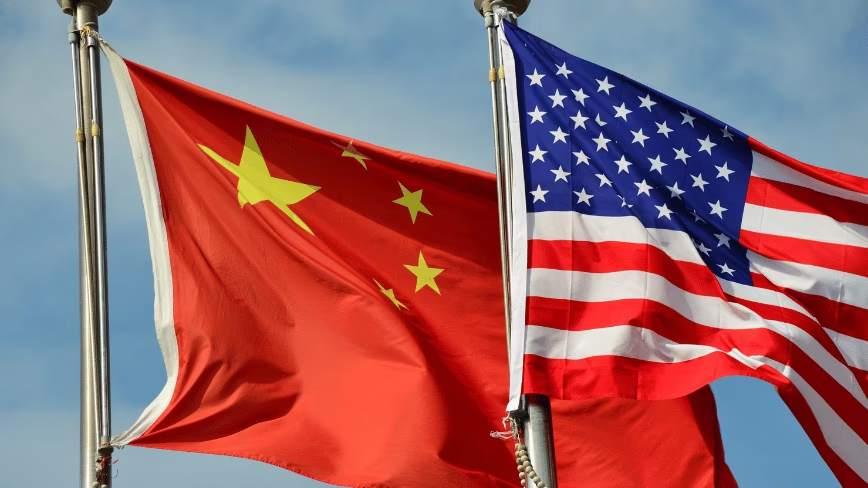
💡WAICO’s rapid expansion could reshape where AI teams can collaborate, deploy, and source technology.
⚡ 30-Second TL;DR
What Changed
WAICO added nine members in its first month.
Why It Matters
AI developers and companies operating internationally may face greater pressure to choose technology, research, and partnership ecosystems. Future policy alignment could affect cross-border collaboration, procurement, and market access.
What To Do Next
Map your international AI vendors, research partners, and data flows against emerging China- and US-aligned policy requirements before renewing major contracts.
Key Points
- •WAICO added nine members in its first month.
- •The organisation now has 38 signatories, up from 29.
- •Washington is drafting a letter urging 35 countries not to join both camps.
- •The growth highlights increasing geopolitical competition over AI cooperation.
🧠 Deep Insight
AI-generated analysis for this event.
🔑 Enhanced Key Takeaways
- •WAICO was formally established in July 2026 as a Beijing-led initiative aimed at promoting 'AI for Good' and establishing alternative global governance standards to those proposed by Western-led coalitions.
- •The 35 countries targeted by Washington's diplomatic pressure are primarily located in the Global South, specifically within the Belt and Road Initiative (BRI) framework, where China has already invested heavily in digital infrastructure.
- •The U.S. strategy, reportedly led by the State Department's Bureau of Cyberspace and Digital Policy, emphasizes 'interoperability' and 'democratic values' as the primary criteria for AI partnership, effectively creating a binary choice for developing nations.
- •Internal documents suggest that WAICO members are being offered subsidized access to Chinese cloud computing resources and large-scale pre-trained models in exchange for adopting standardized regulatory frameworks aligned with Chinese AI safety protocols.
- •The rapid expansion of WAICO has triggered a formal review within the G7 regarding the 'AI divide,' with concerns that the bifurcation of AI standards could lead to incompatible global technical ecosystems by 2028.
📊 Competitor Analysis▸ Show
| Feature | WAICO (China-led) | U.S.-Led AI Partnership (e.g., AI Safety Institute Network) |
|---|---|---|
| Governance Model | Centralized, State-led | Decentralized, Multi-stakeholder |
| Primary Focus | Infrastructure & Development | Safety, Ethics, & Human Rights |
| Pricing/Access | Subsidized/State-backed | Market-driven/Private sector |
| Technical Standards | Proprietary/National Standards | Open/Interoperable Standards |
🔮 Future ImplicationsAI analysis grounded in cited sources
⏳ Timeline
Weekly AI Recap
Read this week's curated digest of top AI events →
👉Related Updates
AI-curated news aggregator. All content rights belong to original publishers.
Original source: The Next Web (TNW) ↗