Nvidia H200 Shipments Reach Chinese Tech Firms
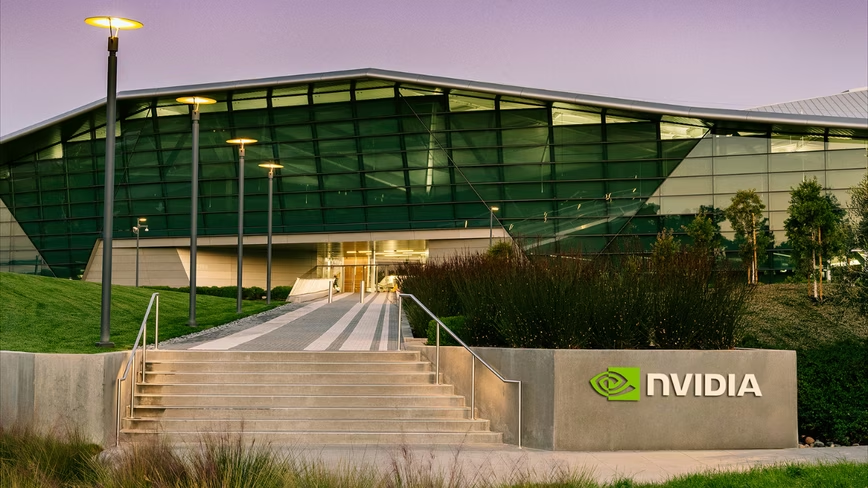
💡H200 access is reopening for major Chinese firms, but export controls still complicate AI capacity planning.
⚡ 30-Second TL;DR
What Changed
Nvidia H200 accelerators have started arriving at Chinese technology companies.
Why It Matters
The shipments could temporarily improve access to high-end AI compute for major Chinese model developers. Availability remains dependent on export controls and licensing, making capacity planning and procurement uncertain.
What To Do Next
Review H200 procurement scenarios with your compliance team and avoid assuming mainland-China availability for production capacity plans.
Key Points
- •Nvidia H200 accelerators have started arriving at Chinese technology companies.
- •ByteDance and Tencent reportedly received approximately 10,000 processors each.
- •Other Chinese groups are expected to pursue similar volumes.
- •The shipments may not represent broad availability across mainland China.
🧠 Deep Insight
AI-generated analysis for this event.
🔑 Enhanced Key Takeaways
- •The H200 shipments to China are specifically configured as 'H20D' variants, designed to comply with U.S. Department of Commerce export control regulations regarding total processing performance and interconnect bandwidth.
- •These shipments utilize the Hopper architecture but feature reduced memory bandwidth and interconnect speeds compared to the global H200 version to remain under the 'performance density' thresholds set by U.S. sanctions.
- •ByteDance is reportedly utilizing these H200 units primarily to accelerate the training of its proprietary large language models (LLMs) like Doubao, reducing reliance on older A800/H800 stockpiles.
- •The U.S. government maintains strict oversight on these shipments, requiring Nvidia to undergo a rigorous license application process for every batch delivered to Chinese entities to ensure compliance with evolving national security directives.
- •Despite the arrival of H200 units, Chinese firms continue to aggressively invest in domestic alternatives such as Huawei's Ascend 910B/C series, viewing Nvidia's export-compliant chips as a temporary bridge rather than a long-term infrastructure solution.
📊 Competitor Analysis▸ Show
| Feature | Nvidia H20D (China) | Huawei Ascend 910C | Cambricon MLU590 |
|---|---|---|---|
| Architecture | Hopper (Modified) | Da Vinci | MLUv05 |
| Memory | 141GB HBM3e (Reduced) | 128GB HBM3 | 64GB HBM3 |
| Interconnect | NVLink (Throttled) | Ascend-C (Proprietary) | Proprietary Fabric |
| Ecosystem | CUDA (Dominant) | CANN (Growing) | Cambricon SDK |
🛠️ Technical Deep Dive
- The H20D variant is a derivative of the H200, specifically engineered to meet U.S. export controls by capping the aggregate compute performance (TFLOPS) and interconnect speed (NVLink bandwidth).
- It retains the 141GB HBM3e memory capacity of the standard H200, which is critical for serving large-scale inference models, though the memory bandwidth is significantly lower than the global version.
- The chip utilizes the same TSMC 4N process node as the standard H200, ensuring compatibility with existing Hopper-based software stacks and CUDA kernels.
- Power consumption profiles have been adjusted to accommodate the thermal constraints of the modified silicon, often requiring different cooling solutions than the standard H200.
🔮 Future ImplicationsAI analysis grounded in cited sources
⏳ Timeline
Weekly AI Recap
Read this week's curated digest of top AI events →
👉Related Updates


AI-curated news aggregator. All content rights belong to original publishers.
Original source: The Next Web (TNW) ↗