China’s AI Race Moves Into the Physical World
China’s AI ambitions may extend far beyond the chatbot models drawing Washington’s attention.
30-Second TL;DR
What Changed
Washington’s attention on Kimi K3 may obscure China’s wider AI strategy.
Why It Matters
AI companies may need to evaluate competition through embodied and real-world applications, not only language-model benchmarks. Founders and researchers should watch how software, sensors, robotics, and deployment data converge in this broader AI race.
What To Do Next
Use NVIDIA Isaac Sim to prototype a small embodied-AI evaluation covering perception, planning, and real-world task execution.
Key Points
- •Washington’s attention on Kimi K3 may obscure China’s wider AI strategy.
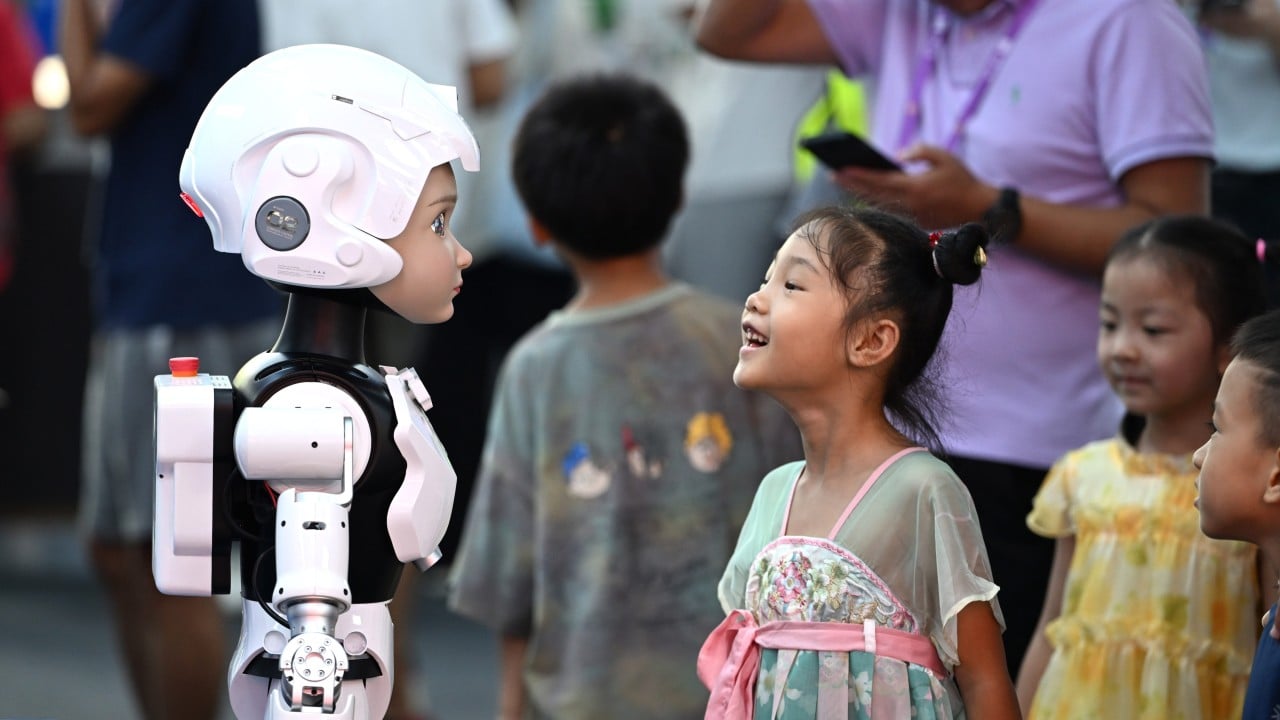
- •China is pushing AI applications beyond conversational chatbots.
- •Physical-world deployment could become a major competitive frontier for Chinese AI developers.
Deep Insight
AI-generated analysis for this event — not the original article.
Enhanced Key Takeaways
- •China's 'AI+ Action' initiative, launched by the Ministry of Industry and Information Technology, explicitly prioritizes integrating AI into manufacturing, agriculture, and logistics to drive industrial upgrading.
- •Chinese robotics firms are increasingly adopting 'embodied AI' architectures, which utilize large multimodal models (LMMs) to enable robots to perceive, reason, and interact with unstructured physical environments.
- •The Chinese government has established multiple national-level 'AI Industrial Parks' specifically designed to provide the high-compute infrastructure and physical testing grounds required for industrial AI deployment.
- •Strategic focus has shifted toward 'edge AI' capabilities, allowing Chinese hardware manufacturers to process complex AI tasks locally on devices rather than relying solely on cloud-based data centers.
- •Major Chinese tech conglomerates are forming cross-sector alliances to standardize data protocols for industrial IoT, aiming to create a unified ecosystem that accelerates the training of physical-world AI models.
Competitor Analysis
- Chinese Embodied AI (e.g., Unitree, UBTECH)
- Industrial automation & mass manufacturing
- US/Global Competitors (e.g., Tesla Optimus, Figure AI)
- General-purpose humanoid labor
- Chinese Embodied AI (e.g., Unitree, UBTECH)
- Aggressive cost-reduction via supply chain integration
- US/Global Competitors (e.g., Tesla Optimus, Figure AI)
- Premium positioning for early enterprise adoption
- Chinese Embodied AI (e.g., Unitree, UBTECH)
- High throughput in structured factory settings
- US/Global Competitors (e.g., Tesla Optimus, Figure AI)
- Superior dexterity in unstructured human environments
| Feature | Chinese Embodied AI (e.g., Unitree, UBTECH) | US/Global Competitors (e.g., Tesla Optimus, Figure AI) |
|---|---|---|
| Primary Focus | Industrial automation & mass manufacturing | General-purpose humanoid labor |
| Pricing Strategy | Aggressive cost-reduction via supply chain integration | Premium positioning for early enterprise adoption |
| Benchmarks | High throughput in structured factory settings | Superior dexterity in unstructured human environments |
Technical Deep Dive
- Embodied AI models in China are transitioning from traditional reinforcement learning to Transformer-based architectures that process visual, tactile, and proprioceptive data simultaneously.
- Implementation often involves 'Sim-to-Real' transfer learning, where models are trained in high-fidelity physics engines like NVIDIA Isaac Sim or domestic equivalents before deployment.
- Edge deployment utilizes custom NPU (Neural Processing Unit) architectures designed to handle low-latency inference for real-time motor control and obstacle avoidance.
- Integration of 'World Models' allows these systems to predict the physical consequences of actions, reducing the need for constant human supervision in dynamic environments.
Future ImplicationsAI analysis grounded in cited sources
Timeline
- 2023-07Moonshot AI (developer of Kimi) is founded in Beijing.
- 2024-03China's 'AI+ Action' initiative is formally introduced during the Two Sessions.
- 2024-05Moonshot AI releases Kimi K3, significantly expanding context window capabilities.
- 2025-02Beijing releases guidelines for the development of 'Embodied AI' as a strategic emerging industry.
- 2026-01Major Chinese industrial hubs report a 40% increase in AI-integrated robotic deployments compared to the previous year.
Weekly AI Recap
Read this week's curated digest of top AI events →
Related Updates

AI-curated news aggregator. All content rights belong to original publishers.
Original source: Bloomberg Technology ↗
This is a summary, not the original. Read the source, or get the weekly briefing.
The weekly digest
One email a week. Unsubscribe anytime.