China’s AI Six Split Over the Business Model
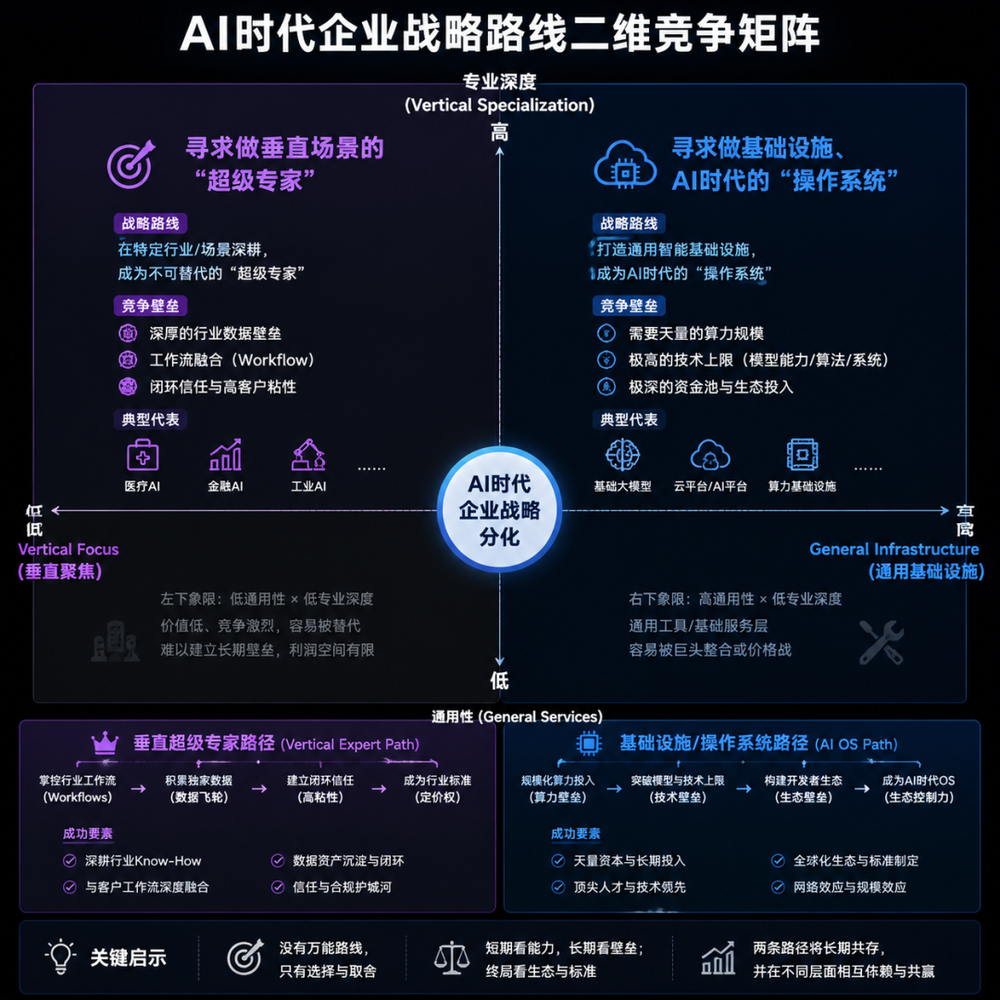
💡The AI startup race is moving from benchmarks and funding to margins, renewals, and real workflow adoption.
⚡ 30-Second TL;DR
What Changed
Zhipu and MiniMax entered Hong Kong’s public market but remain deeply loss-making despite strong revenue growth.
Why It Matters
The article signals a shift from model capability races toward measurable business execution. AI founders may gain more defensibility by embedding models into regulated workflows, proprietary data, and recurring customer operations rather than competing directly on scale.
What To Do Next
Instrument your AI product dashboard around gross margin, inference cost, customer renewal, and workflow-level outcomes before expanding model scale.
Key Points
- •Zhipu and MiniMax entered Hong Kong’s public market but remain deeply loss-making despite strong revenue growth.
- •Baichuan is directing resources toward medical models and an AI family-doctor product.
- •01.AI is focusing on enterprise multi-agent systems, while Moonshot AI emphasizes open models and agents.
- •The emerging market structure separates infrastructure providers, vertical industry solutions, and task-specific agent products.
🧠 Deep Insight
AI-generated analysis for this event.
🔑 Enhanced Key Takeaways
- •The 'China AI Six' (Zhipu, MiniMax, Baichuan, 01.AI, Moonshot, StepFun) are facing increased scrutiny from Hong Kong and mainland investors regarding the sustainability of high-compute expenditure models versus actual ARR (Annual Recurring Revenue).
- •Zhipu AI has pivoted its strategy to emphasize 'GLM-4' ecosystem integration, specifically targeting B2B enterprise private deployment to mitigate the high costs of public cloud API consumption.
- •MiniMax has shifted focus toward 'abroad-first' strategies, leveraging its 'talkie' and character-based AI products to capture international markets where monetization per user is higher than in the domestic Chinese market.
- •StepFun (Jieyue Chenchen) has prioritized 'Step-2' and 'Step-1.5' multimodal architectures, specifically optimizing for low-latency video generation and real-time interaction to differentiate from text-heavy competitors.
- •Regulatory pressures in China regarding data compliance and content safety have forced these companies to allocate significant capital toward 'compliance-as-a-service' layers, further impacting net margins compared to US-based counterparts.
📊 Competitor Analysis▸ Show
| Feature | Zhipu AI | MiniMax | Moonshot AI | 01.AI |
|---|---|---|---|---|
| Primary Focus | Enterprise/Private Cloud | Consumer/Global Social | Open Models/Long Context | Enterprise Multi-Agent |
| Pricing Model | Tiered API/Private Deploy | Subscription/Usage-based | Token-based/Open Source | Enterprise Licensing |
| Key Benchmark | GLM-4 (High Reasoning) | abab 7 (Multimodal) | Kimi (Long Context) | Yi-Large (Coding/Math) |
🛠️ Technical Deep Dive
- Zhipu AI utilizes a mixture-of-experts (MoE) architecture in its GLM-4 series to optimize inference costs while maintaining high parameter counts for complex reasoning tasks.
- Moonshot AI's Kimi model employs a proprietary long-context window management system that utilizes ring attention mechanisms to handle up to 2 million tokens efficiently.
- 01.AI's Yi series models are built on a transformer-based architecture with heavy emphasis on pre-training data quality, specifically focusing on high-density code and mathematical datasets to outperform on benchmarks like HumanEval.
- StepFun's multimodal models integrate visual and audio encoders directly into the latent space, allowing for native cross-modal generation without separate adapter layers.
🔮 Future ImplicationsAI analysis grounded in cited sources
⏳ Timeline
Weekly AI Recap
Read this week's curated digest of top AI events →
👉Related Updates
AI-curated news aggregator. All content rights belong to original publishers.
Original source: 虎嗅 ↗

