🐯虎嗅•Stalecollected in 12m
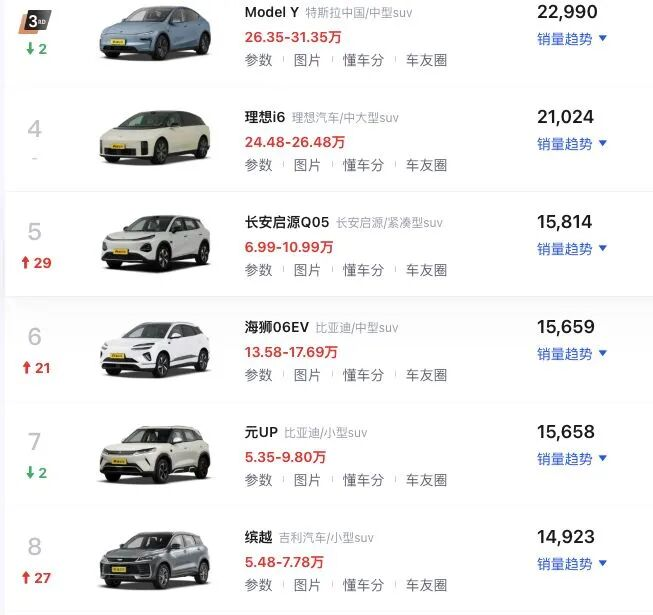
China Top 10 Cars: 9 EVs Dominate
💡McKinsey forecasts AI driving as must-have in China's maturing EV market
⚡ 30-Second TL;DR
What Changed
Only Geely Bin Yue fuel car in April top 10 at #8; top 7 all EVs
Why It Matters
EV shift accelerates but fuel cars persist; auto firms need diverse powertrains. Price wars erode trust, pushing tech innovation like AI cockpits.
What To Do Next
Download McKinsey 2026 China Auto report for AI agent cockpit benchmarks.
Who should care:Enterprise & Security Teams
Key Points
- •Only Geely Bin Yue fuel car in April top 10 at #8; top 7 all EVs
- •Fuel sales drop 32% YoY in April due to high oil prices
- •McKinsey: 71% expect charging parity by 2033; smart driving now mandatory
- •China auto market to sell 240M vehicles 2026-2035 in steady growth
🧠 Deep Insight
AI-generated analysis for this event.
🔑 Enhanced Key Takeaways
- •The surge in NEV adoption is heavily supported by China's 'Trade-in' policy (Yi Jiu Huan Xin), which provides significant government subsidies to accelerate the replacement of older internal combustion engine vehicles.
- •Xiaomi's SU7 has achieved a production milestone of 10,000 units in a single month as of April 2026, signaling a shift from a supply-constrained launch phase to high-volume manufacturing maturity.
- •The decline in fuel car sales is exacerbated by the 'price war' initiated by BYD and Tesla, which has compressed margins for legacy joint-venture automakers, forcing them to accelerate their own electrification roadmaps.
📊 Competitor Analysis▸ Show
| Feature | Xiaomi SU7 | Tesla Model Y | BYD Seal |
|---|---|---|---|
| Primary Segment | Mid-to-Large Sedan | Compact SUV | Mid-Size Sedan |
| Smart Driving | Xiaomi Pilot (End-to-End) | FSD (Vision-only) | DiPilot |
| Ecosystem | HyperOS (IoT Integration) | Tesla App Store | BYD DiLink |
| Starting Price (CNY) | ~215,900 | ~249,900 | ~179,800 |
🛠️ Technical Deep Dive
- Xiaomi SU7 utilizes a 'HyperEngine' V8s motor capable of reaching 27,200 rpm, integrated with a cell-to-body (CTB) battery architecture.
- The vehicle employs an end-to-end large model for autonomous driving, utilizing a BEV+Transformer+Occupancy Network stack.
- Tesla Model Y continues to leverage its 'Unboxed' manufacturing process and high-pressure die-casting (Giga Press) to maintain industry-leading gross margins despite aggressive price cuts.
🔮 Future ImplicationsAI analysis grounded in cited sources
Legacy joint-venture automakers will exit the Chinese market by 2028.
The rapid shift to NEVs and the inability of traditional OEMs to match the software-defined vehicle development cycles of domestic players makes their current business model unsustainable.
In-car AI agents will become the primary differentiator for vehicle sales by 2027.
As hardware performance plateaus, consumer preference is shifting toward seamless integration of LLMs for cabin control and predictive maintenance.
⏳ Timeline
2023-12
Xiaomi officially unveils the SU7 and its 'Human x Car x Home' ecosystem strategy.
2024-03
Xiaomi SU7 officially launches in China, receiving over 50,000 orders within 27 minutes.
2024-04
Xiaomi begins mass deliveries of the SU7, marking its entry into the competitive EV market.
2025-06
Xiaomi announces the expansion of its smart driving capabilities to nationwide 'No-Map' NOA (Navigate on Autopilot).
2026-04
Xiaomi SU7 secures a top-tier position in monthly sales rankings, displacing traditional fuel-powered leaders.
📰
Weekly AI Recap
Read this week's curated digest of top AI events →
👉Related Updates
AI-curated news aggregator. All content rights belong to original publishers.
Original source: 虎嗅 ↗