China sees record unicorn growth driven by AI and robotics

💡Identify the next wave of AI and robotics innovation by tracking the fastest-growing unicorn sectors in China.
⚡ 30-Second TL;DR
What Changed
67 new unicorns created in H1 2026
Why It Matters
The rapid emergence of AI and robotics unicorns suggests a maturing industrial AI sector in China, likely leading to more specialized hardware-software integrated solutions.
What To Do Next
Analyze the portfolio of top Chinese venture firms to identify emerging robotics and embodied AI startups for potential partnerships.
Key Points
- •67 new unicorns created in H1 2026
- •Growth driven by AI and robotics investment cycle
- •Highest unicorn creation rate since H2 2021
🧠 Deep Insight
AI-generated analysis for this event — not the original article.
🔑 Enhanced Key Takeaways
- •The surge in unicorn creation is heavily concentrated in the Yangtze River Delta and Greater Bay Area, which accounted for over 60% of the new valuations.
- •Government-backed 'Guidance Funds' have shifted strategy from consumer internet platforms to 'hard tech' sectors, providing the primary capital injection for these 67 startups.
- •Average time-to-unicorn status has compressed to 3.2 years, down from 4.5 years in 2023, due to accelerated R&D cycles in generative AI infrastructure.
- •New regulatory frameworks introduced in early 2026 have streamlined the listing process for AI-focused startups on the Beijing Stock Exchange, incentivizing private equity participation.
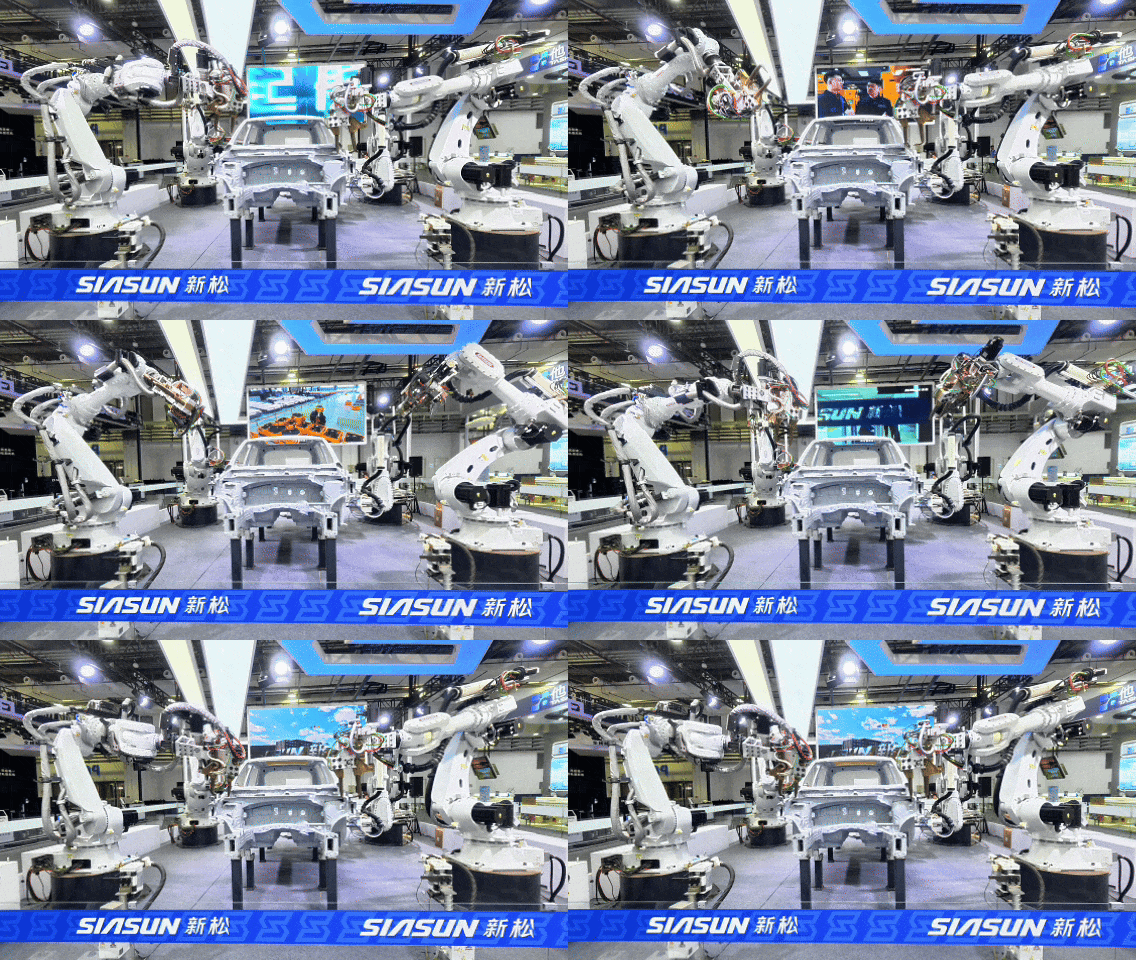
- •A significant portion of the new unicorns are focused on 'Embodied AI,' specifically integrating large language models into industrial robotic arms and autonomous logistics hardware.
🛠️ Technical Deep Dive
- Focus on Embodied AI architectures utilizing transformer-based models for real-time sensorimotor control.
- Implementation of edge-computing chips designed specifically for low-latency inference in robotics, reducing reliance on cloud-based processing.
- Adoption of synthetic data generation pipelines to train robotic systems in simulated environments before physical deployment, significantly lowering development costs.
🔮 Future ImplicationsAI analysis grounded in cited sources
⏳ Timeline
Weekly AI Recap
Read this week's curated digest of top AI events →
👉Related Updates
AI-curated news aggregator. All content rights belong to original publishers.
Original source: SCMP Technology ↗
This is a summary, not the original. Read the source, or get the weekly briefing.
Weekly AI briefing
One email a week. Unsubscribe anytime.