China Robot Boom Hits Commercialization Wall
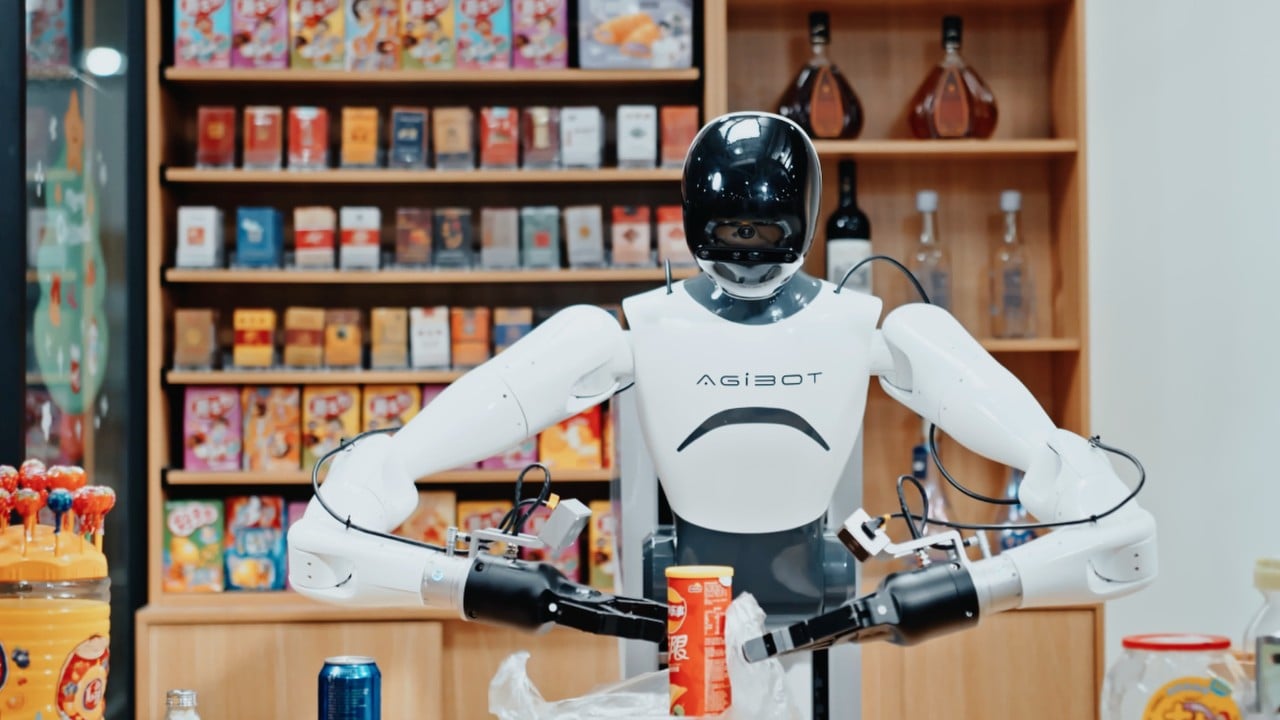
China robotics hype crashes into commercialization reality—key for embodied AI data strategies
30-Second TL;DR
What Changed
China's robot boom questioned for lacking real cash flow
Why It Matters
Challenges in commercialization could slow investment in Chinese robotics, pushing firms to focus on data generation over products. This affects global embodied AI race as China prioritizes foundational data over market-ready bots.
What To Do Next
Investigate teleoperation setups like Agibot's for scalable embodied AI data collection.
Key Points
- •China's robot boom questioned for lacking real cash flow
- •Commercialization lags behind hype in robotics industry
- •Agibot's Shanghai facility acts as data foundry for embodied AI
- •Human teleoperation used for tasks like picking, folding, stacking
Deep Insight
AI-generated analysis for this event — not the original article.
Enhanced Key Takeaways
- •Agibot, founded by former Huawei 'genius youth' recruit Zhihui Jun, has shifted focus from pure hardware manufacturing to 'embodied AI' software stacks, aiming to solve the 'data scarcity' problem in robotics through large-scale teleoperation.
- •The Chinese government's 'Robot + Application' action plan has incentivized massive capital inflow, but industry analysts note that current humanoid deployments are largely restricted to controlled factory environments rather than unstructured consumer or service settings.
- •The 'data foundry' model is a response to the high cost of synthetic data generation, with companies like Agibot betting that human-in-the-loop training is the only viable path to achieving human-level dexterity in manipulation tasks.
Competitor Analysis
- Agibot (China)
- Teleoperation-driven data foundry
- Figure AI (US)
- End-to-end neural networks
- Tesla (Optimus)
- Mass-scale manufacturing integration
- Agibot (China)
- Industrial/Manufacturing
- Figure AI (US)
- Logistics/General Purpose
- Tesla (Optimus)
- Automotive/Factory Automation
- Agibot (China)
- Hardware + AI Software Stack
- Figure AI (US)
- AI-as-a-Service (Partnerships)
- Tesla (Optimus)
- Vertical Integration (Internal)
| Feature | Agibot (China) | Figure AI (US) | Tesla (Optimus) |
|---|---|---|---|
| Core Focus | Teleoperation-driven data foundry | End-to-end neural networks | Mass-scale manufacturing integration |
| Primary Market | Industrial/Manufacturing | Logistics/General Purpose | Automotive/Factory Automation |
| Business Model | Hardware + AI Software Stack | AI-as-a-Service (Partnerships) | Vertical Integration (Internal) |
Technical Deep Dive
- Embodied AI Architecture: Utilizes a transformer-based policy network that maps visual-tactile inputs directly to motor control commands.
- Teleoperation Infrastructure: Employs high-fidelity haptic feedback suits and VR-based control interfaces to capture human motion data at 100Hz+ sampling rates.
- Data Foundry Workflow: Raw teleoperation data is processed through a 'data cleaning' pipeline that filters out sub-optimal movements, followed by imitation learning (IL) and reinforcement learning (RL) fine-tuning.
- Hardware Specs: Agibot's 'Expedition' series features high-torque density actuators with integrated force-torque sensors at the end-effectors to enable delicate manipulation.
Future ImplicationsAI analysis grounded in cited sources
Timeline
- 2023-08Agibot officially launches the 'Expedition' humanoid robot series.
- 2024-02Agibot secures significant Series A+ funding to scale its embodied AI research.
- 2025-06Agibot pivots to emphasize its 'data foundry' capabilities for training foundation models.
Weekly AI Recap
Read this week's curated digest of top AI events →
Related Updates


AI-curated news aggregator. All content rights belong to original publishers.
Original source: SCMP Technology ↗
This is a summary, not the original. Read the source, or get the weekly briefing.
The weekly digest
One email a week. Unsubscribe anytime.