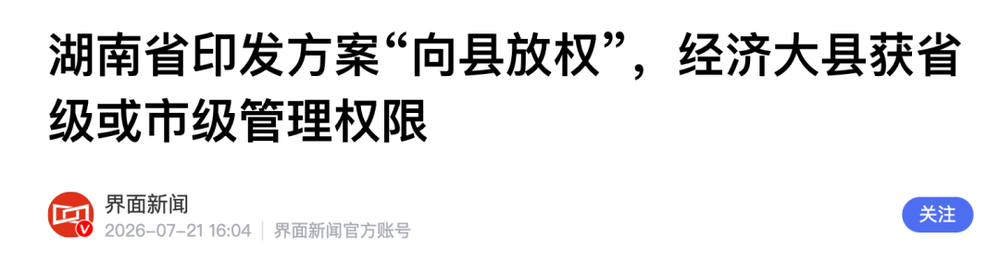
China provinces delegate more power to county level
💡Understand the structural shift in Chinese regional governance that impacts local economic and digital investment.
⚡ 30-Second TL;DR
What Changed
Provinces like Hunan and Sichuan are implementing 'power-to-the-county' reforms.
Why It Matters
This structural shift could significantly alter the landscape for regional economic development, potentially impacting how local governments procure and implement digital infrastructure.
What To Do Next
For enterprise sales targeting government sectors, adjust strategies to engage directly with county-level decision makers as decentralization increases.
Key Points
- •Provinces like Hunan and Sichuan are implementing 'power-to-the-county' reforms.
- •The strategy aims to reduce administrative costs and improve local decision-making autonomy.
- •Data suggests 'provincially-managed counties' outperform traditional 'city-managed counties' in economic metrics.
🧠 Deep Insight
AI-generated analysis for this event — not the original article.
🔑 Enhanced Key Takeaways
- •The 'province-managing-counties' (省直管县) reform pilot program was formally initiated by the Ministry of Finance in 2002 to improve fiscal transparency and resource allocation efficiency.
- •A primary driver for this policy is the 'administrative hierarchy' bottleneck, where prefecture-level cities often withhold fiscal transfers intended for subordinate counties.
- •The reform specifically targets the 'fiscal autonomy' of counties, allowing them to report directly to provincial finance departments rather than routing through city-level governments.
- •Recent iterations of the policy have expanded beyond fiscal management to include 'administrative power delegation' (扩权强县), granting counties authority over land use planning and project approvals.
- •Academic studies indicate that while the reform boosts GDP growth in pilot counties, it has historically faced resistance from prefecture-level cities concerned about losing their tax base and administrative influence.
🔮 Future ImplicationsAI analysis grounded in cited sources
⏳ Timeline
Weekly AI Recap
Read this week's curated digest of top AI events →
👉Related Updates

AI-curated news aggregator. All content rights belong to original publishers.
Original source: 虎嗅 ↗
This is a summary, not the original. Read the source, or get the weekly briefing.
The weekly digest
One email a week. Unsubscribe anytime.