China Opens Its Medical Data Layer
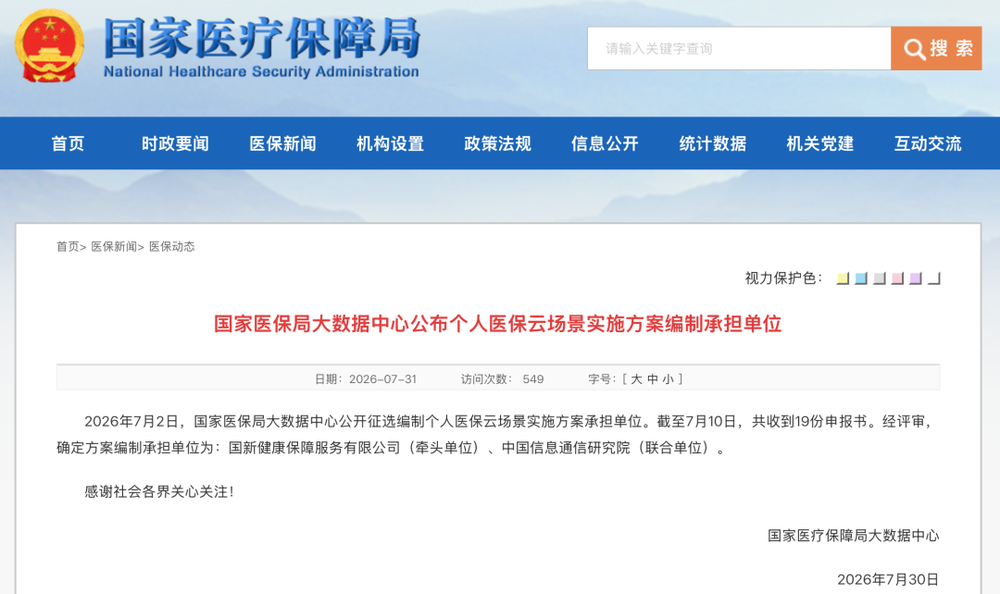
A national health-data gateway could reshape medical AI access, insurance analytics, and real-world evidence.
30-Second TL;DR
What Changed
Guoxin Health was selected from 19 proposals to lead the Personal Medical Insurance Cloud plan.
Why It Matters
If implemented, the cloud could shift value from organizations that merely possess regional medical datasets to companies that can operate and analyze data compliantly. For AI practitioners, access to large-scale, longitudinal, and labeled healthcare data could materially improve clinical models, real-world evidence systems, and insurance applications.
What To Do Next
Prototype a consent-aware healthcare data pipeline using de-identified records, role-based access, audit logs, and federated or privacy-preserving model training.
Key Points
- •Guoxin Health was selected from 19 proposals to lead the Personal Medical Insurance Cloud plan.
- •The system could consolidate data from more than 1.3 billion basic medical insurance participants.
- •The expected commercial opportunity is in consent-based analytics, verification, and matching—not direct medical-data trading.
- •Potential beneficiaries include health insurers, pharmaceutical companies conducting real-world evidence studies, and medical AI developers.
- •Major barriers remain around cross-provincial standards, privacy authorization, accountability, and coordination with national health-information platforms.
Deep Insight
AI-generated analysis for this event — not the original article.
Enhanced Key Takeaways
- •The initiative aligns with China's 'Data Elements ×' (Data Elements multiplied by) action plan, which seeks to leverage high-value data sets to drive economic growth and industrial digital transformation.
- •Guoxin Health, a subsidiary of Sinopharm Group, leverages its state-owned enterprise status to bridge the gap between regulatory compliance and commercial data utilization in the healthcare sector.
- •The project utilizes a 'Data-as-a-Service' (DaaS) model, where raw medical records remain siloed within secure government-controlled environments, and only anonymized insights or authorized compute results are exported.
- •The architecture incorporates blockchain-based logging to ensure an immutable audit trail for every instance of patient data access, addressing critical concerns regarding unauthorized data usage.
- •The National Healthcare Security Administration (NHSA) is mandating that this cloud infrastructure must integrate with the existing 'National Medical Insurance Information Platform,' which already covers over 95% of the Chinese population.
Technical Deep Dive
- Architecture utilizes a Federated Learning framework to allow AI models to train on distributed medical data without moving sensitive patient records from local hospital servers.
- Implements Trusted Execution Environments (TEEs) at the cloud edge to ensure that data processing occurs in isolated, secure hardware enclaves.
- Employs differential privacy algorithms to inject noise into query results, preventing the re-identification of individuals in large-scale pharmaceutical research datasets.
- Utilizes a centralized API gateway for identity verification, requiring multi-factor authentication and digital signatures from both the data requester and the patient (via the national medical insurance app).
Future ImplicationsAI analysis grounded in cited sources
Timeline
- 2021-10NHSA launches the unified National Medical Insurance Information Platform.
- 2023-12China's National Data Bureau releases the 'Data Elements ×' three-year action plan.
- 2025-05Guoxin Health is officially selected to lead the Personal Medical Insurance Cloud pilot project.
- 2026-03Initial technical standards for the Personal Medical Insurance Cloud are finalized and released for provincial testing.
Weekly AI Recap
Read this week's curated digest of top AI events →
AI-curated news aggregator. All content rights belong to original publishers.
Original source: 虎嗅 ↗
This is a summary, not the original. Read the source, or get the weekly briefing.
The weekly digest
One email a week. Unsubscribe anytime.