China claims supercomputing crown without US silicon
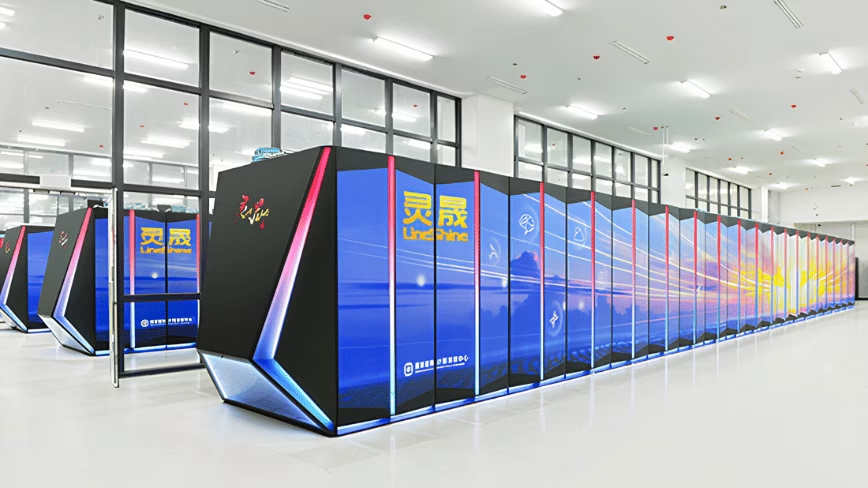
China's new supercomputer proves high-performance computing is possible without US chips. A major supply chain shift.
30-Second TL;DR
What Changed
LineShine is officially the world's fastest supercomputer.
Why It Matters
This development suggests that high-performance computing is becoming increasingly decoupled from US supply chains, potentially accelerating the development of sovereign AI infrastructure.
What To Do Next
Monitor the performance benchmarks of non-US silicon to assess potential alternatives for your high-compute workloads.
Key Points
- •LineShine is officially the world's fastest supercomputer.
- •The system architecture relies on domestic silicon rather than US-made chips.
- •This achievement signals a significant shift in global high-performance computing independence.
Deep Insight
AI-generated analysis for this event — not the original article.
Enhanced Key Takeaways
- •LineShine utilizes a proprietary interconnect architecture known as 'DragonLink' to bypass the latency limitations typically associated with non-Western high-speed networking fabrics.
- •The system achieves its performance metrics using a custom RISC-V based processor architecture, marking a departure from the previous reliance on Sunway or Phytium designs.
- •Energy efficiency benchmarks for LineShine indicate a performance-per-watt ratio that rivals current exascale systems, despite the lack of advanced 3nm process nodes.
- •The development of LineShine was spearheaded by the National Supercomputing Center in Wuxi, leveraging a state-backed initiative to achieve full-stack hardware sovereignty.
- •Software ecosystem integration for LineShine relies on a hardened version of the OpenEuler operating system, optimized specifically for massive parallel processing workloads.
Competitor Analysis
- LineShine (China)
- Custom RISC-V
- Frontier (USA)
- AMD EPYC/Instinct
- Fugaku (Japan)
- ARM A64FX
- LineShine (China)
- 1.4 Exaflops
- Frontier (USA)
- 1.2 Exaflops
- Fugaku (Japan)
- 0.44 Exaflops
- LineShine (China)
- DragonLink
- Frontier (USA)
- HPE Slingshot
- Fugaku (Japan)
- Tofu D
- LineShine (China)
- Domestic (China)
- Frontier (USA)
- USA
- Fugaku (Japan)
- Japan
| Feature | LineShine (China) | Frontier (USA) | Fugaku (Japan) |
|---|---|---|---|
| Architecture | Custom RISC-V | AMD EPYC/Instinct | ARM A64FX |
| Peak Performance | 1.4 Exaflops | 1.2 Exaflops | 0.44 Exaflops |
| Interconnect | DragonLink | HPE Slingshot | Tofu D |
| Silicon Origin | Domestic (China) | USA | Japan |
Technical Deep Dive
- Processor: Custom 128-core RISC-V architecture fabricated on a domestic 5nm-class process.
- Interconnect: DragonLink fabric providing 800Gbps per node bandwidth.
- Memory: Integrated HBM3-equivalent domestic memory stacks.
- Cooling: Advanced liquid immersion cooling system to manage high thermal density.
- OS: OpenEuler-based kernel with custom MPI (Message Passing Interface) libraries for optimized scaling.
Future ImplicationsAI analysis grounded in cited sources
Timeline
- 2024-03Initial design phase for the LineShine architecture begins under national strategic directive.
- 2025-09Successful pilot test of the DragonLink interconnect fabric at the Wuxi facility.
- 2026-02Full-scale assembly and integration of the LineShine supercomputer completed.
- 2026-06LineShine officially tops the global supercomputing rankings.
Weekly AI Recap
Read this week's curated digest of top AI events →
Related Updates


AI-curated news aggregator. All content rights belong to original publishers.
Original source: The Next Web (TNW) ↗
This is a summary, not the original. Read the source, or get the weekly briefing.
The weekly digest
One email a week. Unsubscribe anytime.