China Chip Exports Boom 73% on AI
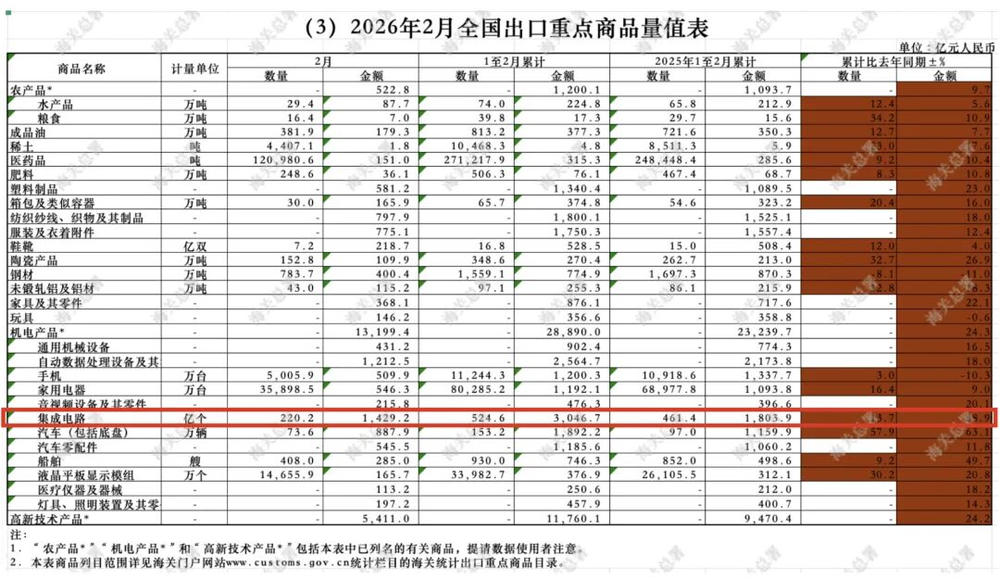
💡China's sanctioned chips power AI data centers: 73% export surge, 52% price jump.
⚡ 30-Second TL;DR
What Changed
Export value +72.6%, quantity +13.7%, ASP +52% from storage cycle and AI demand
Why It Matters
Boosts global AI buildout affordability via cheap peripherals/mature nodes, circumvents sanctions on advanced chips. Chinese firms gain AI supply chain share.
What To Do Next
Source Montage retimers or Jiehuawei PMICs for your AI cluster to slash power costs.
Key Points
- •Export value +72.6%, quantity +13.7%, ASP +52% from storage cycle and AI demand
- •Montage PCIe retimers,国产 PMICs from Jiehuawei enter global AI data centers
- •CXMT/YMTC storage, SMIC 28nm fill TSMC advanced-shift vacuums for industrial AI infra
🧠 Deep Insight
Background and context from public sources — not the original article. 7 sources cited.
🔑 Enhanced Key Takeaways
- •China's chip imports surged 39.8% to $78.2 billion in January-February 2026, indicating sustained reliance on foreign advanced semiconductors despite export growth, with H200 GPU imports remaining constrained by U.S. restrictions limiting Chinese firms to 75,000 units each[2].
- •Chinese chipmakers including SMIC, Hua Hong Semiconductor, and Huawei-linked producers are scaling 7nm and 5nm production capacity, targeting 100,000 wafers within 1-2 years (up from under 20,000) to address AI demand gaps, though U.S. export controls on chipmaking equipment remain a critical bottleneck[4].
- •China-based IC manufacturers are projected to represent only 21.2% of China's domestic IC market by 2026, with foreign companies (Samsung, SK Hynix, TSMC) continuing to control over 50% of in-country production, limiting the impact of domestic export surges on self-sufficiency goals[5].
- •Huawei is positioned to capture approximately 50% of China's AI chip market by 2026, up from lower shares in prior years, reflecting concentrated government support and vertical integration strategies amid U.S. sanctions[7].
🔮 Future ImplicationsAI analysis grounded in cited sources
⏳ Timeline
📎 Sources (7)
Factual claims are grounded in the sources below. Forward-looking analysis is AI-generated interpretation.
- longbridge.com — 278522485
- scmp.com — Chinas Chip Exports Surge 73 AI Demand Fuels Semiconductor Growth
- iconnect007.com — Ein
- sahmcapital.com — Chinas Top Chipmakers Race to Scale Advanced AI Chips Despite US Curbs As Demand Surges Report 2026 02 25
- design-reuse.com — 12233 China Based Ic Production to Represent 21 2 of China Ic Market in 2026
- deloitte.com — Semiconductor Industry Outlook
- huaweicentral.com — Huawei to Own 50 of Chinese AI Chip Market by 2026 Report
Weekly AI Recap
Read this week's curated digest of top AI events →
👉Related Updates
AI-curated news aggregator. All content rights belong to original publishers.
Original source: 虎嗅 ↗
This is a summary, not the original. Read the source, or get the weekly briefing.
Weekly AI briefing
One email a week. Unsubscribe anytime.