China Approves First L3 Self-Driving EVs
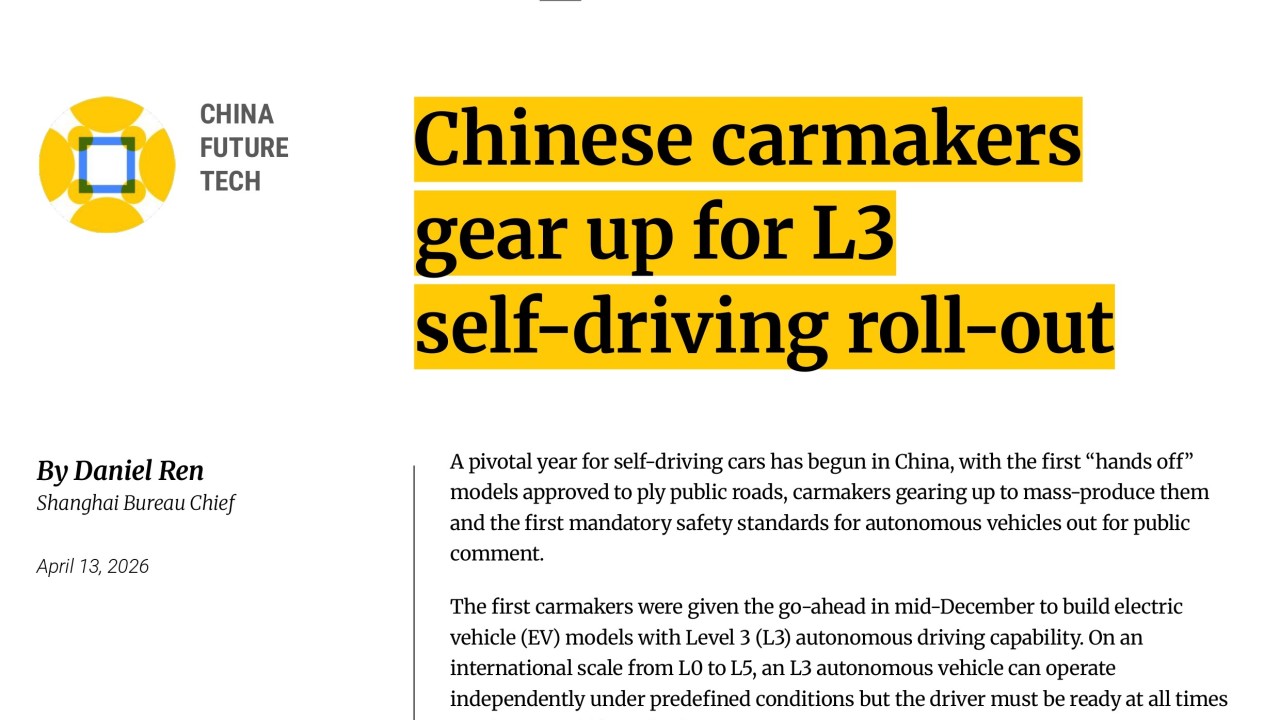
💡China's first L3 AV road approvals signal regulatory shift for embodied AI devs
⚡ 30-Second TL;DR
What Changed
First L3 approvals issued mid-December for public road use
Why It Matters
This positions China as a leader in L3 AV deployment, accelerating adoption and competition globally. AI practitioners gain insights into regulatory frameworks for scalable embodied AI systems.
What To Do Next
Review China's L3 AV safety standards draft to align robotics projects with emerging regulations.
Key Points
- •First L3 approvals issued mid-December for public road use
- •Carmakers gearing up for mass production of hands-off EVs
- •Mandatory L3 safety standards released for public comment
- •L3 enables independent operation under defined conditions
🧠 Deep Insight
AI-generated analysis for this event — not the original article.
🔑 Enhanced Key Takeaways
- •The regulatory framework for L3 deployment in China is governed by the 'Notice on Carrying out Pilot Work for Intelligent Connected Vehicle Access and Road Traffic' issued by the Ministry of Industry and Information Technology (MIIT) and other departments.
- •Under the approved L3 framework, manufacturers assume legal liability for accidents occurring while the autonomous system is engaged, a significant shift from the driver-centric liability model of L2 systems.
- •The pilot program mandates that participating vehicles must be equipped with redundant systems for braking, steering, and power supply to ensure safety during system failures.
📊 Competitor Analysis▸ Show
| Feature | China L3 Pilot Vehicles | Tesla FSD (Supervised) | Mercedes-Benz Drive Pilot (US/DE) |
|---|---|---|---|
| Autonomy Level | L3 (Conditional) | L2+ (Driver must monitor) | L3 (Conditional) |
| Liability | Manufacturer (in pilot) | Driver | Manufacturer (in specific conditions) |
| Operational Domain | Defined public roads | Any road (with supervision) | Highways (mapped/traffic) |
| Pricing Model | Integrated in vehicle cost | Subscription/One-time fee | Subscription/Option cost |
🛠️ Technical Deep Dive
- •System Architecture: Utilizes a multi-sensor fusion approach combining LiDAR, high-definition cameras, and millimeter-wave radar to create a 360-degree environmental perception model.
- •Redundancy: Mandatory dual-redundant architecture for critical control systems (steering, braking, and compute units) to allow for a 'minimal risk maneuver' (MRM) if the primary system fails.
- •Mapping: Requires high-definition (HD) maps with centimeter-level accuracy for localization, integrated with real-time kinematic (RTK) positioning.
- •Human-Machine Interface (HMI): Must include a driver monitoring system (DMS) to detect driver readiness to take over control within a specified transition time (typically 10-30 seconds) when the system requests a handover.
🔮 Future ImplicationsAI analysis grounded in cited sources
⏳ Timeline
Weekly AI Recap
Read this week's curated digest of top AI events →
👉Related Updates

AI-curated news aggregator. All content rights belong to original publishers.
Original source: SCMP Technology ↗
This is a summary, not the original. Read the source, or get the weekly briefing.
The weekly digest
One email a week. Unsubscribe anytime.