Source钛媒体•Stalecollected in 30m
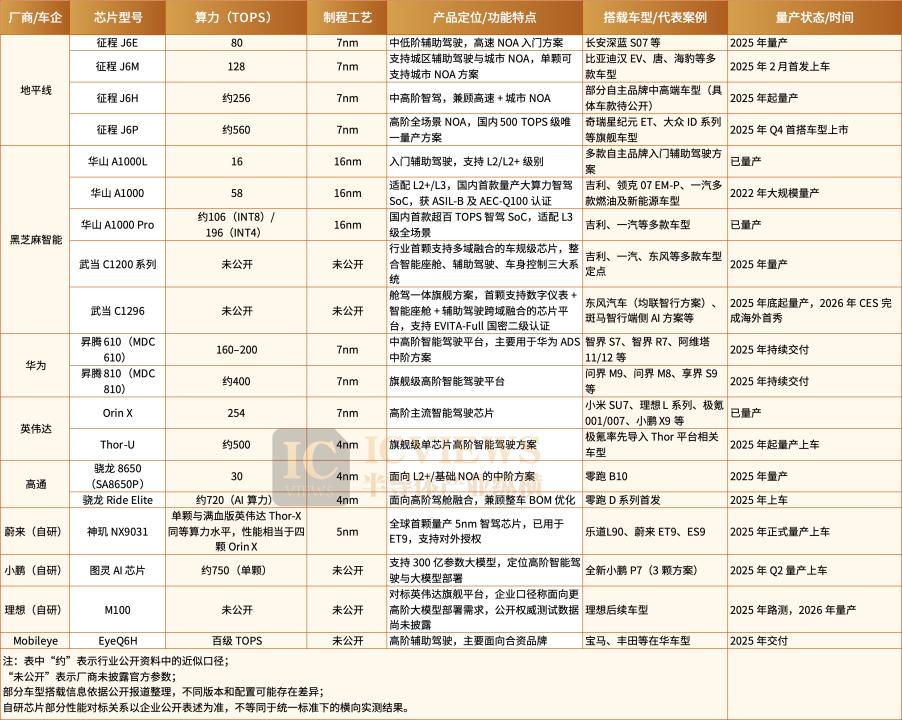
China ADAS Chips Enter Cutthroat Competition
#adas-chips#china-nev#auto-ai#competitionadas-chipshorizon-robotics
China's ADAS chip race accelerates embodied AI hardware alternatives to Nvidia.
30-Second TL;DR
What Changed
Chinese NEVs entering premium segment
Why It Matters
Intensifying rivalry spurs AI chip innovation for autonomous driving, pressuring incumbents like Nvidia.
What To Do Next
Test Horizon Robotics Journey chips for cost-effective ADAS prototyping.
Who should care:Developers & AI Engineers
Key Points
- •Chinese NEVs entering premium segment
- •Accelerated product iteration cycles
- •国产 car chips in life-or-death competition
Deep Insight
AI-generated analysis for this event — not the original article.
Enhanced Key Takeaways
- •The competitive landscape is shifting from simple 'computing power' (TOPS) metrics to 'efficiency per watt' and 'software-defined vehicle' (SDV) integration capabilities, as Chinese chipmakers prioritize reducing total system costs for OEMs.
- •Geopolitical constraints on advanced process nodes (sub-7nm) are forcing Chinese ADAS chip designers to innovate through advanced packaging (chiplets) and optimized neural network compilers to maintain performance parity with international incumbents.
- •Major Chinese NEV OEMs are increasingly adopting a 'multi-vendor' strategy for ADAS SoCs to mitigate supply chain risks, breaking the historical reliance on single-source high-end chips from Western suppliers.
Competitor Analysis
Process Node
- Horizon Robotics (Journey 6)
- 7nm (Optimized)
- NVIDIA (Orin/Thor)
- 7nm / 4nm
- Qualcomm (Snapdragon Ride)
- 5nm / 4nm
AI Performance
- Horizon Robotics (Journey 6)
- Up to 560 TOPS
- NVIDIA (Orin/Thor)
- 254 TOPS / 2000 TOPS
- Qualcomm (Snapdragon Ride)
- Up to 720 TOPS
Target Market
- Horizon Robotics (Journey 6)
- Mass-market to Premium
- NVIDIA (Orin/Thor)
- Premium / Autonomous
- Qualcomm (Snapdragon Ride)
- Premium / Cockpit-ADAS Fusion
Software Ecosystem
- Horizon Robotics (Journey 6)
- Open (BPU Architecture)
- NVIDIA (Orin/Thor)
- Closed (CUDA/DRIVE)
- Qualcomm (Snapdragon Ride)
- Open (Snapdragon Ride Platform)
| Feature | Horizon Robotics (Journey 6) | NVIDIA (Orin/Thor) | Qualcomm (Snapdragon Ride) |
|---|---|---|---|
| Process Node | 7nm (Optimized) | 7nm / 4nm | 5nm / 4nm |
| AI Performance | Up to 560 TOPS | 254 TOPS / 2000 TOPS | Up to 720 TOPS |
| Target Market | Mass-market to Premium | Premium / Autonomous | Premium / Cockpit-ADAS Fusion |
| Software Ecosystem | Open (BPU Architecture) | Closed (CUDA/DRIVE) | Open (Snapdragon Ride Platform) |
Technical Deep Dive
- Heterogeneous Computing Architecture: Modern Chinese ADAS SoCs (e.g., Horizon Journey 6, Black Sesame A1000/A2000) utilize a mix of high-performance CPU cores (ARM Cortex-A series), dedicated NPU (Neural Processing Unit) clusters, and ISP (Image Signal Processor) pipelines.
- BPU (Brain Processing Unit) Architecture: Horizon Robotics' proprietary architecture focuses on high-efficiency tensor processing, specifically optimized for Transformer-based models which are now standard in BEV (Bird's Eye View) perception algorithms.
- Memory Bandwidth Optimization: Implementation of LPDDR5X support and on-chip SRAM caching to minimize latency in high-resolution multi-camera fusion tasks.
- Functional Safety: Compliance with ISO 26262 ASIL-D standards for critical safety-related compute paths, often requiring dual-lockstep CPU configurations.
Future ImplicationsAI analysis grounded in cited sources
Consolidation of the Chinese ADAS chip market will accelerate by 2027.
High R&D costs and the need for massive software ecosystem support will force smaller, undercapitalized chip startups to merge or exit the market.
Chinese ADAS chipmakers will achieve 30% market share in domestic NEVs by 2028.
Aggressive cost-cutting and improved software compatibility with domestic OEM platforms are displacing traditional international incumbents.
Timeline
2021-09
Horizon Robotics launches Journey 5, the first domestic chip capable of supporting L3 autonomous driving.
2022-08
Black Sesame Technologies announces the A1000 Pro, targeting high-performance ADAS applications.
2024-04
Horizon Robotics officially unveils the Journey 6 series, focusing on high-efficiency, large-scale model support.
- 2021-09Horizon Robotics launches Journey 5, the first domestic chip capable of supporting L3 autonomous driving.
- 2022-08Black Sesame Technologies announces the A1000 Pro, targeting high-performance ADAS applications.
- 2024-04Horizon Robotics officially unveils the Journey 6 series, focusing on high-efficiency, large-scale model support.
Weekly AI Recap
Read this week's curated digest of top AI events →
AI-curated news aggregator. All content rights belong to original publishers.
Original source: 钛媒体 ↗
This is a summary, not the original. Read the source, or get the weekly briefing.
The weekly digest
One email a week. Unsubscribe anytime.