China Achieves Mass Production of 360TB Glass Hard Drives
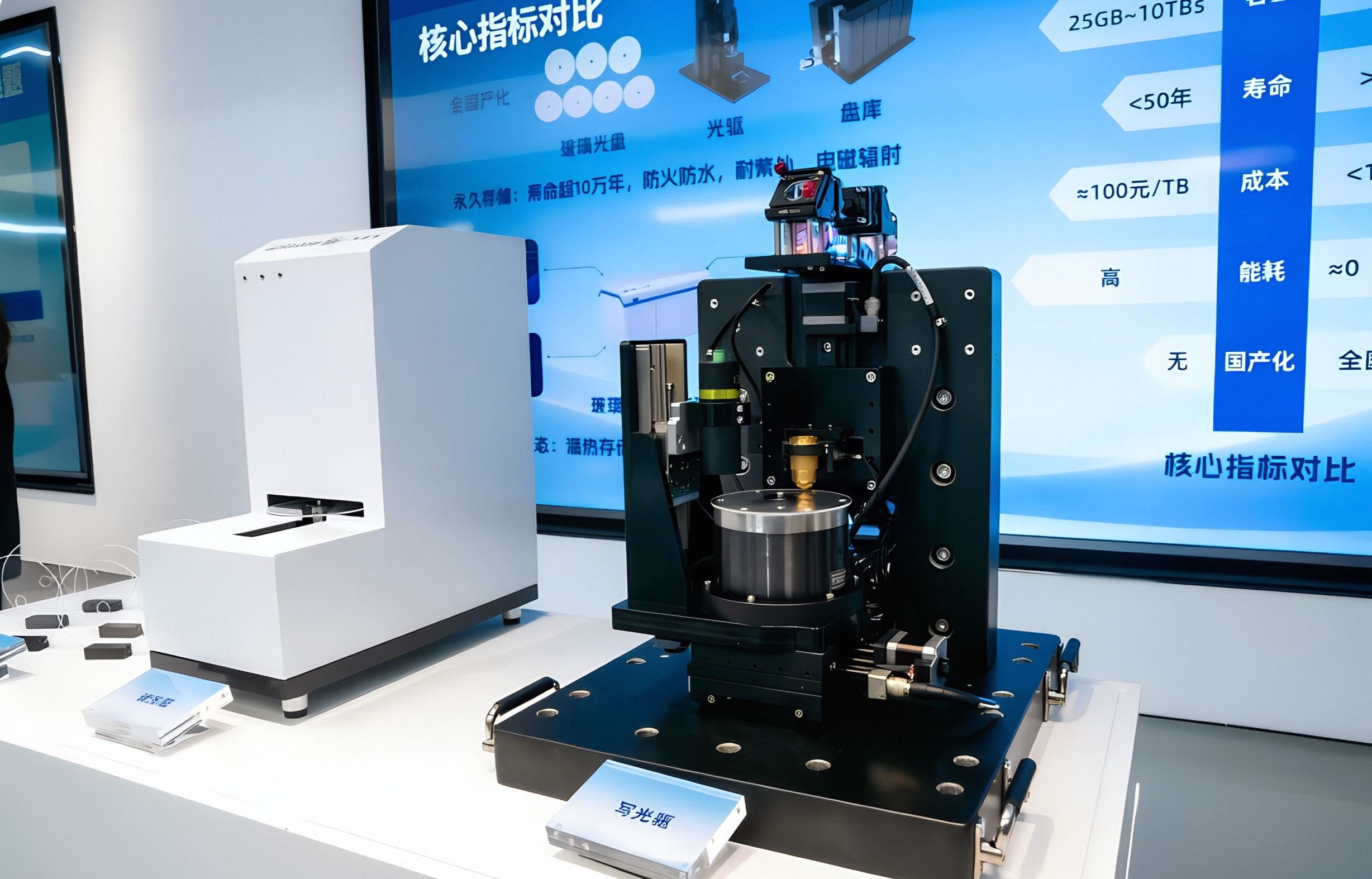
💡Breakthrough in high-density storage could solve the massive data archiving challenges for AI model training.
⚡ 30-Second TL;DR
What Changed
Glass discs offer 360TB capacity per unit.
Why It Matters
This technology could drastically reduce the cost and physical footprint of enterprise cold data storage. It provides a viable solution for the massive data archiving needs of large-scale AI model training.
What To Do Next
Evaluate the potential for integrating high-density glass storage into your data pipeline for long-term model training datasets.
Key Points
- •Glass discs offer 360TB capacity per unit.
- •Utilizes laser carving to write data into the glass internal structure.
- •Features 400 stacked data layers for high-density storage.
🧠 Deep Insight
Background and context from public sources — not the original article. 22 sources cited.
🔑 Enhanced Key Takeaways
- •The technology employs femtosecond laser pulses to create microscopic, three-dimensional modifications within the glass discs.
- •These glass drives function as Write Once, Read Many (WORM) media, making them suitable for long-term archival and cold storage applications but not active workloads.
- •The drives boast exceptional durability, resisting water, electromagnetic fields, and extreme temperatures, with a projected data retention spanning centuries to millennia.
- •Current performance includes write speeds of 8-10 MB/s and read speeds of 50-200 MB/s, positioning them as a viable alternative to magnetic tape for enterprise cold data storage.
- •Developed in collaboration with Wuhan-based startup YiYao Technology, the solution aims to significantly reduce energy consumption by eliminating the need for continuous power to maintain stored data.
📊 Competitor Analysis▸ Show
| Feature | HUST / YiYao Technology (China) | Microsoft Project Silica | SPhotonix (UK) (5D Memory Crystal) | Magnetic Tape (LTO-10) |
|---|---|---|---|---|
| Capacity (per unit) | 360TB per glass disc | 4.8-7TB per glass plate | 360TB per 5-inch disc | 30-40TB native per cartridge |
| Longevity | Centuries to millennia (e.g., 100,000 years claimed) | 10,000+ years | 13.8 billion years (claimed) | ~30 years |
| Write Speed | 8-10 MB/s | 3.13 MB/s (for 4.8TB plate) | ~4 MB/s (prototypes) | 400 MB/s |
| Read Speed | 50-200 MB/s | Not specified in MB/s, uses ML decoding | ~30 MB/s (prototypes) | (Slower access than HDD, but high sequential read) |
| Material | Glass | Borosilicate glass (previously fused silica) | Fused silica glass | Magnetic tape |
| Key Technology | Femtosecond laser carving, 400 stacked layers | Femtosecond laser, phase voxels, robotic libraries, AI decoding | Femtosecond laser, 5D optical data storage (spatial, orientation, intensity) | Magnetic recording |
| Target Market | Enterprise cold data storage, archival | Hyperscale data centers, Azure archival | Cold archival storage, licensing media/platform | Enterprise cold data storage, archival |
🛠️ Technical Deep Dive
- The HUST/YiYao Technology utilizes femtosecond laser pulses to create microscopic modifications within glass discs, encoding data in three dimensions across 400 stacked layers.
- Data is written into the internal structure of the glass medium, making it a write-once technology.
- Microsoft's Project Silica also uses femtosecond lasers to write permanent information deep inside quartz glass, creating nanoscale structures (voxels) that encode data volumetrically.
- Project Silica has advanced to using ordinary borosilicate glass, a more cost-effective material, and introduced "phase voxels" that require a single laser pulse for increased writing speed and simplified reading.
- Reading data from Project Silica's glass involves an automated microscope and machine learning for decoding.
- SPhotonix's 5D Memory Crystal technology employs a femtosecond laser to encode data in nanoscale structures within fused silica glass, leveraging five dimensions: three spatial coordinates (x, y, z), plus the orientation and intensity of the nanostructures, which are read back optically using polarized light.
- Cerabyte's approach involves using femtosecond laser technology to create nanoscale holes in 10nm ceramic layers on a glass substrate, with data encoded in an array of data matrices and read using high-speed image sensors and parallel image processing.
🔮 Future ImplicationsAI analysis grounded in cited sources
⏳ Timeline
📎 Sources (22)
Factual claims are grounded in the sources below. Forward-looking analysis is AI-generated interpretation.
Weekly AI Recap
Read this week's curated digest of top AI events →
👉Related Updates


AI-curated news aggregator. All content rights belong to original publishers.
Original source: Pandaily ↗
This is a summary, not the original. Read the source, or get the weekly briefing.
The weekly digest
One email a week. Unsubscribe anytime.